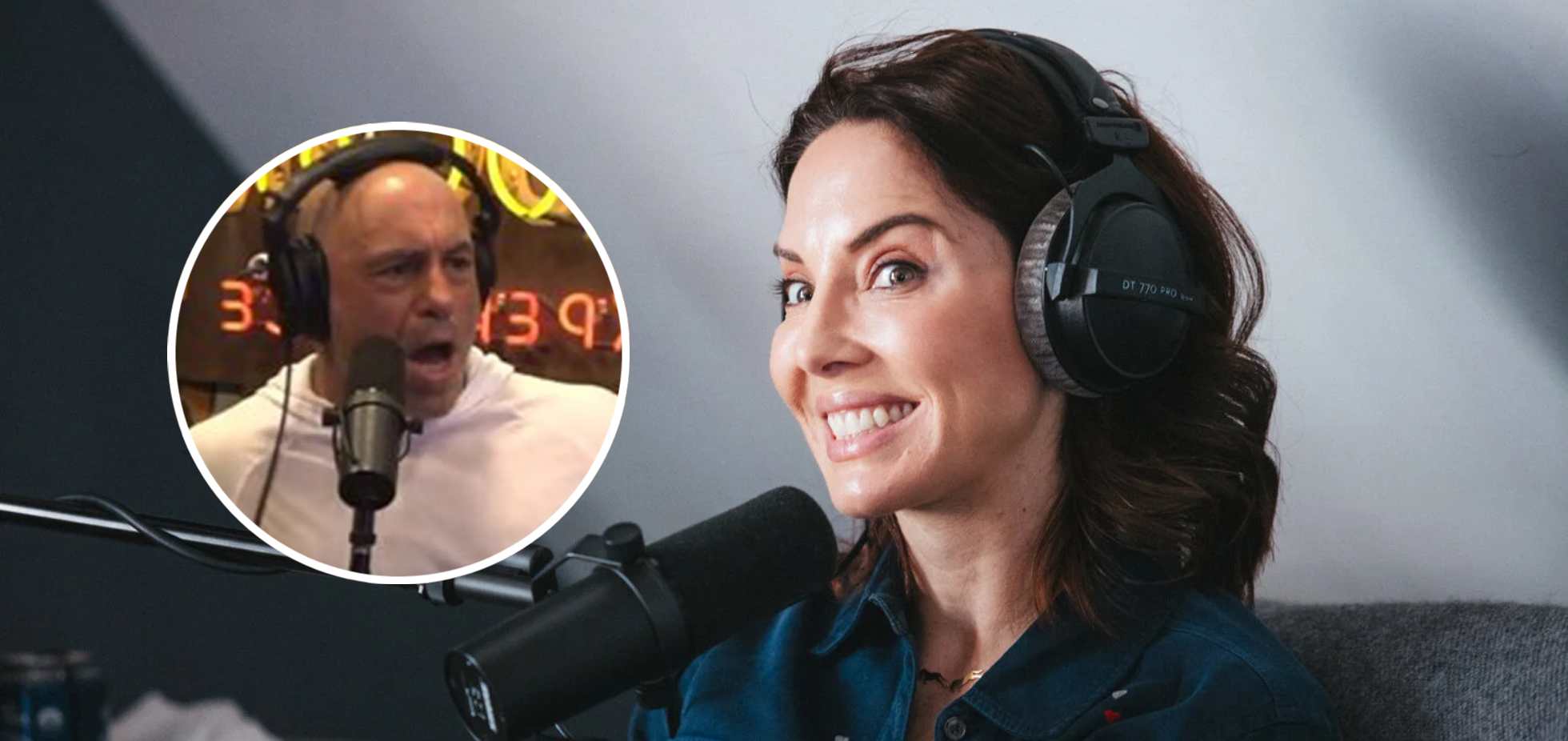
Whitney Cummings has quietly become one of the most-watched podcast hosts on YouTube, according to recent analysis, with her “Good for You” podcast pulling numbers that rival and sometimes exceed Joe Rogan‘s podcast episodes. The development has raised eyebrows throughout the comedy community, with many questioning how the comedian achieved such astronomical growth.
Content creator Apologia Comedia recently released a detailed examination of Cummings’ YouTube analytics, revealing that several of her recent episodes have garnered between 1.2 and 2.4 million views. One episode featuring Grace Ali accumulated 2.4 million views, nearly double what Joe Rogan’s episodes from the same period achieved, despite Rogan having approximately 20 million more subscribers.
The Blind Mike Project discussed these findings extensively in a recent YouTube video, noting the unusual nature of the metrics. For months, Cummings’ podcast averaged a few hundred thousand views per episode, consistent with successful comedy podcasts. Then, over recent months, her numbers jumped dramatically to 1 to 2 million views per episode.
However, the engagement metrics tell a different story. The Grace Ali episode, with its 2.4 million views, generated only approximately 230 comments and 1,000 likes, paired with 20,000 dislikes.
By comparison, typical successful YouTube content with similar view counts would generate tens of thousands of comments. Even Cummings’ older episodes show this pattern, with a 1.3 million-view upload of her comedy special producing just 93 comments.
The analysis explored several possibilities for the discrepancy. One theory suggests paid promotion through YouTube’s advertising system, which allows content creators to boost their videos for increased visibility. This method is legitimate and common, but it can generate views without proportional engagement like comments or likes. Another possibility raised was malicious manipulation by those looking to harm her channel, particularly following controversy surrounding her participation in the Riad Comedy Festival.
Hosts from The Blind Mike Project noted that Cummings appears to be adopting a style similar to comedian Tim Dillon, attempting to deliver lengthy rants about social and political topics. However, they observed that her execution lacks the substance and humor that makes Dillon’s approach successful. Her content has been described as jumping rapidly between topics without clear transitions or payoffs, covering subjects from TikTok to the Kardashians to historical facts about makeup and corsets.
The timing of this viewership increase coincides with Cummings’ return from performing at the Riyadh Comedy Festival, an event that generated significant backlash within the comedy community. Her response to critics, which some perceived as dismissive of fan concerns, may have contributed to the elevated dislike ratios visible on her content.
For context, established comedy podcasts like Bad Friends and shows featuring Shane Gillis typically receive hundreds of thousands of views, with episodes occasionally breaking one million. Joe DeRosa’s recent special, which received critical acclaim, took over four months to approach one million views. Joe List’s “Small Ball” special, another well-received release, just recently surpassed the million-view mark.
The broader implications extend to how podcast success is measured and how sponsorship deals are structured. Some sponsors base payments on raw view counts, which means artificially inflated numbers could affect advertising value, though no definitive evidence suggests this is occurring with Cummings’ content.
Despite the impressive view counts, there appears to be little organic conversation about Cummings’ podcast within comedy circles, unlike other shows that achieve viral status. When Kill Tony briefly eclipsed Joe Rogan’s numbers, it generated widespread discussion across the comedy community. Cummings’ apparent success, by contrast, has gone relatively unnoticed beyond those specifically analyzing the metrics.