Free to use under the Unsplash License
A Ukrainian content creator with 6 million subscribers found himself in legal trouble after live streaming an unauthorized visit to Japan’s Fukushima nuclear exclusion zone, sparking international controversy and diplomatic tensions.
Alexander Kryukov, who runs the YouTube channel KREOSAN, specializes in what he calls “creative experiments and extreme science projects.” His content has included demonstrations showing people how to pull electricity from train tracks and charge phones using high voltage power lines.
The channel began in 2011 with simple experiments and grew substantially after Kryukov attended a Moscow creator festival in 2014, eventually allowing him to leave his job repairing televisions and washing machines to focus on video production full-time.
This wasn’t Kryukov’s first experience with restricted locations. He had previously entered the Chernobyl exclusion zone without authorization and filmed inside the actual nuclear power plant. In September 2025, he traveled to Japan with two friends and set their sights on Fukushima.
The Fukushima Daiichi nuclear power plant experienced one of history’s worst nuclear disasters on March 11, 2011, following a catastrophic earthquake and tsunami. The natural disasters knocked out the electrical grid and backup generators, leading to a meltdown that forced approximately 165,000 people to evacuate their homes. About 12% of Fukushima became a restricted zone, with entire communities abandoned practically overnight. While some areas have since reopened, certain zones remain designated as difficult to return because radiation levels remain too dangerous for permanent residence.
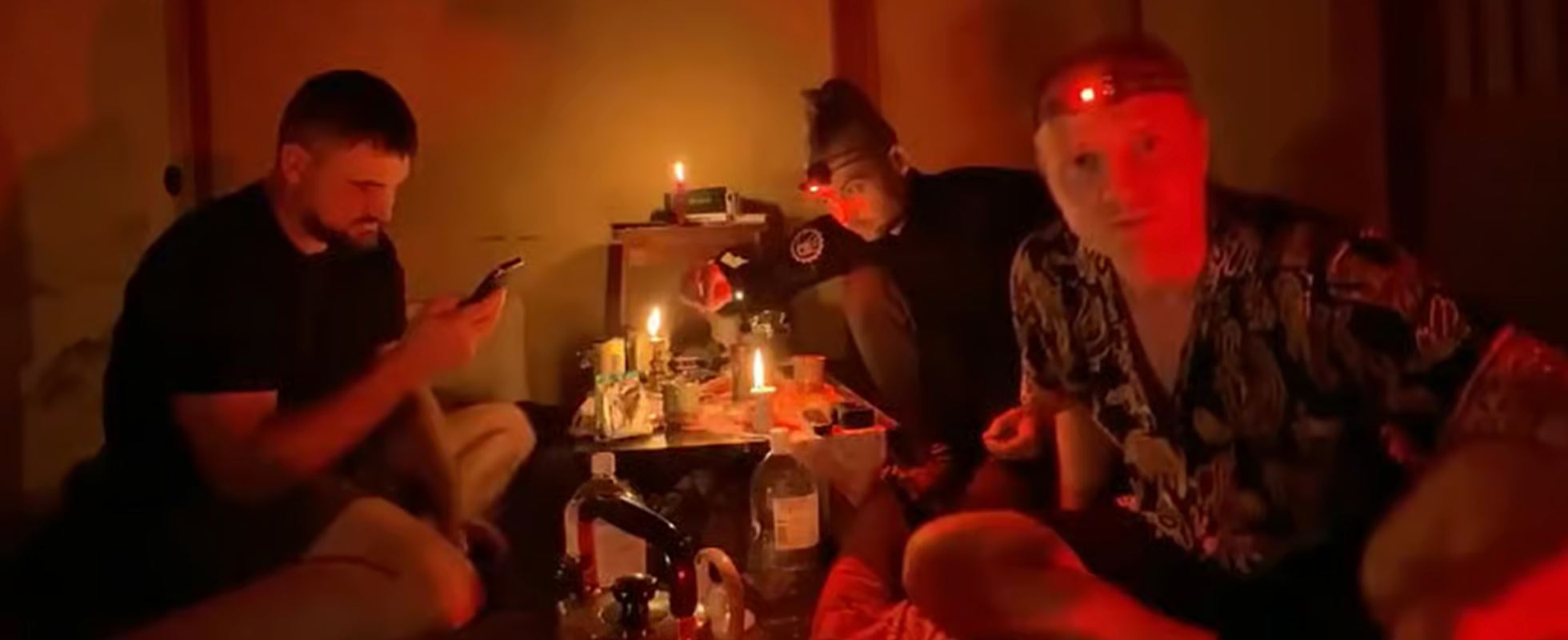
On September 23, 2025, the three creators entered the exclusion zone in Okuma and found an abandoned house where they began broadcasting. The footage showed them sitting by candlelight, making tea, and examining personal items left behind during the evacuation over a decade ago. However, an anonymous viewer recognized the location and immediately contacted local police.
Using screenshots from the broadcast, authorities pinpointed the exact location and arrived the following morning to make arrests. The three men were found inside the property and taken into custody, admitting to unlawful entry during questioning. They were formally charged with trespassing.
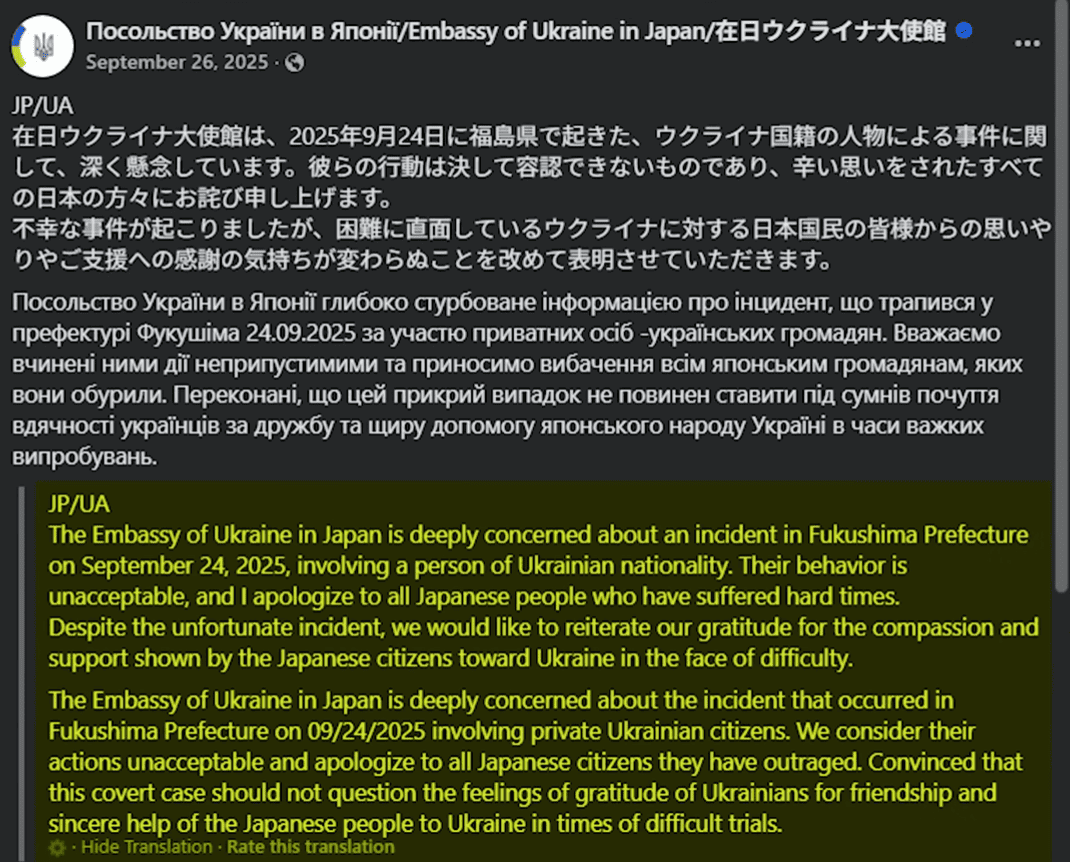
The situation quickly escalated into a diplomatic incident. On September 26, the Ukrainian embassy in Japan released an official statement condemning the actions and issued a public apology to Japanese citizens. The embassy emphasized that the incident shouldn’t reflect poorly on Ukrainian-Japanese relations, particularly given Ukraine’s current circumstances.
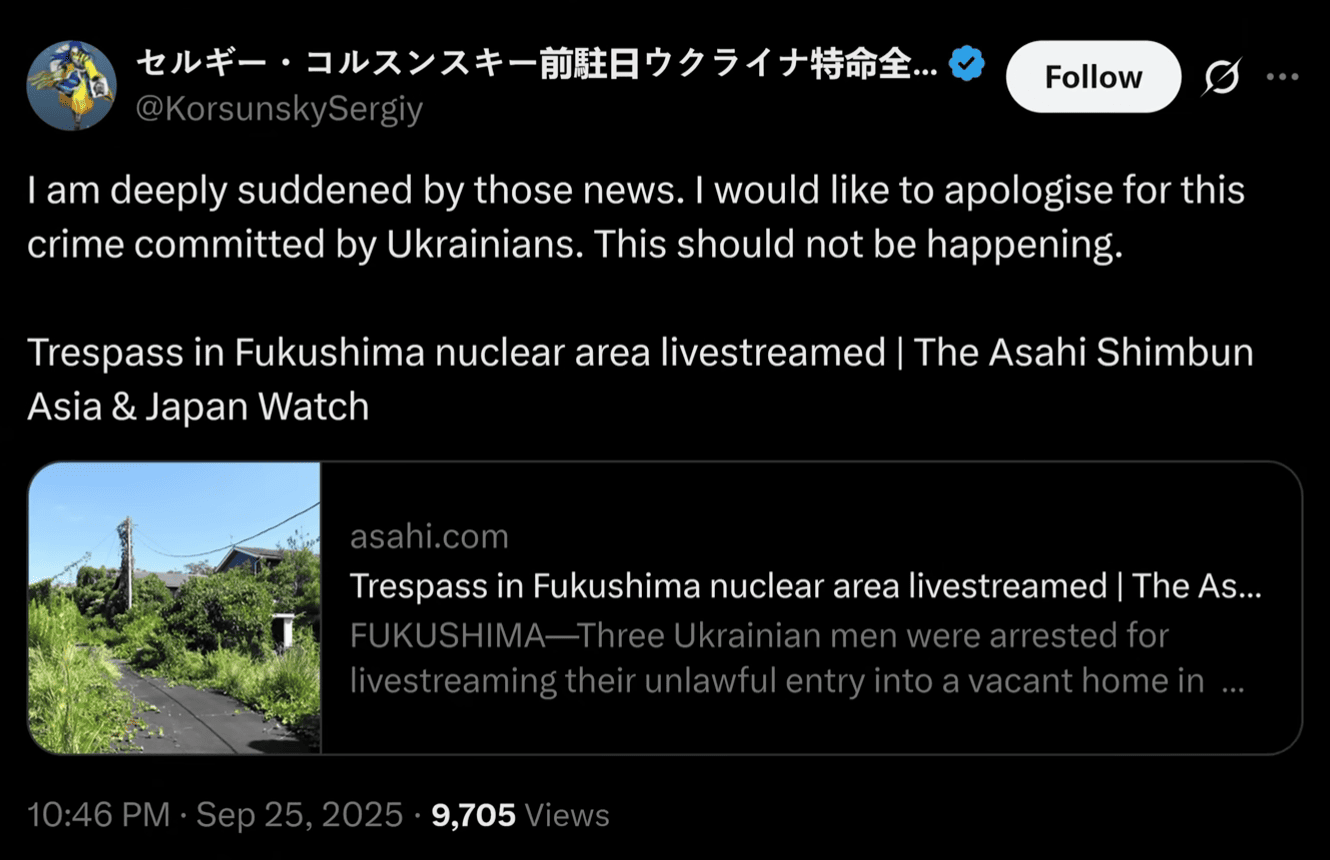
The former Ukrainian ambassador to Japan also posted a personal apology on social media.
Prosecutors sought six-month prison sentences, arguing the men intentionally entered a restricted zone while knowing they were breaking the law and broadcasting their actions. One of Kryukov’s friends told the court his goal was to show viewers how the Fukushima region was recovering, claiming he hadn’t considered the legal ramifications. Defense attorneys requested fines or suspended sentences instead.
On December 25, the judge issued the final verdict: all three defendants received fines of 100,000 yen each, approximately $650 per person, and were released.
The sentence sparked debate about whether Japan’s punishment was sufficient. Some viewed the outcome as fair, while others worried it sends a message that Japan won’t seriously penalize such behavior. Commentary in the Japan Times noted Japan’s approach contrasts sharply with other Asian countries handling similar cases involving content creators who have faced significantly harsher consequences for comparable or worse behavior.
Alexander and his friends have since returned to Ukraine. What was intended as compelling urban exploration content resulted in arrests, international embarrassment, and their own government publicly apologizing on their behalf.


