

Free to use under the Unsplash License
Bryan Johnson has built a reputation as one of the world’s most dedicated longevity enthusiasts, meticulously tracking every aspect of his health and optimizing his lifestyle for maximum lifespan. Yet despite a new study showing substantial cognitive benefits from coffee consumption, the tech entrepreneur publicly declared he simply cannot bring himself to drink it.
The study in question, published in JAMA and spanning an impressive 40 years with over 130,000 participants, found that moderate coffee consumption is associated with significant protection against dementia. Specifically, individuals who consumed 2-3 cups of caffeinated coffee daily showed an 18% lower risk of developing dementia compared to non-coffee drinkers.
Johnson’s response on social media captured a tension many health-conscious individuals face: knowing what science says is beneficial versus what feels right for their own body. “Even with these benefits, I can’t do it; caffeine creates a physiological roller coaster and enslaves me,” he wrote.
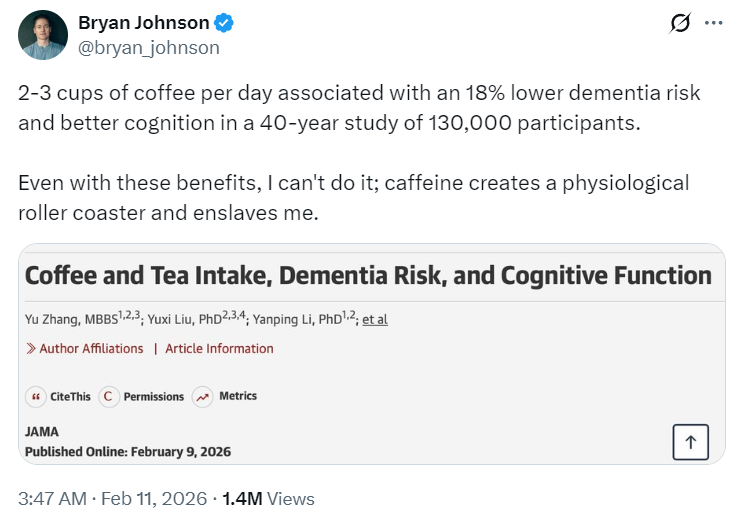
The study, conducted by researchers from the Nurses’ Health Study and the Health Professionals Follow-up Study, represents one of the most comprehensive examinations of coffee’s effects on brain health to date. Over 43 years of follow-up, scientists documented 11,033 cases of dementia among participants while tracking their dietary habits through repeated assessments every 2-4 years.
The findings revealed a clear pattern: higher caffeinated coffee intake correlated with better cognitive outcomes across multiple measures. Beyond the reduced dementia risk, regular coffee drinkers showed lower rates of subjective cognitive decline and modestly better performance on objective cognitive tests. The protective effect appeared strongest at moderate consumption levels, with diminishing returns beyond 2-3 cups daily.
Importantly, the study distinguished between caffeinated and decaffeinated coffee. Only caffeinated coffee showed significant cognitive benefits, suggesting caffeine itself plays a central role in the neuroprotective effects. Decaffeinated coffee consumption showed no association with reduced dementia risk.
Tea consumption showed similar benefits, with 1-2 cups daily associated with the most pronounced cognitive advantages. The researchers adjusted for numerous confounding factors including lifestyle choices, diet quality, medical conditions, and genetic predisposition to ensure the associations held independent of other variables.
The biological mechanisms behind coffee’s cognitive benefits likely involve multiple pathways. Caffeine acts primarily through adenosine receptor antagonism, which modulates brain signaling and may reduce the accumulation of harmful proteins associated with Alzheimer’s disease. Coffee also contains polyphenols and other bioactive compounds with antioxidant properties that could protect brain cells from oxidative stress and inflammation.
For Johnson, who has invested millions in his longevity protocols and maintains rigid control over his physical and mental state, the stimulant effects of caffeine apparently disrupt his carefully calibrated system.
Additionally, the study’s authors themselves noted that the observed differences in cognitive test scores were modest in magnitude. The mean difference in cognitive performance between high and low coffee consumers, while statistically significant across large populations, translates to relatively small individual benefits equivalent to less than a year of typical age-related cognitive decline.
The research does have limitations. As an observational study, it cannot definitively prove causation. Residual confounding from unmeasured factors remains possible, and reverse causation where early cognitive changes influence coffee consumption cannot be entirely excluded. The study population consisted primarily of health professionals, potentially limiting generalizability.
For the general population, the research suggests moderate coffee consumption can be part of a brain-healthy lifestyle. The optimal range appears to be 2-3 cups daily, with no additional benefits observed at higher intakes.


