
Free to use under the Unsplash License
China’s precious metals market faces a crisis of trust as allegations emerge that commemorative silver coins and investment products from state-backed institutions contain little to no actual silver. A video from a precious metals collector revealed that 2008 Beijing Olympics commemorative coins produced by the Shanghai Mint, marked as AG999 to indicate 99.9% pure silver, tested positive for pure copper instead.
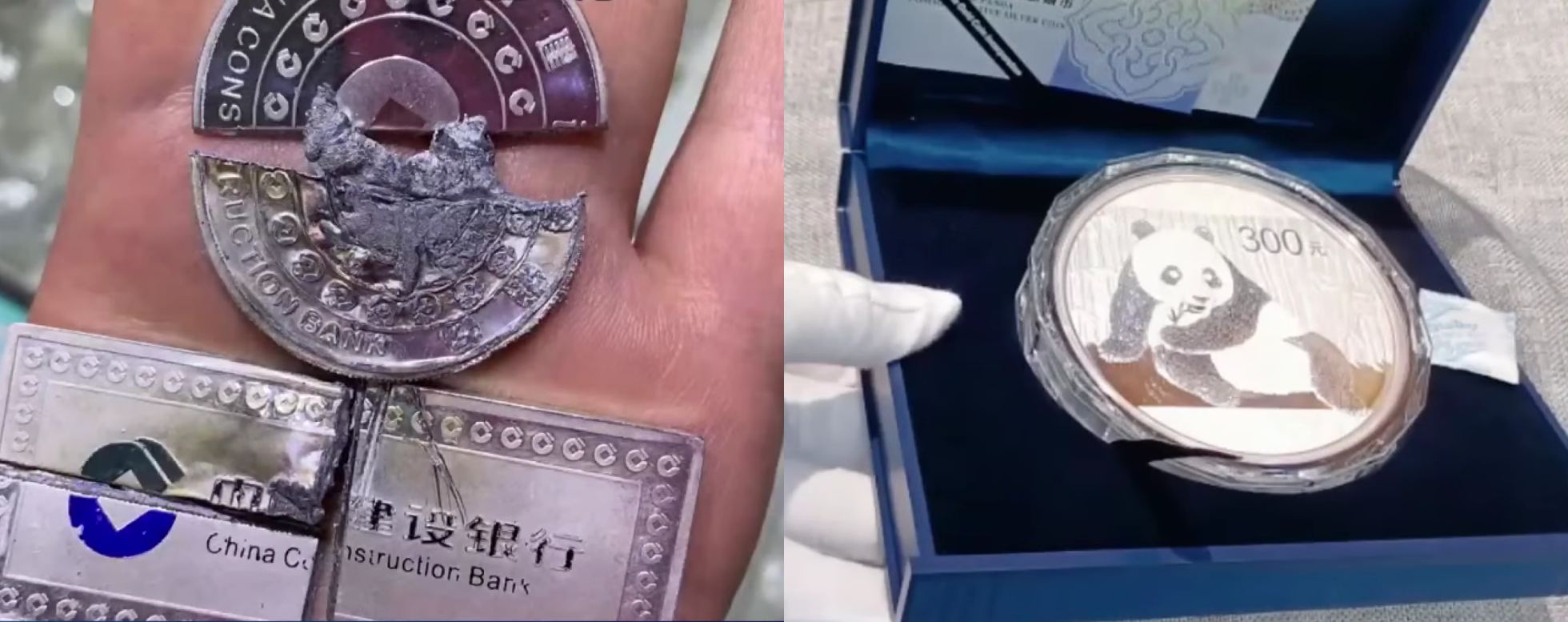
The scandal extends beyond commemorative coins. Online videos claim that silver panda coins issued by the People’s Bank of China and silver bars sold by China Construction Bank are counterfeit, with accompanying certificates also fraudulent.
Some silver bars purchased from China Construction Bank allegedly contained only tin when tested at pawn shops. A viral video on Douyin showed a Chinese silver investment bar breaking apart when heated, revealing tin and lead content with different melting points causing uneven expansion.
The involvement of established institutions like China Construction Bank and the Shanghai Mint in selling counterfeit products highlights the scale of fraud in China’s precious metals sector. A widely circulated phrase online reflects consumer disillusionment: “AG999 is just a model, not actual silver content, and meets national standards.” According to China’s official standards, AG999 should indicate 99.9% purity, commonly known as fine silver or pure silver 999.
At the start of 2026, China’s silver market experienced a scandal involving 132,000 pounds (60 tons) of fake silver bars. These bars were coated with thin layers of pure silver that tested at 99.9% purity on the surface, but cutting them open revealed cores of iron, lead, or copper. Following this revelation, the Shenzhen Shuibei market saw people refusing to trust certificates or documentation, with buyers demanding to cut open silver bars as the only verification method.
Taiwanese architect Tang Xiaohong posted on Facebook: “You thought that buying gold and silver in chaotic times was the safest hedge in China. Even silver bars sold by China Construction Bank had been found to be fake. This is not just a scam, but a national scale collapse of trust.”
Independent commentator Du Wenjen emphasized that the fake silver issue reflects problems within China’s economic structure and government-controlled economy, with lack of market regulation and promotion of speculation during high-risk periods leading to disastrous consequences for ordinary investors.
The gold jewelry industry also faces scrutiny. In early February, a gold shop owner in Hangzhou posted a video claiming his shop extracted 3.7 pounds (1,700 grams) of gold powder from waste materials, refined into gold bars worth nearly 2 million RMB.
Industry experts calculated this was impossible under normal conditions, as typical loss rates range from 0.2% to 0.3%. To produce that amount of gold powder in one month would require processing 1,500 pounds (680 kilograms) of gold, unrealistic for a small shop.
Tang Xiaohong noted that when protecting consumer rights costs more than the value lost, consumers are structurally disadvantaged. She emphasized that ordinary Chinese citizens have been exploited through housing market crashes, stock market losses, financial product defaults, and now discovering even gold and silver investments are fake.
Despite rampant fraud, many Chinese continue investing in precious metals, though recent price fluctuations have caused significant losses. On February 17th, spot gold fell below $2,900 per ounce, while spot silver declined over 4%, falling below $33 per ounce. The price drops occurred amid Russia-Ukraine and US-Iran negotiations in Geneva, though no significant agreements materialized.


