
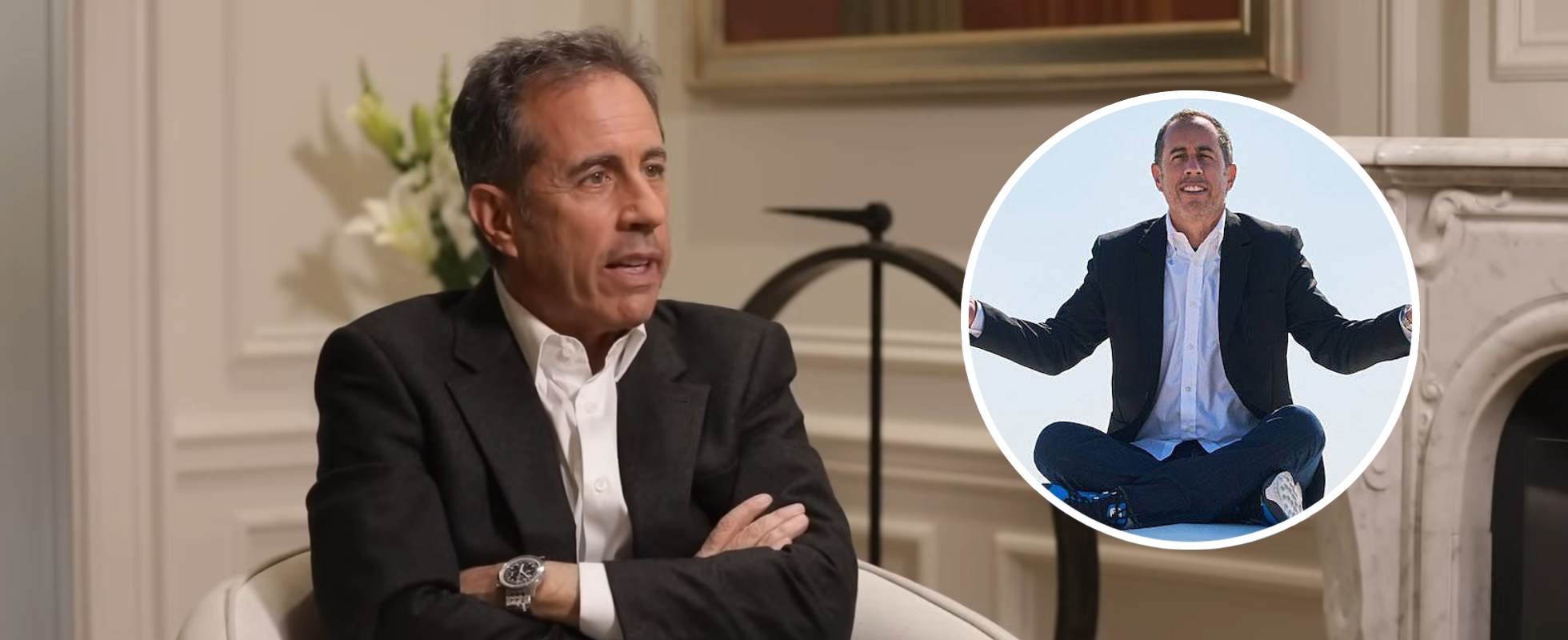
Jerry Seinfeld has distilled the secret to a successful life into three simple practices: Transcendental Meditation, lifting weights, and espresso. He talked about it in a recent podcast interview with Graham Bensinger. At 70 years old, the comedian credits this trio with extending his career and maintaining the energy needed to continue performing at the highest level.
For Seinfeld, Transcendental Meditation stands as the foundation of his daily routine. He practices it at least twice daily, sometimes more, calling it “the greatest thing as a life tool, as a work tool, and just making things make sense.”
He explains the practice with pragmatism, comparing it to getting into a hot tub for five minutes. “Meditation is even easier than that,” he says. The value proposition is simple in his view: it doubles your energy to accomplish what you want in life.
He also describes meditation as providing a level of rest that sleep cannot achieve. When asked about his longevity in the business, he attributes it directly to this practice.
“If you ask me my three keys to a successful life, you want my three keys? Transcendental Meditation, lift weights, espresso. You just do those three things and you will k*ll it,” Seinfeld told interviewer Graham Bensinger.
While Seinfeld’s personal experience with Transcendental Meditation has clearly been positive, studies present a more complicated picture. Clinical case reports published in Psychopathology have documented instances in which intensive meditation practices preceded acute psychotic episodes, including relapse in vulnerable individuals and even first-onset psychosis in those without prior psychiatric history.
A later review in the Irish Journal of Psychological Medicine warned that meditation may act as a precipitating factor in susceptible individuals.
More broadly, research found that adverse psychological events, including anxiety, dissociation, mood disturbance, and cognitive destabilization, are often underreported in meditation research. Another study documented a wide range of meditation-related challenges, such as depersonalization and emotional volatility, some of which impaired daily functioning.
Earlier neurophysiological studies suggested that altered EEG profiles during transcendental meditation resemble patterns associated with unusual temporal lobe activation, raising questions about dissociative vulnerability. Additionally, it has been argued that adverse psychological reactions within the TM movement were sometimes reframed as “stress release,” potentially discouraging clinical interpretation.
The wide range of evidence complicates the idea that transcendental meditation is an uncomplicated life hack. For practitioners, particularly those with latent psychiatric risk, intensive meditation has coincided with destabilizing outcomes rather than simple cognitive enhancement.
Weight training entered Seinfeld’s life through a book called Body for Life, which he discovered in a Milwaukee bookstore in 2004. The program introduced him to interval training, which appealed to him because it was both very painful and very short.
“I like to be in a difficult environment,” he explained. “I just felt instinctively I’m going to do better under pressure.”
This attraction to difficulty runs throughout Seinfeld’s approach to life. He maintains a rigorous exercise schedule, alternating three days of cardio with three days of weight training, doing something physical every day.
His philosophy connects physical exercise directly to mental performance. “Exercise is so unfunny, I really can’t talk about it,” he jokes, before explaining his genuine belief: “The body and the mind are one thing, so if you exercise your body then you exercise your mind.”
His third pillar, espresso, might seem frivolous compared to meditation and exercise, but for Seinfeld it represents another source of the energy he prizes above all else. He owns espresso machines everywhere he goes, refusing to leave home without access to quality coffee.
Energy, according to Seinfeld, is “the most valuable quantity of human life.” His entire system is built around maximizing and preserving it. This focus on energy management extends beyond his personal habits into how he approaches his work and relationships.
References
- Anthony, Dick, and Thomas Ecker, TM and Cult Mania (Berkeley: And/Or Press, 1980).
- Chan-Ob, T., Boonyanaruthee, V., and Watanasirichaigoon, S., ‘Meditation-induced psychosis’, Psychopathology, 40, no. 6 (2007), pp. 461–465.
- Kuijpers, H. J. H., van der Heijden, F. M. M. A., Tuinier, S., and Verhoeven, W. M. A., ‘Meditation-induced psychosis’, Psychopathology, 40, no. 6 (2007), pp. 461–464.
- Shonin, E., Van Gordon, W., and Griffiths, M. D., ‘Meditation-induced psychosis: a case report and review of the literature’, Irish Journal of Psychological Medicine, 31, no. 4 (2014), pp. 279–282.
- Persinger, Michael A., ‘Striking EEG profiles from single episodes of glossolalia and transcendental meditation’, Perceptual and Motor Skills, 50, no. 3 (1980), pp. 1239–1242.
- Farias, Miguel, Maraldi, Everton, Wallenkampf, Kevin C., and Lucchetti, Giancarlo, ‘Adverse events in meditation practices and meditation-based therapies: a systematic review’, Acta Psychiatrica Scandinavica, 142, no. 5 (2020), pp. 374–393.
- Lindahl, Jared R., Fisher, Neil E., Cooper, David J., Rosen, Rachel K., and Britton, Willoughby B., ‘The varieties of contemplative experience: a mixed-methods study of meditation-related challenges in Western Buddhists’, PLOS ONE, 12, no. 5 (2017), e0176239.