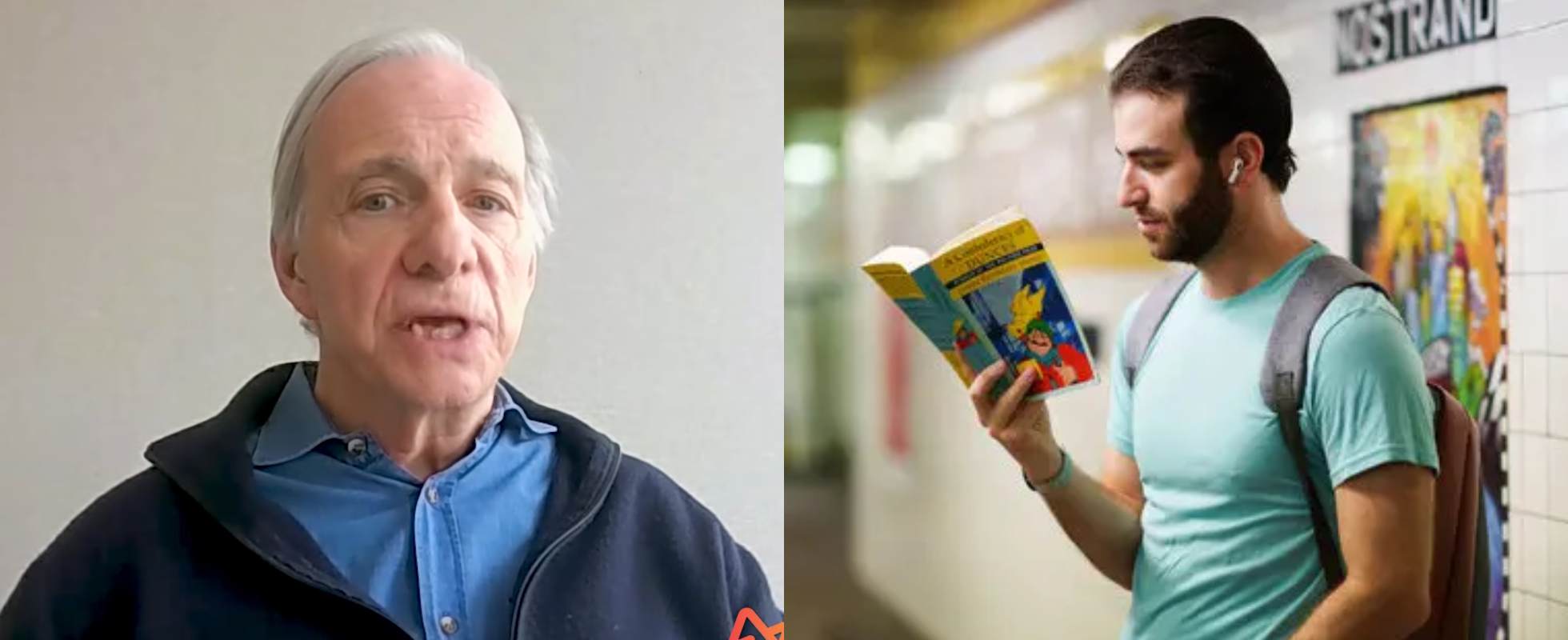
Ray Dalio delivered an assessment of America’s workforce challenges during his recent appearance on the All-In Podcast, highlighting a crisis that extends far beyond economic cycles into fundamental questions about human productivity and societal structure.
The billionaire investor framed the issue within what he calls the “K economy,” describing a bifurcated nation where vastly different realities coexist. At the top, conversations revolve around “who will be the first to be a trillionaire” and the technological revolution reshaping industries.
Meanwhile, a different America struggles with basic competencies.
“60% of all Americans have below a sixth grade reading level,” Dalio stated, “and to make them productive particularly as we are also having AI have replacements for them is a particularly difficult thing to achieve.”
This observation cuts to the heart of what Dalio sees as an approaching collision between technological advancement and human capability. The challenge is not merely about job displacement but about the fundamental inability of a majority of Americans to adapt to an economy increasingly dominated by artificial intelligence and advanced technologies.
Dalio emphasized that this productivity gap represents the nation’s “biggest problem,” extending beyond mere wealth inequality into questions of human capital and economic viability. The timing proves particularly concerning as AI rapidly advances, threatening to render large segments of the workforce obsolete before education systems can adequately prepare them for alternative roles.
The investor’s analysis suggests no easy solutions. When asked about restructuring government and improving efficiency through initiatives like the Department of Government Efficiency, Dalio questioned whether the democratic system itself could effectively address these challenges.
“Are you going to have the executive leadership that’s going to be able to make this satisfactory with most people?” he asked, calling the task “a h*ll of a trick to pull off.”
His prescription centers on three fundamental requirements for national success: educating children well so they become capable and civil, creating an orderly environment where people can compete and work together productively, and staying out of wars. Yet even Dalio seemed uncertain whether these remedies could address the scale of the challenges ahead.
The context makes the reading level statistic particularly troubling. With federal workforce reductions eliminating over 317,000 government positions, questions arise about where these workers will find productive employment in an economy that may not value their skills. Dalio noted the inherent inefficiency of government work but offered little optimism about absorption into private sector productivity.