
Free to use under the Unsplash License
On Joe Rogan Experience #2477, podcast host Joe Rogan sat down with former Texas Governor Rick Perry and W. Bryan Hubbard of Americans for Ibogaine. While much of the conversation focused on the push to bring ibogaine through FDA d**g development, Rogan made several direct observations about why Republicans have long been seen as opposed to psychedelics and why he believes that view is both outdated and rooted in deliberate political manipulation.
Rogan opened by acknowledging the perception problem head-on, telling Perry that his Republican background actually made him an essential figure in advancing the cause. “Generally speaking, most people think of Republicans as being anti-psychedelics,” Rogan said, “and that this whole thing is just a bunch of people trying to escape reality and poison their mind and, you know, tune out of society and become losers.”
He attributed this attitude to a lack of understanding, calling it the “general consensus of people that are just, for lack of a better term, ignorant of the effects of these subs tances.”
Rogan credited Perry’s involvement as critical to changing minds within conservative circles. “If it wasn’t for you, your open-mindedness, your willingness to engage in this and try to understand it and to speak to these veterans, I don’t think people would be taking it seriously,” he said.
When Perry expressed concern that championing psychedelic medicine could damage his decades-long reputation, Rogan disagreed sharply. “I don’t think you’re risking your reputation at all. I think that’s foolish thinking. I think it’s people that don’t understand the times. This is a different world. We’re living in a world of information now. And you can’t go by these false narratives that were adopted in the 1970s.”
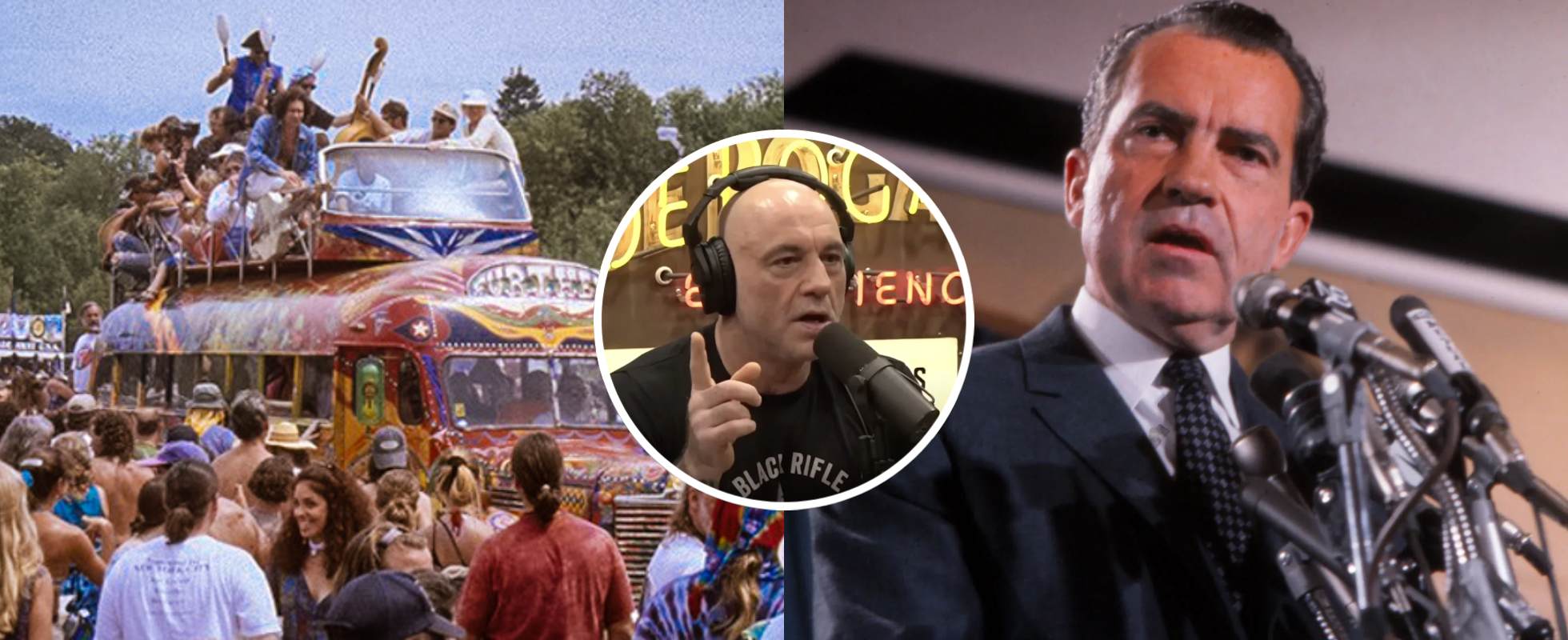
Rogan placed the blame for those false narratives squarely on the Nixon administration, connecting the anti-psychedelic movement to a calculated political strategy.
He said, “I just think our modern perception of it, which is very tainted by what happened during the Nixon administration, where they were trying to squash the hippie movement, the anti-war movement, and the civil rights movement, and that’s why they demonized these dr**s, these compo unds, and that’s why they put them in this category of having no medicinal use, which is clearly not accurate.”
He was careful not to advocate for unregulated access. “It doesn’t mean that they should just be given to everyone and everyone should do them with no restrictions and no regulations,” he noted. “It just means we should understand that they have a long history of human use and have spectacular results and all sorts of things that our society is suffe ring from greatly. And to just pretend that that’s not the case based on what happened in the 1970s is just ins ane. It doesn’t make any sense.”
By the end of the episode, Rogan reflected on what he saw as a long-overdue shift in public awareness. He stated, “I’d always kind of given up hope that people would wake up to the powerful potential that a lot of these compo unds have to change people’s lives.”


