
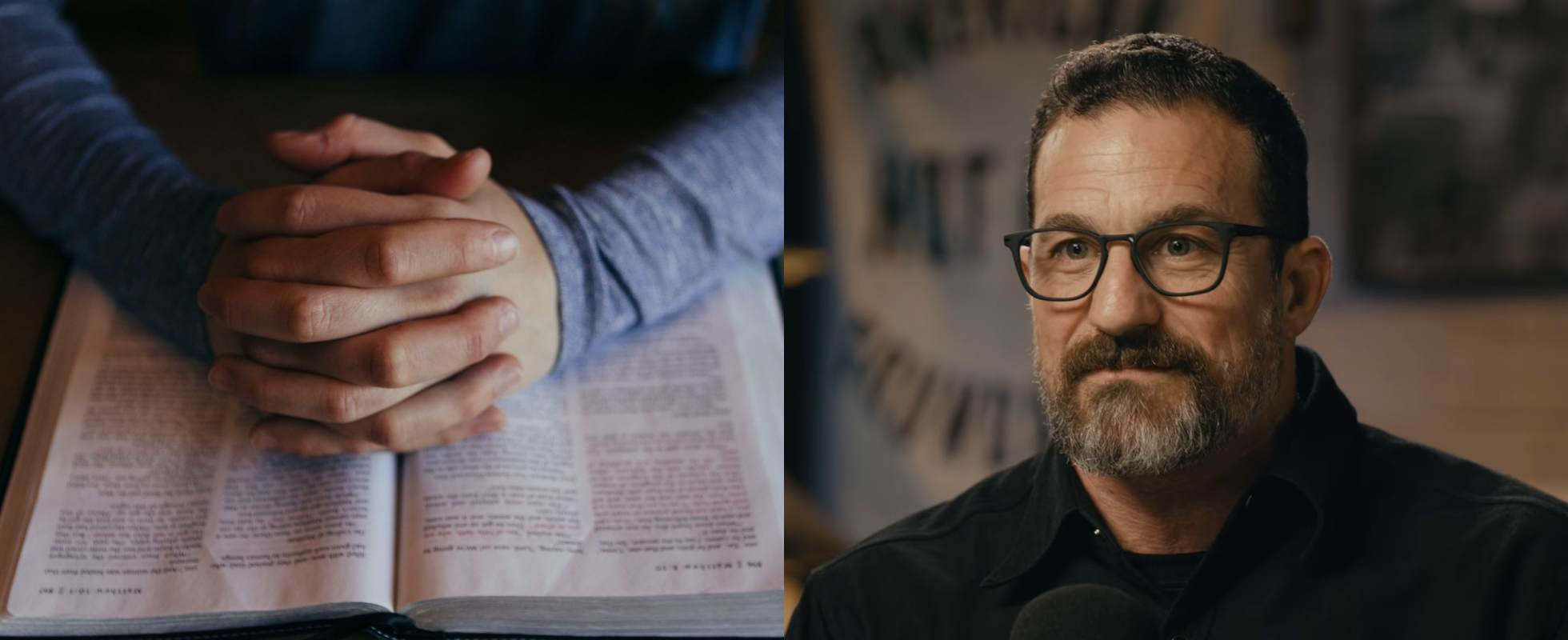
Free to use under the Unsplash License
In a conversation with Chris Williamson, neuroscientist Andrew Huberman spoke about his evolving relationship with faith, prayer, and the idea of a higher power.
Huberman explained that his growing interest in spirituality is closely tied to his research on human behavior and the limits of individual willpower. He noted that many of the virtues people strive for may not come solely from internal discipline.
“The reason I’m so interested these days in spirituality and notions of God is that virtues, I believe, can start to arrive through things that are outside of us,” he said.
Although he acknowledged that this perspective might sound unscientific, Huberman pointed to patterns he has observed in research on recovery and resilience. According to him, belief in something greater than oneself often plays a critical role in helping people overcome hardship.
“If you look at the science around religious belief or belief in a higher power, what you find is that for everything from recovery from a**iction to recovery from immense loss, almost without fail, moving through that without self-destruction involves some notion of top-down control from outside,” he explained.
He went on to draw a connection between neuroscience and the idea of surrendering control. In his view, handing responsibility over to a higher power can create a sense of relief that allows people to function more effectively.
“When people hand that over to God, whether it’s Christ or some other form of God, it seems as if they get relief from the process, and yet it’s very effective. You can’t deny this as a phenomenon,” he said.
Huberman also posed a question that he believes science has yet to fully answer.
“How could it be that the thing that’s hardest for humans to do for themselves becomes far easier when they stop trying to do it for themselves? It’s a wild thing that neuroscience doesn’t really understand,” he added.
Using ad*iction recovery as an example, he highlighted the role of a higher power in 12-step programs like Alc**olics Anonymous.
“The notion of a higher power is central to almost every al**holic who goes through AA. In some sense, it is a prerequisite,” he said. “It’s brilliant because it takes away the need for constant top-down control. You give that over to something else.”
Huberman also reflected on religious teachings, suggesting that ancient texts recognized the difficulty humans face when trying to live virtuously on their own.
“I think it is not a coincidence that the Bible talks about sins and virtues and the need not just for good works but avoiding sin, and acknowledges that in some cases it’s nearly impossible for people to do on their own,” he said.
Despite his scientific background, Huberman was clear that his personal beliefs do not conflict with his work as a researcher. Instead, he sees faith as something that complements scientific understanding rather than replaces it.
“I absolutely think there’s something real there, and I say that completely as a scientist,” he said. “I’m used to studying proteins, recording from neurons, and looking at neural circuits. But there’s no doubt in my mind that giving over to the understanding that there’s something much greater than us, and that we are not in total control, feels very comforting.”
Huberman then shared details about a daily habit that has become central to his routine: prayer.
“I’m in a very serious prayer practice now, every night before I go to sleep without fail,” he said. “It’s been a couple of years, and I haven’t missed a single night. I’ll get out of bed if I fall asleep and remember I haven’t done it.”
Even if the benefits of prayer can be explained through biology, he said the practice remains valuable to him. “Even if it turns out that it’s all filtered through standard neurobiological mechanisms, I’m good with that,” he added. “But in the meantime, I’m going to keep praying.”
During the conversation, Huberman also reflected on reaching a milestone age and experiencing a sense of calm he had not felt before.
“I’m 50, and for the first time in my life I’ve experienced sustained periods of real, deep peace,” he said. “Like everything’s okay. Everything is as it should be.”
Looking back, Huberman admitted that he resisted faith for years because he believed it conflicted with his identity as a scientist.
“The one thing I wish I had done earlier was to stop resisting the voice in my head that said, ‘I think there’s a God, and I’m going to pray,’” he said. “I kept pushing that away because I thought it was incompatible with what it meant to be a scientist.”


