Joe Rogan has never been shy about weighing in on politicians, but his recent dismissal of California Governor Gavin Newsom’s repeated public requests to appear on The Joe Rogan Experience has drawn attention for a different reason: it exposes a contradiction Rogan himself seems unwilling to fully acknowledge.
When Newsom went public with his frustration directly calling out Rogan with, “Joe, why won’t you have me on the show?” Rogan didn’t take it as an invitation. Instead, he framed it as a misstep.
“But it’s just st**id. It’s like this is a bad strategy,” Rogan said while reacting to the clip. “Like I probably would have had him on. Yeah. But now I’m like no. What are you doing?”
To Rogan, the public pressure came off as desperate and tactically foolish.
However, that framing starts to fall apart when you look at how a similar situation played out just a year earlier.
Back in 2024, Donald Trump took a strikingly similar approach. After Rogan endorsed RFK Jr., Trump didn’t quietly reach out behind the scenes. He went after Rogan publicly, even saying he hoped Rogan would get booed at a UFC event. It was a direct, high-profile callout aimed at one of the biggest voices in media.
Trump not only appeared on the podcast, but Rogan later endorsed him for president. What is now being labeled a “bad strategy” worked almost perfectly when it came from Trump.
That contradiction has not gone unnoticed, particularly by those around Rogan. On a recent episode of Protect Our Parks, Rogan spoke openly about his relationship with Trump, offering a glimpse into how it all came together.
Reflecting on his involvement in pushing federal movement on ibogaine access for veterans, Rogan described how direct the communication became: “How about sending him a text message explaining everything to him and him saying, ‘Let’s do it.’”
That exchange, he explained, was followed by a handshake at a UFC event where Trump told him, “It’s done.” From there, the relationship developed into something far more personal. Rogan described visiting the Oval Office, noting the gold leaf decor and the unexpectedly relaxed tone of the meeting, painting a picture of genuine access to the White House.
What stands out is how that relationship began: with deliberate, public outreach from Trump, who clearly understood the value of Rogan’s platform and made his interest known. It’s the same playbook Newsom is now using, albeit with a very different reception.
Rogan’s issue with Newsom appears to run deeper than strategy alone. It likely ties back to pandemic-era tensions, his move to Texas, and a long-running frustration with California leadership. Newsom, for his part, has leaned into the conflict, adopting a more aggressive, Trump-style tone on social media.
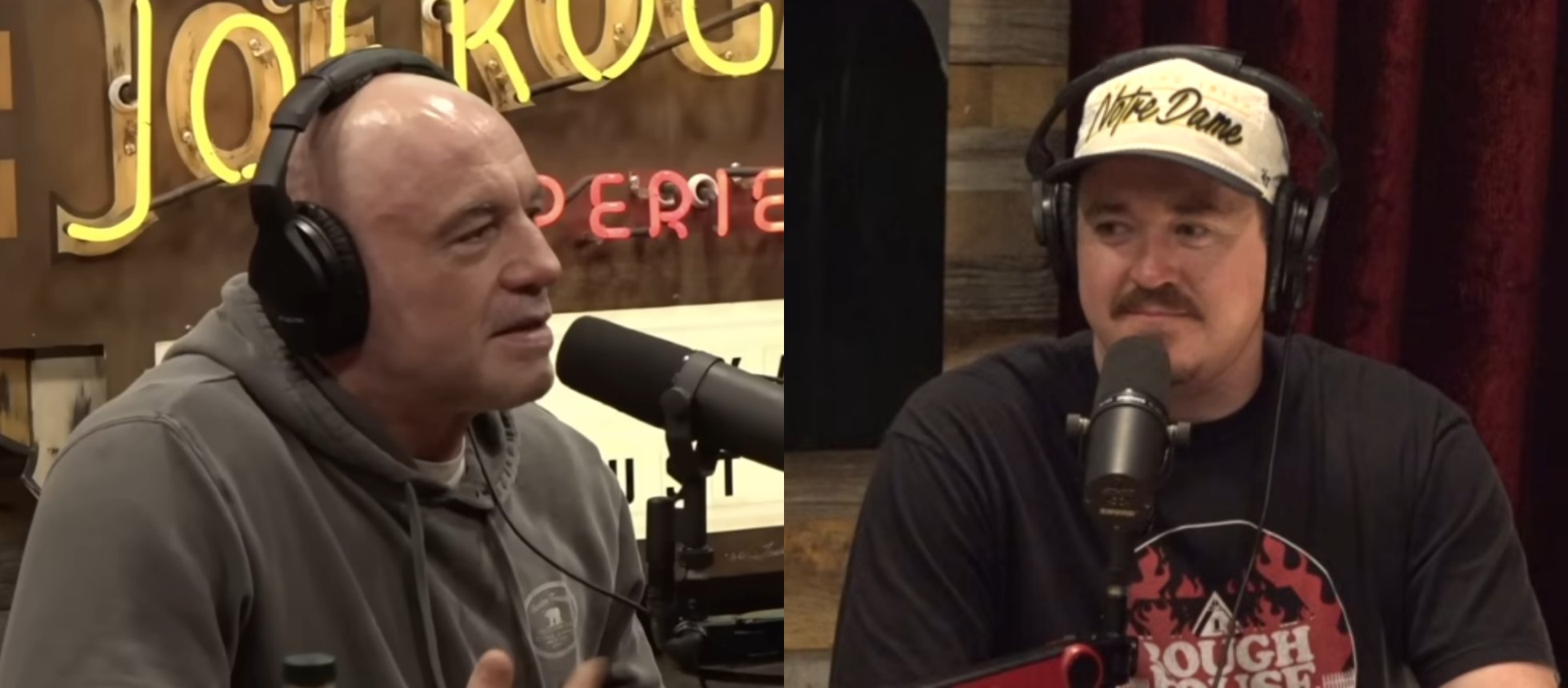
The irony is difficult to ignore. On a Christmas Day episode with Shane Gillis, Rogan spoke about concerns over how political pressure could be weaponized in the future. Now, he finds himself on the receiving end of exactly that kind of public push and rejecting it outright.
Gillis, who joined Rogan alongside Mark Normand and Ari Shaffir on Protect Our Parks, has quietly highlighted these inconsistencies without turning them into outright confrontations. Gillis has grown more comfortable letting pointed observations land on their own. He has also publicly stated that he did not vote for Trump.