
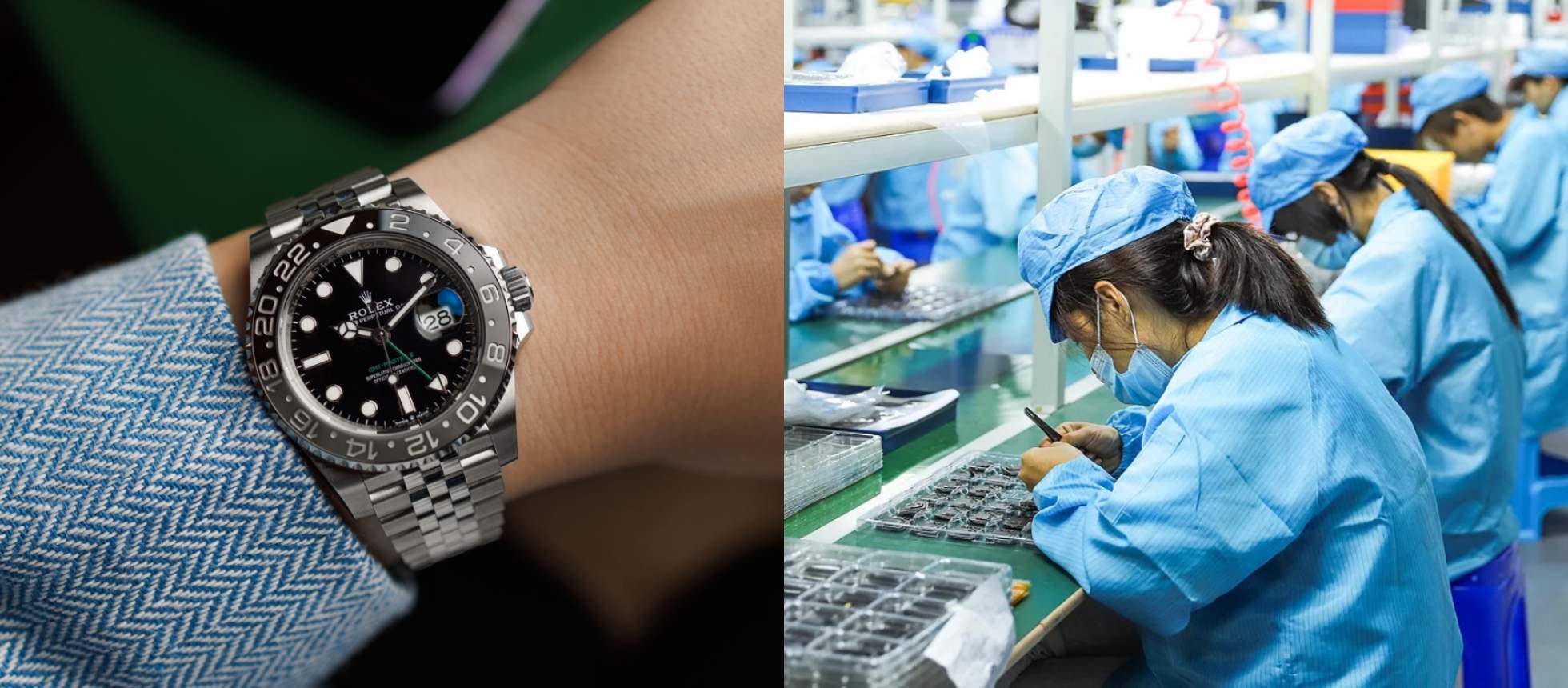
On a recent episode of The Iced Coffee Hour, watch expert and collector Nico Leonard sat down with hosts Graham and Jack to unpack some of the most controversial claims floating around the watch world. One theory in particular stood out: the idea that modern Rolex watches are no longer truly made in Switzerland.
Graham introduced the claim bluntly. “The second controversial theory that you’ve got is that you strongly believe that any Rolex that you buy manufactured after 2010 is actually not made in Switzerland,” he said. “You believe this is an Asian product.”
Nico didn’t entirely dismiss the premise at first. “Yeah,” he replied, before adding nuance. “The major part of the component parts of the watch are all made in the Orient.”
To build on the controversy, the hosts played a clip of a third party holding a 2025 Rolex Pepsi GMT and making a bold claim about its value. “The reason it’s a $1,500 watch is I can go to Hong Kong and buy this same thing, super clone,” the person said. “You can’t tell the difference. That’s why it’s 1,500. It’s 15,000 because Rolex wants 15,000.”
He continued with a warning: “Let me tell you, after this next year and the truth comes out about production in China, try to sell this for anything. Try to sell this more than two grand.”
Nico pushed back on that framing almost immediately. “What you see here is a little bollocks, right?” he said.
He acknowledged that some components may come from China, but clarified the bigger picture. “Yes, there’s parts coming out of China. That doesn’t really work for Rolex. For many other brands, it does.”
He then explained the legal definition behind the “Swiss Made” label. “But, to give you an idea, in order for a watch to be called Swiss made, 50% of the value, not 50% of the components, but 50% of the value of the movement needs to be coming from Switzerland,” he said.
Breaking it down further, Nico pointed out that sourcing certain parts internationally isn’t unusual or even a negative. “So that means they can have screws coming from China,” he said. “And yes, there’s nothing wrong with that because some of the Chinese manufacturing is significantly better than what they can produce in Switzerland.”
Ultimately, he rejected the idea that this undermines the watch’s legitimacy. “So they’re making the best product,” he said. “And what he’s saying is wrong. That’s not a $1,500 watch. Maybe it is. It’s a Rolex and it’s a legit Rolex.”
Nico also emphasized that critics often misunderstand what buyers are actually paying for. “You’re not paying for the manufacturing,” he said. “Buying a Rolex is not the product.”
Instead, he framed the value around the brand experience. “It’s like I said, the cycle,” he explained. “Being able to be considered, feel special. Yes, I can buy a watch. That cycle is the product, not the actual watch.”