
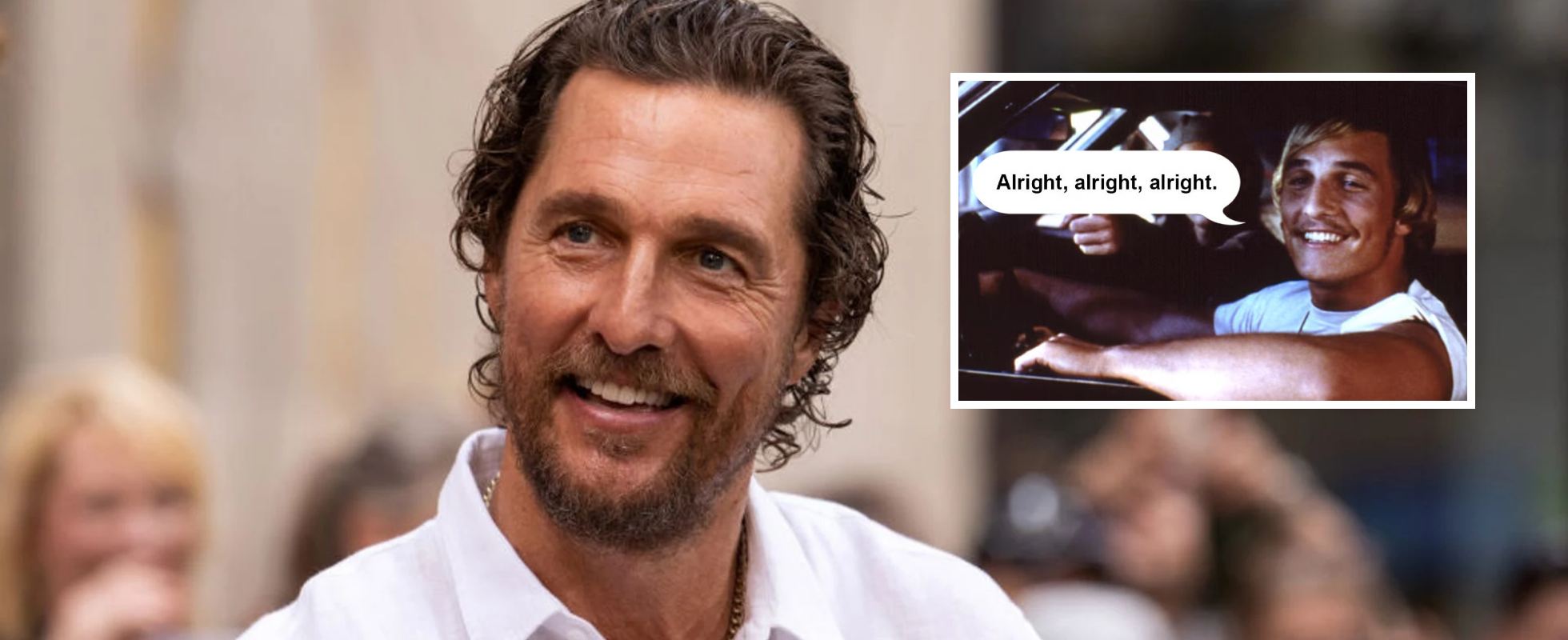
Matthew McConaughey is pioneering a novel legal approach to protect himself from unauthorized artificial intelligence replication. The Academy Award-winning actor has successfully registered eight trademarks with the U.S. Patent and Trademark Office that cover various elements of his public persona, including video clips and audio recordings of his voice.
Sources say that the approved trademarks encompass a seven-second clip of McConaughey standing on a porch, a three-second segment featuring him seated before a Christmas tree, and perhaps most notably, an audio recording of his iconic line from “Dazed and Confused”: “Alright, alright, alright.”
According to the approved filings, these registrations are designed to establish legal boundaries around the actor’s image and voice in an era of rapidly advancing AI technology.
“My team and I want to know that when my voice or likeness is ever used, it’s because I approved and signed off on it,” McConaughey explained in an email statement. “We want to create a clear perimeter around ownership with consent and attribution the norm in an AI world.”
The legal strategy comes at a time when AI-generated content poses an escalating concern for performers across the entertainment industry. While traditional state “right of publicity” laws already provide protection against unauthorized commercial use of celebrity images, McConaughey’s legal team believes federal trademark registration could offer stronger defenses, particularly against AI-generated content that may not involve direct commercial transactions.
Attorney Jonathan Pollack, who represents the actor, emphasized the potential power of this approach. “In a world where we’re watching everybody scramble to figure out what to do about AI misuse, we have a tool now to stop someone in their tracks or take them to federal court,” Pollack stated.
McConaughey’s lawyers acknowledge they are not currently aware of any specific instances where his likeness has been misappropriated by AI technology. However, they view these trademark registrations as a preventive measure intended to discourage future unauthorized reproductions.
Kevin Yorn, another attorney working with McConaughey on this initiative, admitted the legal territory remains largely unexplored. “I don’t know what a court will say in the end. But we have to at least test this,” Yorn noted, acknowledging the experimental nature of using trademark law to combat AI-related concerns.
While other entertainers have previously trademarked signature phrases (singer Lizzo, for instance, secured rights to “100% That Bitch”) McConaughey appears to be among the first to pursue comprehensive trademark protection specifically as a defense against artificial intelligence reproduction. Legal experts suggest that if successful, his approach could establish important precedents for how performers protect themselves in the digital age.
The timing of these trademark applications coincides with McConaughey’s expansion into the personal development space. Following his involvement with a $400 program called “Road Trip” that he co-created with motivational speakers Dean Graziosi and Tony Robbins roughly a year and a half ago, the actor has launched his own independent initiative.
His current project, “Lyrics of Living,” is a weekly newsletter distributed every Friday at 5 PM Eastern Time through the email marketing platform ConvertKit. Unlike the previous partnership, this newsletter is currently offered at no cost to subscribers. The content promises personal reflections, motivational messages, and philosophical insights drawn from the same journaling practice that informed his bestselling book “Greenlights.”
McConaughey promotes “Lyrics of Living” through video content that typically features him in casual settings, often outdoors or near a trailer, maintaining his recognizable persona of relaxed wisdom. Some observers have noted that the advancement of AI technology makes it theoretically possible for such content to be artificially generated, with subtle discrepancies between audio and visual elements potentially indicating computer-generated production.
The actor has also demonstrated a willingness to engage with AI technology on his own terms. He recently partnered with AI voice company ElevenLabs to create a Spanish-language version of his newsletter. Both McConaughey and attorney Yorn hold investment stakes in the company, suggesting the actor recognizes both the opportunities and risks presented by artificial intelligence.
Industry observers speculate that “Lyrics of Living,” while currently free, may eventually transition into a monetized platform, potentially through premium subscriptions, exclusive content, or related products. The use of ConvertKit, a platform commonly employed for automated email marketing campaigns, suggests a structured strategy for audience development.
McConaughey’s recent activities in the motivational speaking space, combined with his previous public consideration of a gubernatorial run in Texas, have led some to wonder whether he is building a foundation for broader public influence beyond acting. By establishing a carefully managed public persona that blends entertainment credibility with grassroots engagement, he appears to be positioning himself for an expanded role in public life.
Legal experts hope that future federal legislation will eventually provide clearer protections for performers facing AI-related concerns, potentially making individual trademark strategies unnecessary.


