
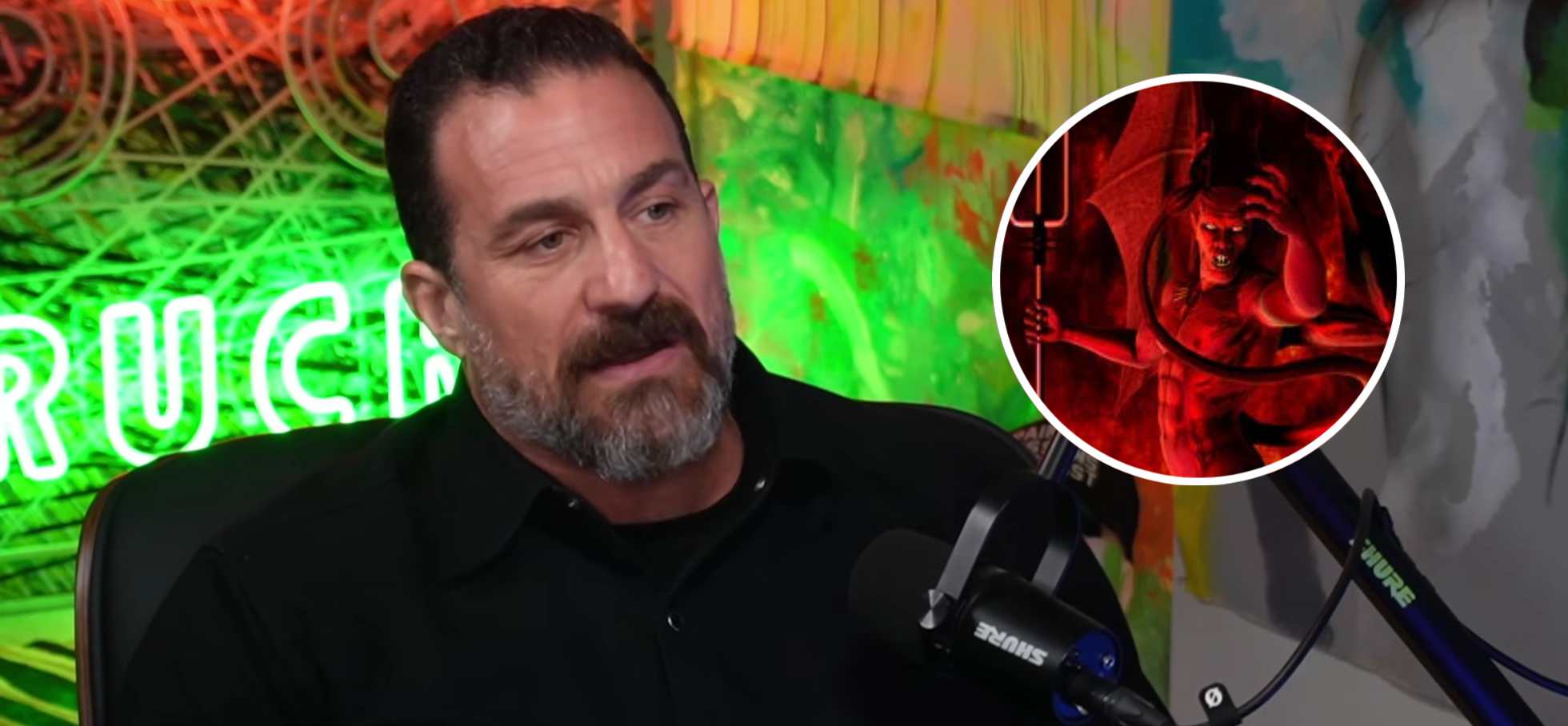
Neuroscientist and podcaster Andrew Huberman recently joined Tyler Ramsey on the Punk Rock Sober podcast for a conversation that delved into one of his most provocative beliefs: that evil forces are real, and that the devil can literally enter men’s minds.
Speaking alongside Ramsey and his nine-year-old son River, Huberman explored the psychological mechanisms behind personal shame and how they can lead to destructive patterns, even among the most accomplished individuals.
Huberman’s perspective emerged from observing friends who have taken their own lives, including high-achieving professionals, physicians, and Navy SEALs. “I do think that at some point in life, men have something in their mind based on their experience somewhere in life where it’s like a point of shame or they feel like they’re not enough,” Huberman explained. This core insecurity becomes a driving force, pushing men to prove themselves worthy or avoid becoming what they fear most.
The danger, according to Huberman, lies in how temptation exploits this vulnerability. “At some point in their life, the devil offers a temptation. And that temptation is always the way that they can overcome thinking about that,” he said.
Whether through achievement, relationships, or sub**ances, men pursue solutions that temporarily silence their shame. But eventually, Huberman argues, these very solutions become the source of deeper shame, creating a feedback loop that can prove fatal.
Speaking from a biblical perspective, Huberman stated clearly: “I believe that evil forces are real. I believe that the devil gets into men’s heads and finds their [weakness].” While acknowledging that others might view these forces differently, as energy or psychological patterns, Huberman has found the biblical framework most useful for understanding what he’s witnessed. “That’s where it’s been written about so clearly that you know exactly what you’re talking about when you talk about evil,” he noted.
Ramsey, who has openly discussed his own recovery journey, connected deeply with Huberman’s analysis. He described his friend Blake McKoski, founder of TOMS Shoes, reaching such a dark place that “I was looking in his eyes and I felt like I was looking at someone that like a voodoo priestess had taken their soul.” McKoski has since transformed his life and now focuses on mental health advocacy, particularly around the concept of being “enough.”
The conversation touched on neuroplasticity, which is the brain’s ability to rewire itself, and how this biological mechanism can work against those struggling with patterns of self-harm. Huberman explained that certain behaviors create reinforcement loops in the brain, where “the person thinks something’s going to solve the problem, does the thing, it temporarily solves the problem and it creates another problem.” Over time, even when someone recognizes the destructive pattern, they become trapped in a circuit they cannot escape.
For Ramsey, recovery required confronting multiple layers. He credited experiences at the Hoffman Process with Huberman, work with plant medicine, and ultimately a spiritual breakthrough at a faith-based rehabilitation center called the Dream Center.
“Someone prayed over me and they go, ‘I get the sense that you’re having trouble forgiving yourself,'” Ramsey recalled. “And all of a sudden, I felt like I had like a blank slate. And it was exactly what I needed.”
Huberman emphasized that understanding one’s point of shame requires careful attention. “I wish I had heard like when I was in my teens or something maybe when I was like fourteen, fifteen,” he said, wishing someone had told him: “Listen, the thing that you’re most afraid of, that’s the thing to really think about.” He compared it to putting that fear in a glass case, visible but contained, rather than letting it unconsciously drive behavior.
The discussion also addressed gratitude as a powerful tool for mental health. Huberman cited research showing that receiving gratitude produces the most significant effects on wellbeing. “Seeing someone receive gratitude is like the big one,” he explained. This finding supports practices where families and communities actively express appreciation to one another.
Throughout the conversation, both men stressed the limitations of relying solely on one’s own understanding. “The human brain is not wired to solve everything for itself, much less for the rest of the world,” Huberman stated. This recognition of limitation, he argued, opens the door to seeking help from higher powers, community, or therapeutic support. whatever framework allows someone to stop trying to control everything alone.
Ramsey now describes his approach to recovery as “punk rock sober,” a phrase he learned from actor Josh Brolin. The concept reframes sobriety not as deprivation but as the ultimate act of courage, choosing to feel everything rather than numb out. “It made me realize that I wasn’t giving anything up but I was going to gain everything,” Ramsey said.