
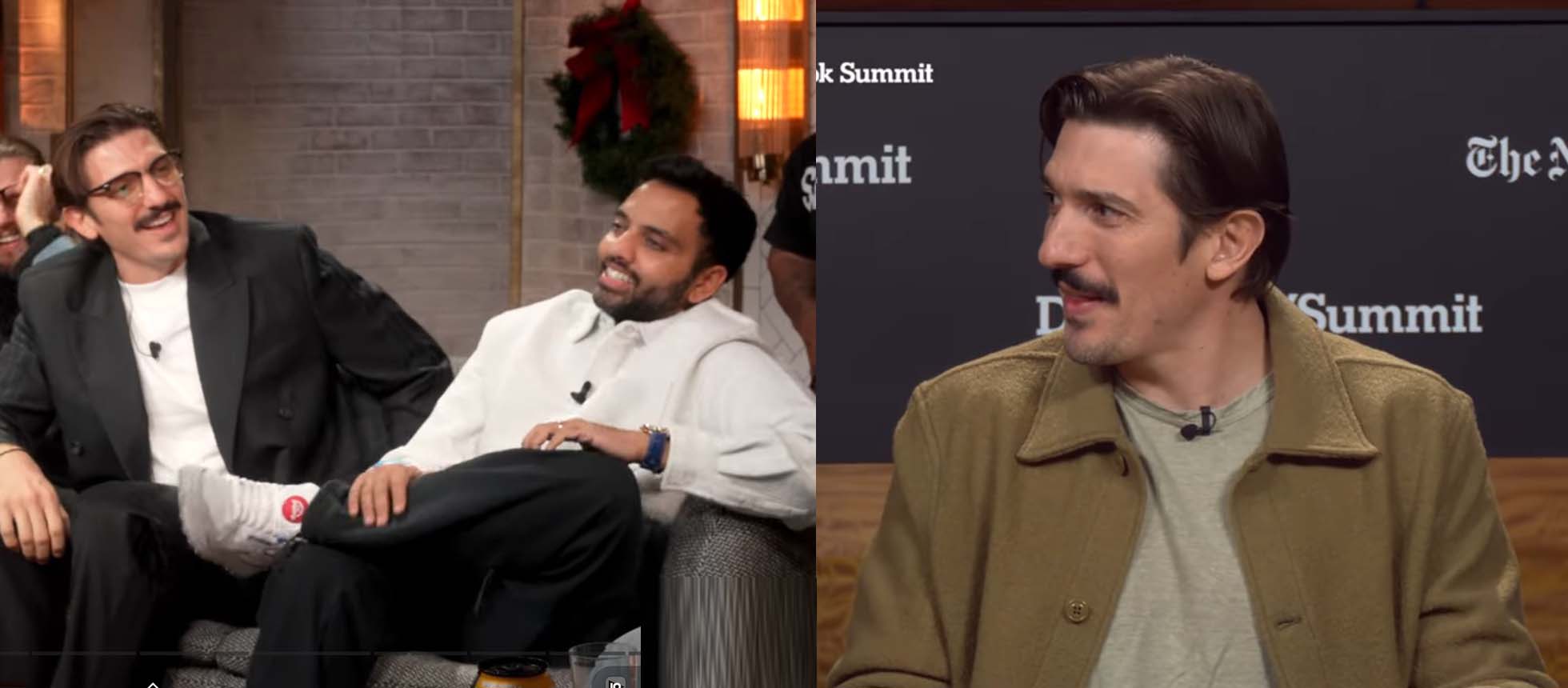
Andrew Schulz found himself in an unexpected position at the New York Times DealBook Summit 2025. The setting placed him among journalism heavyweights to discuss media trust. While he introduced himself with the quotes above Schulz delivered pointed cultural commentary throughout the panel.
When asked whether people should trust the media in 2025 Schulz offered a cynical assessment:
“Trust the media to serve their audience what their audience wants… Trust them to just feed their audience what they want… Trust the media to lie to their audience to make them feel good.”
This framing positioned media outlets as businesses optimizing for audience satisfaction rather than truth-seeking institutions.
Schulz was sharply critical of media organizations that compromise their principles for financial gain. When discussing corporate ownership of media he argued that if networks are “willing to curtail their own personal constitution on what they should put out and what media is so that they can make money,” then
“I’m kind of like, f**k them.”
He called on media organizations to “prove you care about the media” by prioritizing journalism over mergers and acquisitions. He also suggested they should “ring the alarm” when facing government pressure rather than folding to secure business deals.
On Trump administration actions against media Schulz was unequivocal. He called FCC Chairman Brendan Carr‘s attempt to remove Jimmy Kimmel from broadcast “horrible” and emphasized:
“As a comedian, you got to allow people to make jokes.”
This defense of free expression extended beyond partisan lines as Schulz noted he “doesn’t even love Jimmy.”
Perhaps Schulz’s most notable commentary addressed the algorithmic fragmentation of information. He explained how TikTok’s algorithm has created “a thousand different silos” and has forced content creators to “ratchet up the rhetoric” because “only the most wild stuff crosses over.” Using a provocative analogy he noted:
“There’s a performer that had relations with a thousand guys in a day. You didn’t need to do that back in the day, but that’s what you need to do to cross over.”
Schulz proposed a solution based on media literacy similar to nutritional awareness.
“We didn’t know that food was bad for us when we were growing up,”
he explained.
“What I assume will happen in the next two to five years is we’ll start realizing that the internet also needs nutrition facts.”
He suggested that when consuming content from unknown sources viewers should think:
“Big Mac, fries, milkshake. Don’t take this as truth.”
Throughout the discussion Schulz acknowledged the separation between entertainment and journalism. He stated:
“I don’t do gotcha journalism… I bring people on because I have an interest in them and I want to see the humanity in them.”
When pressed about his Trump interview he defended his approach by distinguishing between the media class “who know everything about the Russia hoax” and “the rest of us” who simply observe outcomes.
Ultimately Schulz echoed Ben Shapiro‘s prescription for healing American discourse:
“Everybody should turn off their f**king phone and we should all start spending time with each other in person.”
While admitting this recommendation hurts everyone’s business interests he argued it addresses a fundamental problem.
Perhaps Schulz’s most insightful commentary addressed the algorithmic fragmentation of information. He explained how TikTok’s algorithm has created “a thousand different silos,” forcing content creators to “ratchet up the rhetoric” because “only the most insane stuff crosses over.” Using a provocative analogy, he noted, “There’s a p**n star that had s*x with a thousand guys in a day. You didn’t need to do that back in the day, but that’s what you need to do to cross over.”
Despite the confident posture he carried onstage at the DealBook Summit, Schulz’s commentary revealed a tension he can’t quite escape. He spoke about media distortion, algorithmic chaos, and the need for audiences to develop something like nutritional awareness when consuming online content. Yet those same dynamics are swallowing the world he comes from. While Schulz positioned himself as a cultural critic beside legacy-media figures, his own co-host was simultaneously becoming a viral punchline across TikTok and Reddit. The contrast is impossible to ignore.
That escalation is exactly what pushed Flagrant into the mess it occupies in 2025. His reflections on fractured information ecosystems and performative extremity were accurate, but they also unintentionally described the conditions that turned his podcast into a spectacle and pushed Akaash Singh into meme territory. Schulz was urging people to unplug, recalibrate, and relearn how to process information, even as his own audience was busy circulating clips that made his show look unsteady and desperate.
In that sense, the DealBook panel became a snapshot of Schulz at a crossroads. He can still articulate the cultural forces shaping media consumption, and he can still diagnose the distortions driving online discourse. What he cannot do is reconcile that insight with the unraveling of the brand that made him famous. While he tried to argue for healthier public conversation, his co-host’s viral humiliation and Flagrant’s declining credibility were unfolding in real time.


