
A California judge recently rejected a peculiar piece of evidence submitted by Andrew Tate‘s legal team in a DV case, revealing that the controversial influencer’s attorney had attempted to use an AI-generated medical analysis from Grok, the artificial intelligence platform associated with X (formerly Twitter).
The unusual submission came to light in court documents related to a civil lawsuit filed by model Bri Stern, who accused Tate of assault during a March 2025 encounter at The Beverly Hills Hotel. According to the filing, Tate’s attorney Joseph McBride included as evidence what appeared to be an analysis from the AI tool examining photographs of Stern’s facial bruising.
The document, labeled as Exhibit 4 in McBride’s declaration, featured a screenshot showing an inquiry made to the AI platform, followed by what purported to be the tool’s medical assessment. The analysis claimed, “Artificial Intelligence concludes that the bruise marks are consistent with cosmetic injections, not choking or slapping.”
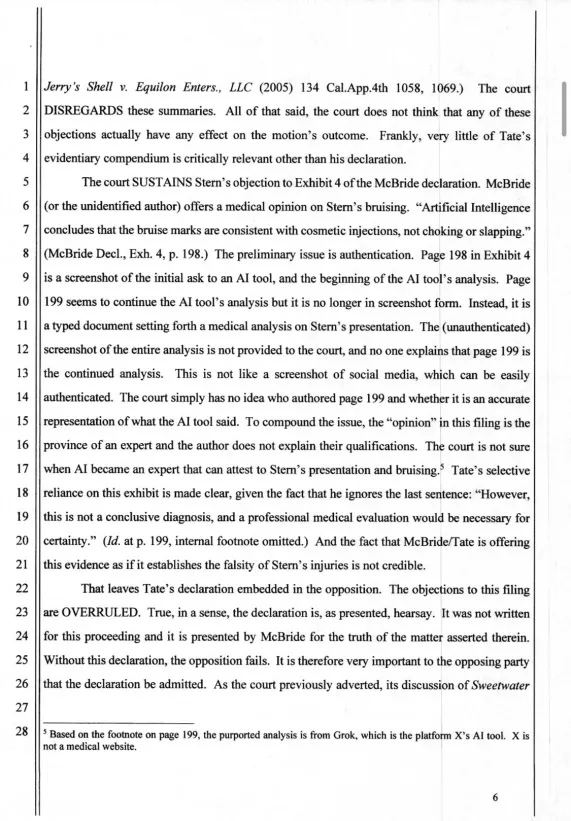
However, the judge handling the case was not persuaded. In a written ruling, the court sustained Stern’s objection to the exhibit, citing multiple problems with the submission. The judge noted that page 199 of the exhibit appeared to continue the AI analysis but was no longer in screenshot form. Instead, it was presented as a typed document without clear authentication.
“The court simply has no idea who authored page 199 and whether it is an accurate representation of what the AI tool said,” the judge wrote in the decision. The ruling emphasized that unlike social media screenshots, which can be more easily verified, this document lacked proper authentication.
The court also raised concerns about whether AI could serve as a qualified medical expert. “The court is not sure when AI became an expert that can attest to Stern’s presentation and bruising,” the judge observed. A footnote in the ruling identified the source as Grok, noting that “X is not a medical website.”
Further undermining the submission’s credibility, the judge pointed out that Tate’s legal team had apparently cherry-picked favorable portions while ignoring a crucial disclaimer. The AI-generated analysis itself concluded with the caveat: “However, this is not a conclusive diagnosis, and a professional medical evaluation would be necessary for certainty.”
“And the fact that McBride/Tate is offering this evidence as if it establishes the falsity of Stern’s injuries is not credible,” the judge added.
The attempted use of AI-generated medical testimony represents one element in a broader legal battle. Stern filed her civil lawsuit in late March 2025, alleging that Tate had assaulted her during an intimate encounter at the luxury hotel. Her complaint included claims of s**ual battery and harassment, along with disturbing text messages allegedly sent by Tate.
While criminal charges were ultimately declined by the Los Angeles District Attorney’s Office in June 2025 due to what prosecutors described as insufficient evidence, the civil case continues. McBride characterized the criminal case’s dismissal as vindication, stating, “Tate’s foes have weaponized courts globally to attack him. We’re grateful the evidence clearly showed his innocence, sparing him an unjust indictment.”
Regarding the civil lawsuit, McBride described it as “a blatant cash grab” and said his client would defend himself “fiercely in court, where the truth will expose this baseless scheme.”
Stern maintains that she sustained genuine injuries from the alleged assault. In an interview, she described experiencing a persistent headache following the incident and said a doctor subsequently diagnosed her with post-concussion syndrome. Photographs reportedly showing facial bruising were provided to law enforcement.
The incident involving the AI-generated analysis highlights emerging questions about the role artificial intelligence can play in legal proceedings. While AI tools have become increasingly sophisticated at processing information and generating content, their use as substitutes for qualified expert testimony raises significant concerns about authentication, reliability, and appropriate standards of evidence.
The Tate brothers also face ongoing legal challenges in Romania, where they are defending against allegations related to trafficking and running a criminal network. They deny all charges in both jurisdictions.
Stern told reporters that multiple women have contacted her with similar accounts after she came forward with her allegations, though she has also received threatening messages from some of Tate’s online supporters.