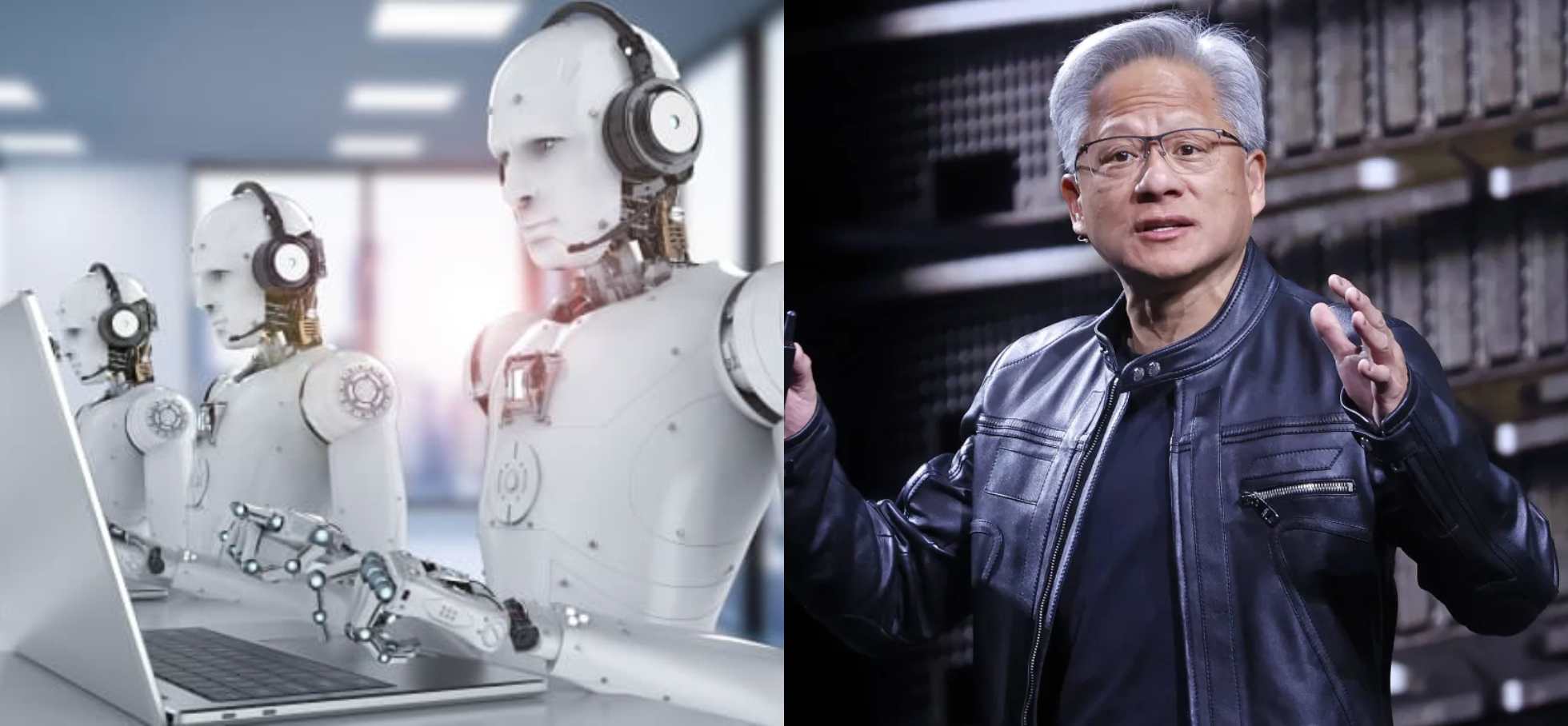
In a recent appearance on the Joe Rogan Experience, Jensen Huang, CEO of Nvidia, made a striking prediction about the future of information and artificial intelligence. According to Huang, within the next two to three years, approximately 90% of the world’s knowledge will likely be generated by AI rather than humans.
During the conversation, Huang explained his reasoning behind this dramatic forecast. He noted that until now, all knowledge has been created, propagated, and modified by humans. We generate information, share it with each other, amplify it, add to it, and change it over time. However, AI is poised to fundamentally alter this paradigm.
“In the future, in a couple of years, maybe two or three years, 90% of the world’s knowledge will likely be generated by AI,” Huang stated matter-of-factly. When Rogan expressed surprise at the prediction, Huang reassured him: “I know. But it’s just fine.”
The Nvidia CEO went on to explain why this shouldn’t be cause for alarm. He drew a parallel to how we currently consume information, asking what fundamental difference exists between learning from a textbook written by people we don’t know and learning from knowledge generated by AI computers that assimilate and resynthesize existing information.
In both cases, Huang argued, we still need to fact-check and ensure the information is based on sound first principles. He said, “To me, I don’t think there’s a whole lot of difference. We still have to fact check it. We still have to make sure that it’s based on fundamental first principles, and we still have to do all of that just like we do today.”
This perspective ties into Huang’s broader optimism about AI’s trajectory. Throughout the podcast, he emphasized that AI development has been largely channeled toward safety and accuracy. He pointed out that AI capabilities have increased perhaps 100-fold in just the last two years, but rather than creating uncontrolled power, that computational strength has been directed toward making AI think more carefully—breaking down problems step by step, conducting research before answering, reflecting on responses, and grounding answers in truth.
Huang also addressed concerns about AI’s accessibility and the potential for a technology divide. He believes AI will actually reduce rather than increase technological inequality. He noted that ChatGPT has grown to nearly a billion users “practically overnight” because it’s remarkably easy to use—you simply speak to it in any language. Unlike traditional software that requires specialized knowledge, AI interfaces naturally with human communication.
The CEO acknowledged that frontier AI development does require significant resources and energy, which has led some to worry about unequal access. However, he pointed out that due to continued advances in computing efficiency—what he called an acceleration beyond even Moore’s Law—yesterday’s AI will still be “freaking amazing” and accessible to countries and communities with fewer resources.