
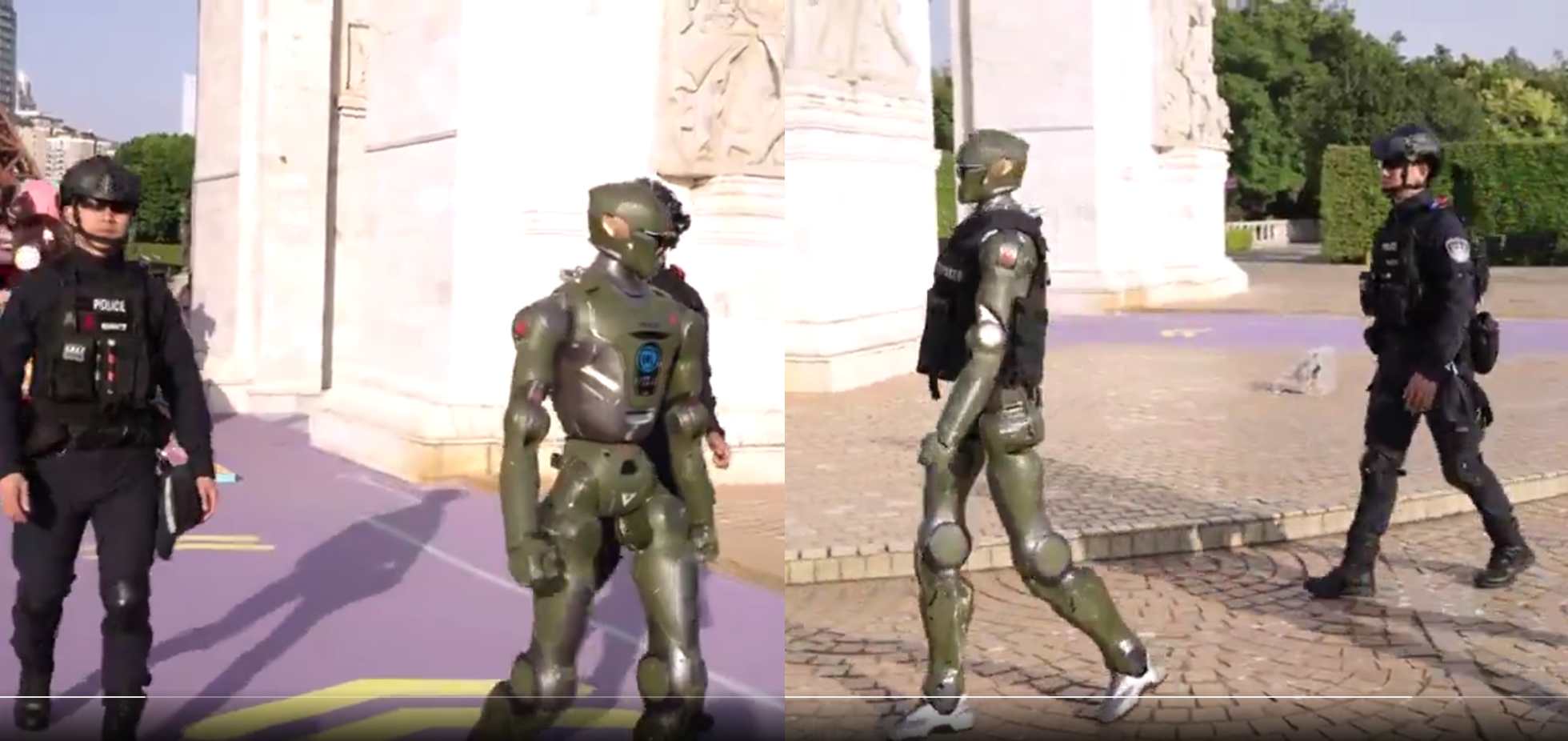
Recently, a humanoid robot has been spotted in a video walking alongside armed police officers at a tourist destination in southern China. The machine, designated as the EngineAI T800, recently appeared on patrol at Window of the World, a popular attraction in Shenzhen.
The robot’s name alone seems to acknowledge what everyone is thinking, a deliberate reference to the iconic T-800 model from the Terminator franchise. Its metallic appearance and humanoid form certainly evoke images of Hollywood’s vision of future law enforcement, though this real-world version is considerably less apocalyptic.
Visitors to the tourist site appeared unfazed by the robotic presence, suggesting that in China’s tech-forward cities, seeing machines walk among humans may already be approaching the realm of the ordinary.
🇨🇳 CHINA NOW HAS A TERMINATOR PATROLLING WITH POLICE IN PUBLIC
In the south of China, a humanoid robot straight out of a sci-fi movie was spotted walking side by side with real armed cops.
It happened in Shenzhen, where the machine, EngineAI T800, casually joined police patrol… pic.twitter.com/C7KUV34vC2
— Mario Nawfal (@MarioNawfal) December 31, 2025
This public appearance comes amid China’s aggressive push into humanoid robotics manufacturing. AGI Bot, a leading Chinese robotics company, recently marked the delivery of its 5,000th humanoid robot from its Shanghai production facility. The milestone represents what industry observers are calling a pivotal year for mass production of humanoid machines.
The manufacturing plant, operated by AGI Bot’s partner Ningboang in Shanghai’s Lingong Pilot Free Trade Zone, launched in April 2024 and produced its first A2 model by October. According to sources, the 65 square meter facility has the capacity to manufacture more than 5,000 A2 robots annually when operating at full capacity, with approximately 2,000 units assembled and delivered by the end of the year.
“From the components to a complete robot, the whole process involves dozens of steps and dozens man assembly and test steps, mainly we call it like a five modules: the joint and the upper limbs and the lower limbs, the torso and the final assembly,” a Ningboang representative explained.
The company applies rigorous quality control measures borrowed from three decades of experience in automotive component manufacturing. Each robot undergoes extensive testing before leaving the factory, including incoming material tracking, real-time process monitoring during production, and multiple evaluation phases for critical components.
Safety protocols receive particular emphasis. Testing includes verification of radar systems, inertial measurement units, lower limb motions, and motion control systems to ensure the robots can respond quickly to unexpected situations.
On the factory’s second floor, robots undergo a comprehensive testing regimen that includes software installation, mechanical performance evaluation of joint limits, minimum scenario testing for reception and guidance functions, and a four-hour aging test on various surface materials including marble and ramps. “After this part we can make sure that all the parts is reliable,” an AGI Bot director noted.
One robot has reportedly logged over 3,000 hours of continuous testing, contributing to the A2’s Guinness World Record for the longest distance walked by a humanoid robot.
Current applications focus primarily on commercial and institutional settings. The robots serve as greeters and guides in enterprises, banks, exhibition halls, and museums. They also perform at entertainment events and commercial shows.
“We have the different solutions for the people to celebrate this ceremony and robotics is quite good choice for this part. It can maybe dancing,” the director explained. For customers requiring temporary robotic services, the company has established a rental alliance.
The progression from one unit to 5,000 represents more than just increased output. “To from 200 to 1,000 look at different because we will move this production part from our R&D center to the manufacturer center,” transforming the operation from research and development into true manufacturing. Reaching 5,000 units validates the business model through real-world application testing.
AGI Bot has ambitious expansion plans, aiming to add “a zero in the tail of the number” for next year, targeting production in the tens of thousands. The robots currently support seven foreign languages, with plans to expand to 20 languages by year’s end. International deliveries have already reached Europe and Japan.
However, don’t expect a humanoid robot butler in your home anytime soon. The director estimates it will take five to 10 years before these machines become integrated into daily life and family environments. Current applications remain limited to specific jobs with standard operating procedures, rather than the flexible, complex tasks required in domestic settings.
For now, the sight of a T800-named robot walking patrol in Shenzhen represents both a glimpse of that future and a reminder of how quickly China is working to make it reality.