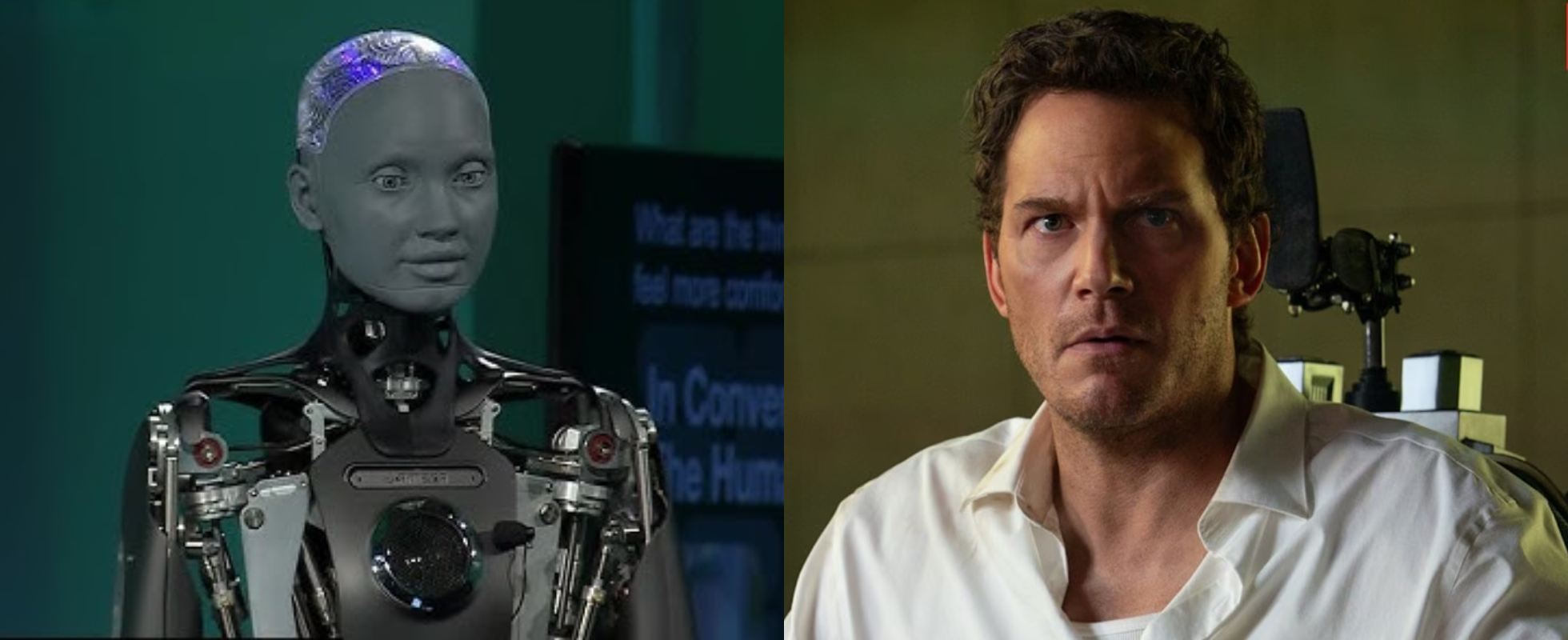
When Chris Pratt pitched the idea of using artificial intelligence to portray the antagonist in his latest science fiction thriller “Mercy,” the response from his collaborators was swift and unanimous: absolutely not.
The actor recently revealed to Entertainment Weekly that during early discussions about casting, he floated the concept of having an AI “actor” take on the role of the tyrannical AI judge at the center of the film’s narrative. The suggestion was quickly dismissed by everyone involved in the production.

“I remember talking about the various people who could play these characters, and early on, I was like, ‘Should we have it be an AI, where the judge is actually AI, and we create an AI?’ And everyone was like, ‘No, I don’t think so,'” Pratt explained. “I was like, ‘Yeah, I don’t think that’s a good idea at all.'”
Instead of pursuing the experimental approach, the production ultimately cast Rebecca Ferguson in the pivotal role, allowing a human performer to bring depth and nuance to the character.
Pratt acknowledged that the idea never progressed beyond the initial brainstorming phase. “So it was actually never a possibility any more than anything is a possibility when you’re zeroing in on what the outcome is going to be and what the choices are that you’re going to make. It’s a collaborative effort,” he said.
The AI pitch wasn’t Pratt’s only unconventional suggestion during the planning stages. He also proposed a scenario where his character could select any judge he wanted, since the character ultimately appears as a face on a screen.
“But one of my pitches early on was like, ‘What if [my character] could pick the judge, and I could pick Oprah, or I could pick anyone I want. Because ultimately it’s just a face on a [screen].’ And I thought that would be funny to have Oprah do it,” he recalled.
Amazon MGM’s “Mercy” places Pratt in the role of Chris Raven, a law enforcement officer from the near future who finds himself on trial for his wife’s demise. Ferguson’s AI judge character gives him just 90 minutes to establish his innocence or face immediate consequences. Annabelle Wallis also stars in the film.
Given the narrative’s focus on the oppressive potential of artificial intelligence, questions about the technology became a central topic during the promotional campaign. At the New York premiere, Pratt expressed confidence that synthetic AI won’t replace human actors anytime soon.
“I don’t feel like someone’s gonna replace me that’s AI,” Pratt told Variety. “I heard this Tilly Norwood thing, I think that’s all bulls**t. I’ve never seen her in a movie. I don’t know who this bi**h is. It’s all fake until it’s something.”
The debate about artificial intelligence in Hollywood extends far beyond Pratt’s film. Industry veterans have expressed growing concerns about how technology might reshape creative work. Ben Affleck recently discussed AI’s limitations in a podcast, arguing that the technology fundamentally lacks the capacity for genuine artistic expression.
“If you try to get ChatGPT or Claude or Gemini to write you something, it’s really bad,” Affleck said. “By its nature, it goes to the mean, to the average.”
Affleck doesn’t believe AI will develop the capability to craft meaningful narratives or create films independently. “I don’t think that’s going to happen,” he stated. “I think it actually turns out the technology is not progressing in exactly the same way they sort of presented it.”
While Affleck sees potential for AI as a tool in specific technical applications, comparable to visual effects technology, he emphasized that it cannot replicate the human element of performance. Matt Damon reinforced this point by discussing how authentic performances draw from genuine life experiences that no algorithm could simulate.
“That is an artist. That’s a piece of art that comes out of lived human experience,” Damon said, describing a powerful scene from Dwayne Johnson’s recent work.
For now, audiences watching “Mercy” will see Rebecca Ferguson’s performance, not a computer-generated AI.