
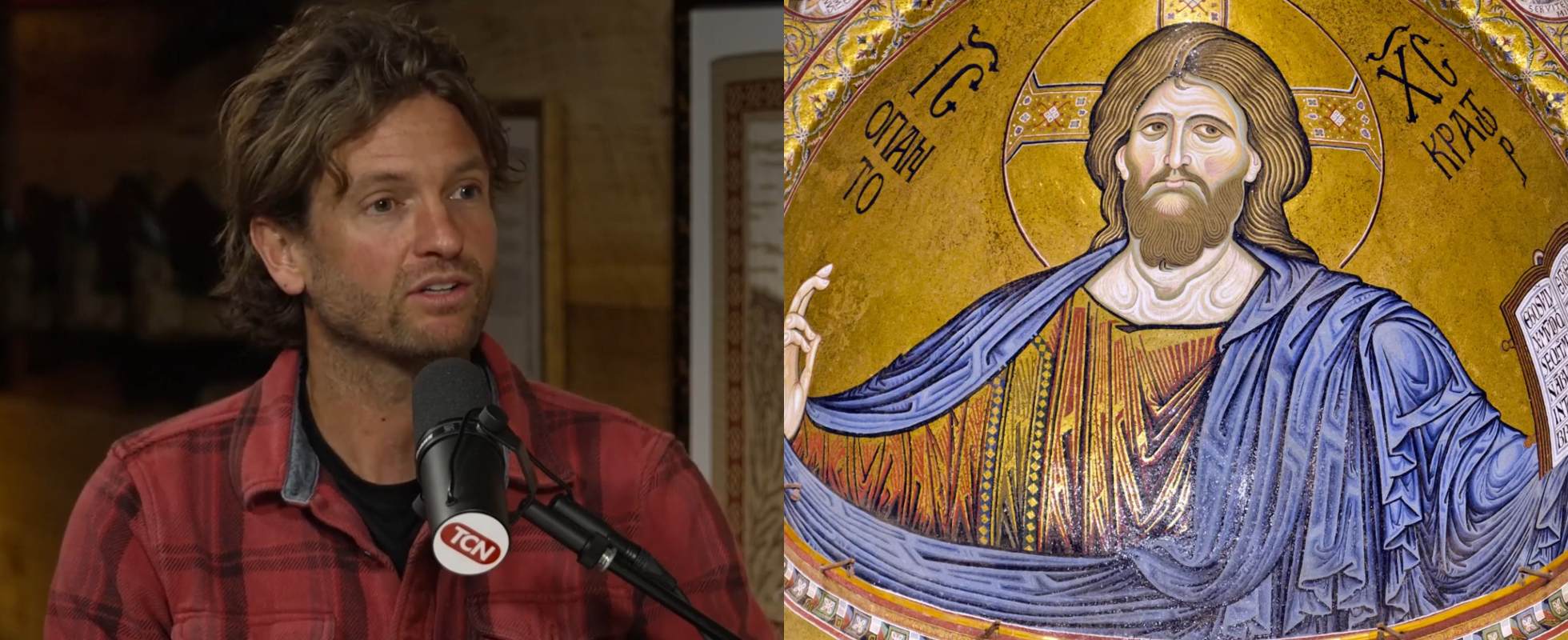
During a conversation on Tucker Carlson’s program, guest Nathan Apffel made a direct argument about the relationship between Christianity and capitalism, stating that the two systems are fundamentally incompatible.
Apffel put it plainly: “Capitalism should not be anywhere near Christianity.”
He went further, making a distinction that he acknowledged carried some political weight: “Christianity is more, and I don’t like the word socialist with the weight it carries, but Christianity is socialism at its core. It’s the marker to build social capital.”
To support this claim, Apffel pointed to the early church described in the Book of Acts as his primary evidence. He stated, “You look at that early church of Acts, and it transformed Rome within a couple hundred years, the greatest superpower of its time, to where Constantine was like, I’m a Christian hanging out with these dudes. They had no money, they had no buildings, but somehow the love of their neighbor transformed the greatest superpower of its time.”
Carlson pushed back gently, asking about greed as the more straightforward explanation for what he was observing in institutional Christianity. Apffel agreed that greed was part of it, but maintained his structural argument, pointing to what he called the “rugged American individualistic experience,” a phrase he attributed to reformation thought expert Carl Trueman, as something that has had what he described as detrimental effects on Christianity.
Apffel argued that capitalism had crept into the church through the nonprofit legal architecture established in 1913, the same year the federal income tax was created. He described how that structure, combined with religious exemptions, created a system with no external accountability, one that he said inevitably bends toward self-preservation and financial accumulation rather than serving the poor.
“The church was never meant to be a capitalistic endeavor,” Apffel said. “But capitalism has crept into it and shrewd, smart businessmen and women and lawyers have realized it is the perfect legal architecture to either scam people or build empires in the name of Jesus.”
He described how churches that began with genuine missions have, over time, redirected their energy inward. He stated, “Naturally, what does that do? If I’m bringing everybody into my church, hierarchy starts building. We need resource to do this.”
Apffel contrasted this with what he described as the outward nature of the original Christian message. “The beautiful part about Christianity is it was an outward gospel,” he noted. “It was help your neighbor. It was go out and make disciples. Of course, Jesus sends the disciples out. But now it’s come in.”