The tech billionaire has turned his attention to a controversial claim, that organizations receiving taxpayer money to combat homelessness may actually have a financial stake in the problem continuing.
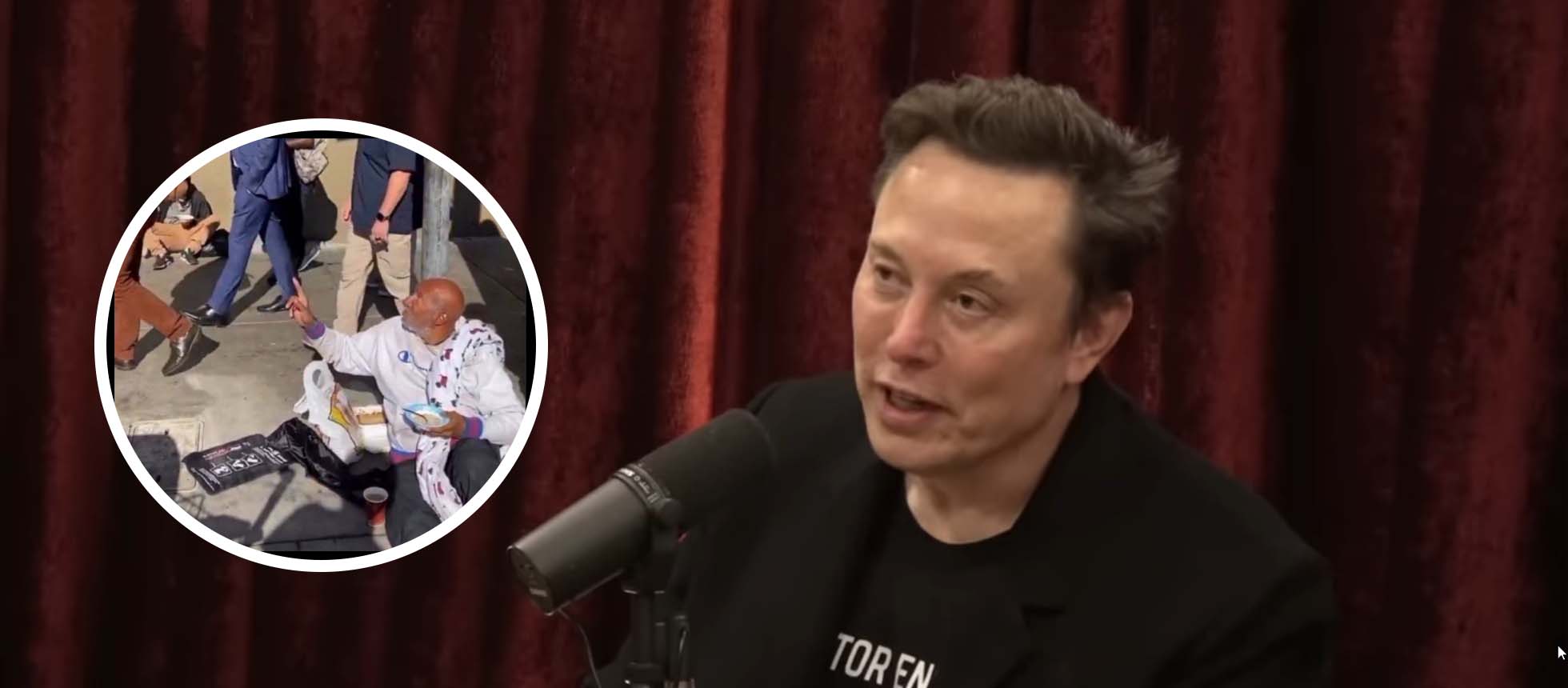
Speaking on the Joe Rogan Experience, Elon Musk outlined what he sees as a fundamental flaw in how government addresses social challenges through nonprofit organizations. His central argument revolves around the structure of NGOs themselves.
“The whole NGO thing is a nightmare,”
“And it’s a misnomer because if you have a government-funded non-governmental organization, you’re simply a government-funded organization. It’s an oxymoron.”
The Tesla CEO’s critique centers on what he describes as a system operating outside normal accountability measures. According to Elon Musk, these entities function as government extensions while avoiding the legal restrictions and oversight that would apply to direct government agencies. This creates what he characterizes as a loophole that sophisticated political operatives have learned to exploit.
Musk pointed to a specific pattern, wealthy donors can establish nonprofits with relatively modest initial investments then lobby politicians to direct substantial government grants toward those same organizations. The organizations then receive ongoing public funding year after year often with minimal scrutiny of their actual results.
“It’s a gigantic scam, one of the biggest, maybe the biggest scam ever,”
Recently on social media platform X, Elon Musk elaborated on how this dynamic specifically impacts homelessness policy.
“If you pay organizations per homeless person, you get more homeless people and the NGOs fight hard to maximize the homeless population,”
“Whatever you incentivize will happen.”
This theory draws on basic economic principles about incentive structures. When organizations receive funding based on the scale of a problem solving that problem completely would eliminate their reason to exist and their revenue stream. This creates a misalignment between stated mission and organizational survival.
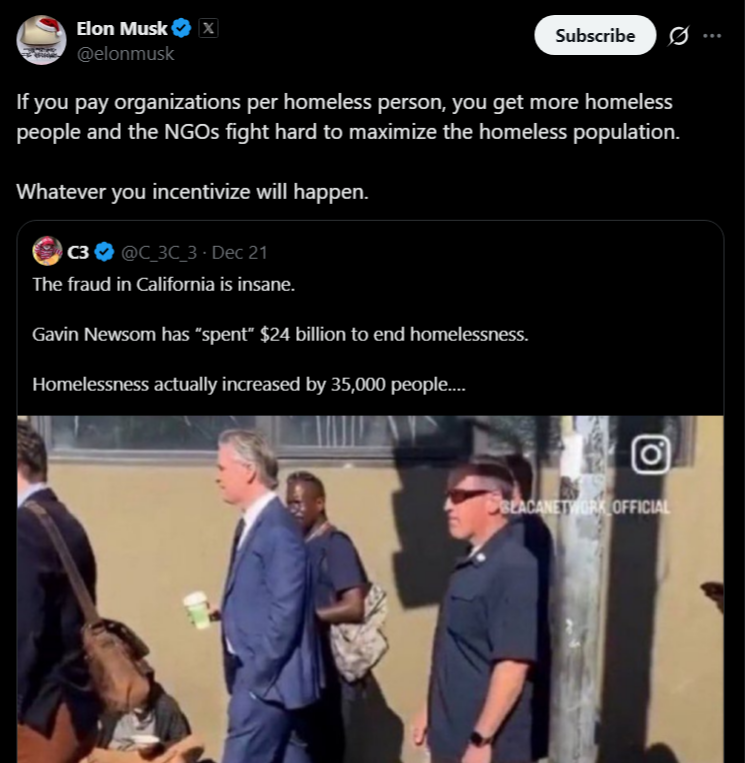
Musk referenced California’s struggles as evidence. The state has directed billions toward homelessness initiatives yet the problem has grown rather than diminished. According to recent data cited on social media despite spending $24 billion California’s homeless population actually increased by 35,000 people.
During the podcast Musk acknowledged that these organizations do provide some legitimate services.
“It’s not like zero percent good,”
“If it was really zero percent good it would be much easier to attack. So they’re going to be some percent good that they add in there, but it’s like it might be five percent or 10 percent good but 90 to 95 percent not.”
The entrepreneur also described how these organizations often adopt benign-sounding names.
“like the institute for peace or something like that,”
He argued that this masks what he believes is their true function as vehicles for directing public money without proper accountability.
What makes this system particularly difficult to reform according to Musk is its complexity and opacity. Thousands of interconnected nonprofits have emerged creating a web that’s challenging to trace and even harder to hold accountable. Unlike government agencies required to pass audits and justify expenditures these entities operate in what Musk described as a gray zone.
The criticism raises uncomfortable questions about how America tackles persistent social challenges. While private nonprofits can sometimes offer flexibility that government bureaucracies lack Musk’s argument suggests the current arrangement has created something different, organizations that spend taxpayer money without facing the checks and balances designed for public spending.
Whether this critique will prompt legislative action or policy changes remains uncertain. However Elon Musk’s platform and willingness to challenge established systems means his perspective is reaching millions of people who may not have previously considered these structural questions about nonprofit funding and accountability.