
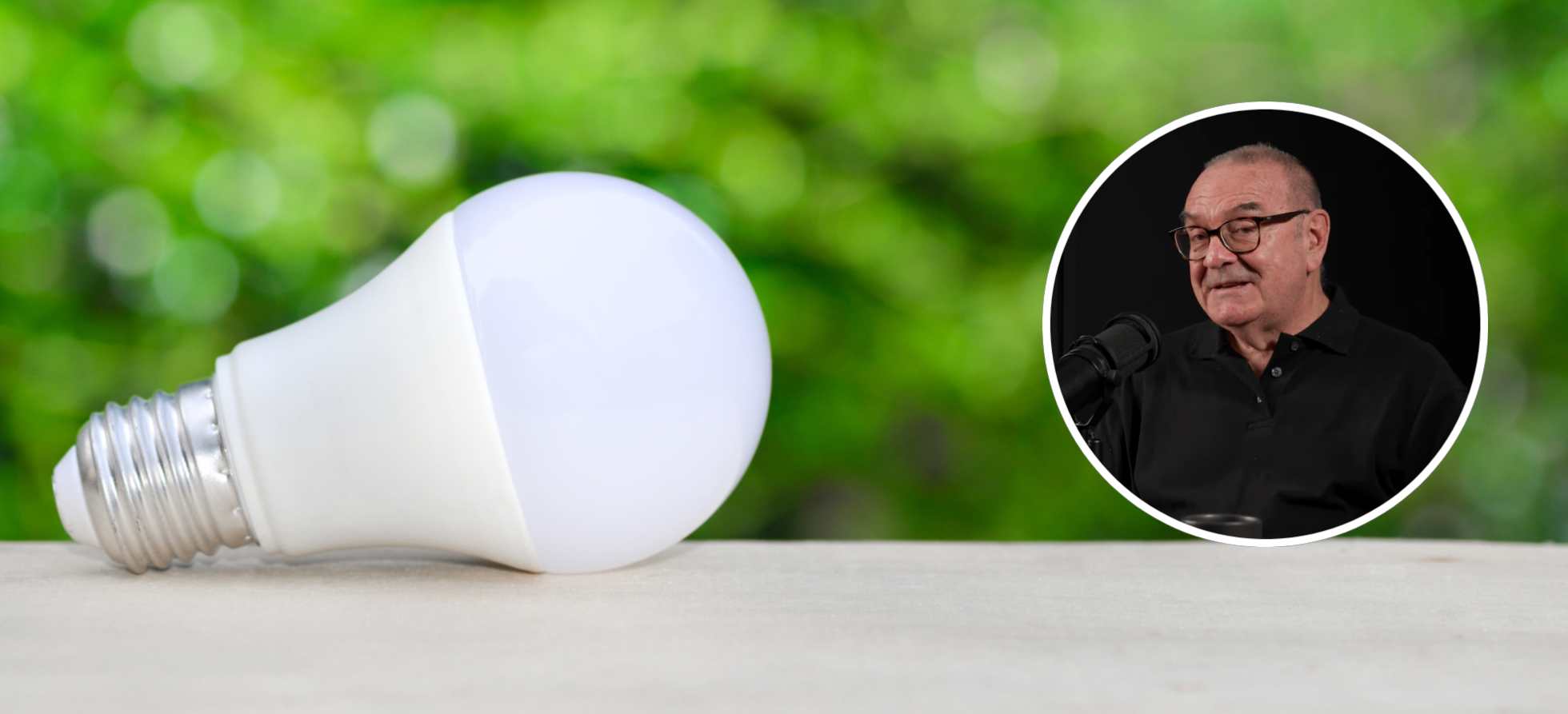
In a striking warning that challenges our modern lighting infrastructure, Dr. Glenn Jeffrey, a professor of neuroscience at University College London, has declared that LED lighting may pose a public health crisis comparable to asbestos exposure.
Speaking on the Huberman Lab podcast, Dr. Jeffrey didn’t mince words: “This is an issue on the same level as asbestos. This is a public health issue and it’s big.”
Dr. Jeffrey’s concern centers on the dramatic shift in our light environment that occurred in the early 2000s when energy-efficient LED bulbs began replacing incandescent lighting. While LEDs save energy and reduce costs, they emit a spectrum of light fundamentally different from what humans evolved under for billions of years. The problem lies in their heavy concentration of short-wavelength blue light and near-complete absence of long-wavelength red and infrared light.
Through laboratory research, Dr. Jeffrey and his colleagues have observed alarming effects when exposing mice to LED lighting at typical indoor intensities. The mitochondria—the powerhouses of our cells—show measurable decline in real time. “We can watch the mitochondria gently go downhill,” Dr. Jeffrey explained. “They’re far less responsive. Their membrane potentials are coming down. The mitochondria are not breathing very well.”
The consequences extend beyond cellular function. Mice under LED lighting gained weight, developed fatty livers, and showed signs of chronic low-grade inflammation. Their organs became smaller, including hearts, kidneys, and livers.
Even reproductive health suffered, with sperm showing abnormal morphology and swimming capacity. Most disturbingly, these animals consumed the same food as their counterparts under full-spectrum lighting—the only difference was their light environment.
Dr. Jeffrey pointed to a troubling correlation in human health data: after decades of steadily increasing lifespans in Western Europe, the trend began flattening around 2010, coinciding with widespread LED adoption. While he stops short of claiming causation, he and his colleagues believe this warrants serious investigation.
The solution, according to Dr. Jeffrey, doesn’t require expensive interventions. Simple halogen or incandescent bulbs—which emit a full spectrum similar to sunlight—can help restore balance. Even better is maximizing natural sunlight exposure and incorporating plants around buildings, as plant matter naturally reflects beneficial infrared light. For those on tight budgets, even strategic use of candlelight can provide supplementary long-wavelength exposure.
Dr. Jeffrey emphasized that early intervention matters most. Once disease processes advance significantly, light therapy shows diminished effects. This makes the widespread exposure of children to LED-rich environments particularly concerning, especially given emerging evidence linking inadequate long-wavelength light exposure to rising myopia rates.
As modern architecture increasingly features infrared-blocking glass and relies exclusively on LED lighting, Dr. Jeffrey warns we may be creating a “double whammy” that systematically undermines mitochondrial function.