

A French Navy officer set out for a morning run on March 13, 2026, covering just over 7 kilometers in roughly 35 minutes aboard the deck of one of the world’s most powerful warships. By the time he finished, he had unwittingly broadcast the real-time position of France’s flagship aircraft carrier, the Charles de Gaulle, to anyone curious enough to open a fitness app.
According to sources, the officer was identified in an investigation under the pseudonym Arthur. He had recorded his workout using a smartwatch linked to Strava, a popular fitness tracking platform. His profile was set to public.
Within moments of syncing, his GPS data appeared on Strava’s global activity map, and the carrier’s location in the Mediterranean Sea, northwest of Cyprus and approximately 100 kilometers from the Turkish coast, was visible to the world.
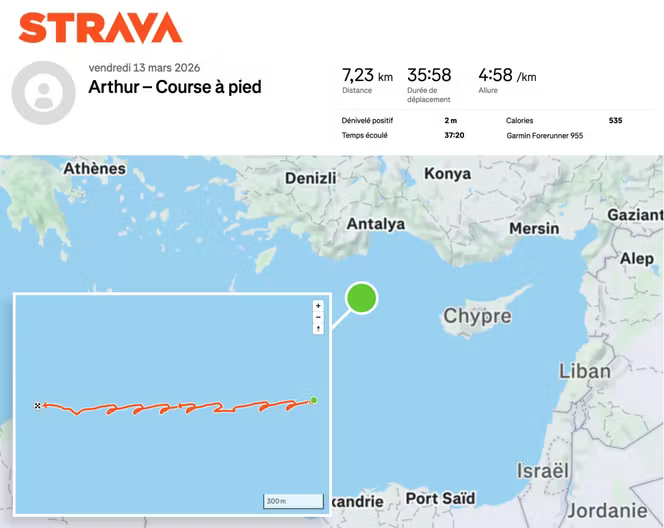
Rather than tracing a path across land or a fixed course, the track curved in open water, a pattern consistent with someone circling a moving ship’s deck.
Journalists were then able to cross-reference the data with satellite imagery, which placed the Charles de Gaulle roughly six kilometers from the recorded Strava route approximately one hour after the run was completed.
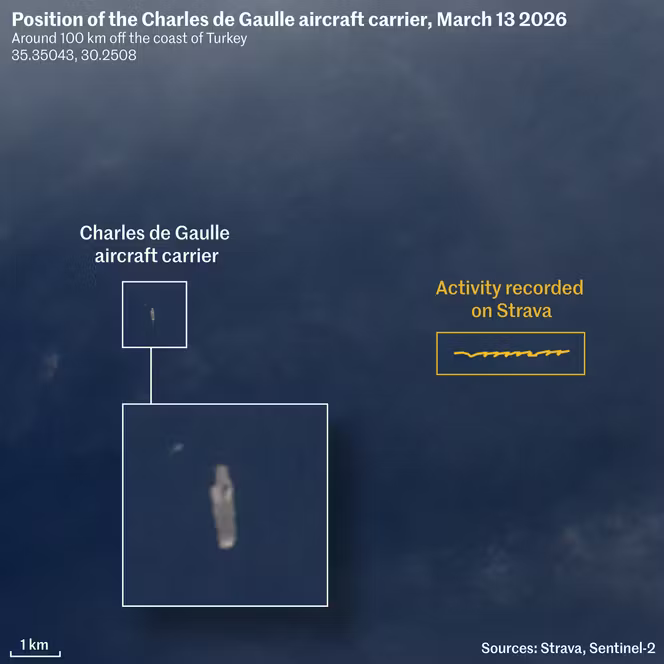
The French strike group at the time was not traveling alone. The carrier was accompanied by at least three frigates and a support vessel, forming a formidable naval contingent that President Emmanuel Macron had ordered to the Middle East following a period of heightened regional tensions involving the United States, Israel, and Iran. The outline of the mission was already known to the public. What was not meant to be known was exactly where the carrier was positioned at any given moment.
Even when a deployment is announced, precise and near real-time location data is among the most closely guarded categories of information. French military authorities confirmed that sharing such data violates operational guidelines, stating that personnel are regularly briefed on “digital hygiene” and that action would be taken.
Arthur was not alone. At least one additional sailor was identified posting geolocated activity from what appeared to be inside military vessels, with some profiles even including photographs taken aboard ships. The pattern suggests the problem extends well beyond a single momentary lapse.
This is not the first time consumer fitness technology has created headaches for the French armed forces. A string of similar incidents in 2024 and 2025, collectively referred to as “StravaLeaks,” exposed the movements of security personnel attached to world leaders, as well as the patrol patterns of French naval submarines. In each case, the French Navy characterized the breaches as individual negligence rather than any structural failure in its security framework.
That framing, however, is increasingly difficult to sustain. The Charles de Gaulle incident arrived despite years of documented warnings and repeated internal briefings. T
The challenge facing modern militaries is not a new one, but it grows more pressing with each generation of wearable technology. Smartwatches, fitness bands, and GPS-enabled devices generate a constant stream of location data as a byproduct of ordinary daily life. S
France is already planning for the long term. The Charles de Gaulle, which has served as the centerpiece of French naval power for over two decades, is slated to be replaced by a next-generation carrier called the France Libre, expected to enter service around 2038.