In a groundbreaking moment for anthropology and conservation, naturalist Paul Rosolie has shared the first-ever extended footage on a recent episode of Lex Fridman’s podcast. During the conversation, he talked in detail about an encounter with the Mashco Piro, one of the world’s last uncontacted tribes, during his recent appearance on the Lex Fridman Podcast.
The encounter, which occurred in October 2024 along Peru’s Las Piedras River, represents a historic first. “This is a world first,” Rosolie confirmed before revealing footage that has never been shown publicly. The recording captures members of the Mashco Piro emerging from the deep Amazon rainforest in what Rosolie describes as an unprecedented peaceful contact attempt.
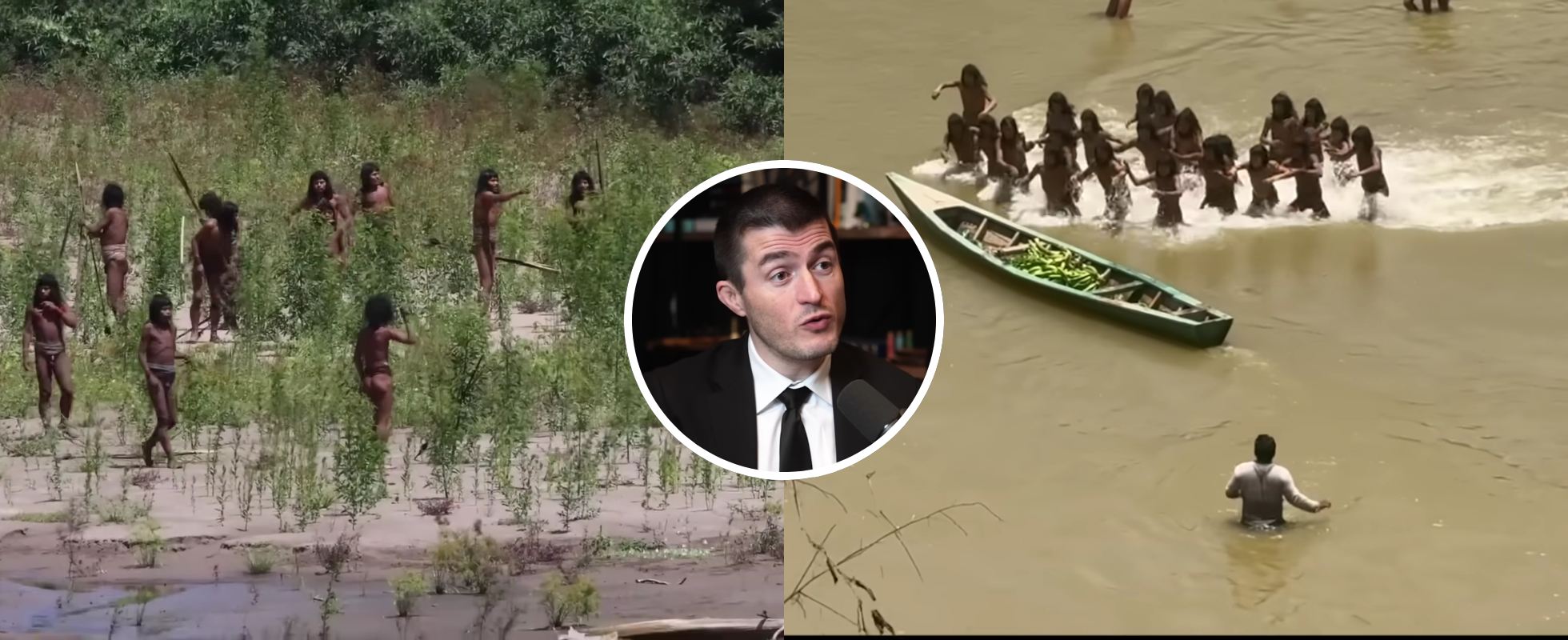
The footage shows warriors carrying seven-foot bamboo arrows, moving cautiously down a beach while local indigenous people and the Jungle Keepers team watched with a mixture of fear and fascination. “At any moment an arrow could just fly through your neck,” Rosolie explained, describing the tension of the moment. “They can hit a spider monkey out of the treetops at 40 meters. They can sneak up and you will never know they’re there.”
The encounter began after Rosolie’s conservation organization, Jungle Keepers, received an urgent satellite phone call from an indigenous community upriver. Despite initial skepticism, Rosolie and his team made a grueling overnight boat journey, condensing what normally takes two days into a single night of travel through lightning storms and torrential rain.
What makes this footage particularly significant is the level of detail it captures. The tribe members, numbering around 50, wore minimal clothing and carried enormous bows with razor-sharp bamboo-tipped arrows. Some wore mysterious containers around their necks, possibly made from Brazil nuts and animal teeth, the purpose of which remains unknown even to anthropologists who have reviewed the footage.
During the encounter, the tribe communicated using a word that may represent their self-designation: “Namole,” meaning “brothers” in a related dialect. An anthropologist present at the scene, named Romel, attempted communication by offering boatloads of plantains as peace offerings. The video shows tribe members rushing to claim the bananas while simultaneously sending women to raid farms behind the main group, demonstrating sophisticated tactical coordination.
The interaction revealed fascinating details about the tribe’s technology and worldview. They possess no metal tools, no knowledge of agriculture, and live entirely from hunting monkeys, turtles, and small game. “They don’t know that water freezes, because they’ve never seen it,” Rosolie noted. “They don’t know that water boils, because they don’t even make clay pots.”
Perhaps most poignant was the tribe’s central concern: “Why are you cutting down the trees?” According to Rosolie, the massive ironwood trees, some over 1,000 years old, hold profound spiritual significance for the Mashco Piro. “They see us as the destroyers of worlds,” he explained.
The encounter took a darker turn just one day later. After what appeared to be a successful peaceful contact, tribe members ambushed a boat carrying local residents, firing arrows at the occupants. One man, George, who had been friendly and confident during the initial meeting, was struck by a seven-foot arrow that entered above his shoulder blade and emerged near his belly button. He survived only through emergency evacuation.
This violence underscores the complexity and danger surrounding any contact with the Mashco Piro. Rosolie believes their aggressive response to outsiders stems from historical trauma. “Their grandparents must have told them, ‘When the outside world comes, you shoot first. That’s the only thing that’s gonna keep you alive,'” he said, referencing encounters with rubber barons in the late 19th and early 20th centuries.
The footage and encounter have profound implications for conservation efforts. Jungle Keepers has now protected 130,000 acres of rainforest along the Las Piedras River, with the goal of securing an additional 200,000 acres. This territory represents the last refuge for the Mashco Piro and several other nomadic groups who wish to remain isolated from modern civilization.
“We realized that along with the butterflies and the monkeys and the jaguars and the trees and the ecosystem, there’s also a human culture that will, in the next few years, cease to exist, that will be exterminated if we don’t protect them,” Rosolie said.
The area faces mounting threats from narco-traffickers building airstrips, illegal loggers, and gold miners. Rosolie himself now has a price on his head, with intercepted communications revealing that cartel members have been ordered to eliminate him and his colleague if encountered.
Despite these dangers, Rosolie remains committed to protecting what he calls “the last great jungle.”


