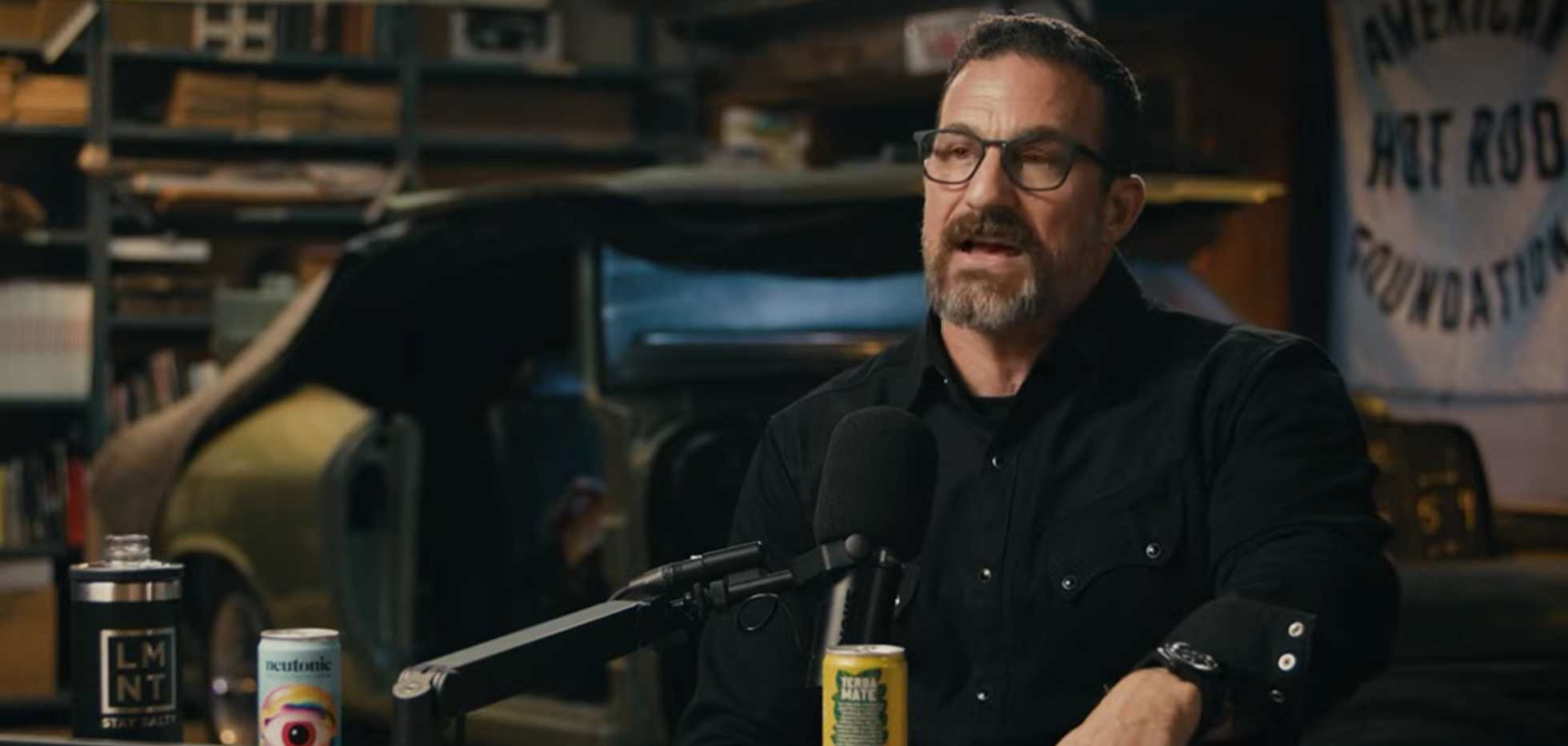
Neuroscientist Andrew Huberman recently opened up about his spiritual journey in a lengthy conversation with Chris Williamson, revealing how faith has transformed his approach to life’s challenges and brought him a sense of peace he had never experienced before.
During their discussion about breaking bad habits, Huberman acknowledged the profound limitations of pure neuroscience when it comes to understanding human resilience. “When we’re talking about breaking bad habits, overcoming immensely difficult scenarios that normally would throw people into complete self-destruction or just giving up, which is a bad habit in its own right, it’s as if the top-down control is so immense, like the going against oneself that’s required is so immense that when people hand that over to God, whether or not it’s Christ or whether or not some other form of God that they are attached to, it seems as if they get some relief from the process and yet it’s very effective.”
He continued, “And you can’t deny this, right? Just as a phenomenon. I mean, let’s take off our hats as scientists and people who kind of parse things. How could it be that the thing that’s hardest for humans to do for themselves becomes far easier when they stop trying to do it for themselves? It’s a wild mindbend that neuroscience doesn’t really understand.”
Huberman pointed specifically to addiction recovery as an area where belief in something greater proves essential. “The notion of a higher power is central to almost every alcoholic at least who goes through AA getting sober. It’s almost a prerequisite. And in some sense, it is a prerequisite. And it’s so brilliant that it is because it takes away the need for constant top-down control. You give that over to something else, this notion of a higher power.”
He explained how this operates differently for different people: “For some people that’s God. For some people it’s Christ. For some people it’s just general higher power because 12-step is very agnostic as to what people consider higher power.”
Perhaps most striking was Huberman’s candid discussion of his own spiritual practices and their impact on his life. “It’s helped me tremendously. I mean I’m in a very serious prayer practice daily now, every night before I go to sleep without fail. I’m going on a couple years now where I’ve not missed a single night. I’ll get out of bed if I fall asleep and do that.”
He acknowledged the uncertainty inherent in faith while emphasizing its practical benefits: “Let’s say it’s just purely neurobiological. Let’s say there’s nothing outside of us in the real sense. I don’t believe that. But let’s just assume for a moment. Well, then my neurobiology seems to be responding to all this very well. And I don’t think I’m alone with that.”
Huberman made a bold statement about human limitations: “I think there are too many burdens in life for anyone to be able to navigate life extremely well without these notions of higher power. I don’t think people can do it.”
He continued: “And you could show me the most successful, wealthiest people in the world and I would say yeah, but they are highly deficient in this area. Not because I’m judging them, right? We all are deficient in some area, but it must be, it has to be because there’s this huge gap in the knowledge set.”
The scientist noted how religious texts address human nature in ways that align with our biological realities. “I think it is not a coincidence that the Bible writes in these kinds of things about sins and virtues and the need not just for good works but avoiding sin and acknowledges in some sense that it’s in some cases near impossible for people to do on their own.”
He pointed out the practical wisdom in this approach: “And yes, community can help and yes, reward processes can help. And yes, punishment can help. These all work. We know this. You can see this in animal learning studies where humans are different is that they can, as far as we know, humans are unique in their ability to give this top-down restriction process over to some other entity. And it makes it easier not harder and it makes it more concrete somehow not more abstract.”
When celebrating his 50th birthday, Huberman reflected on what he wished he had done differently. “The one thing that I wish that I had done earlier was to stop resisting the voice in my head that said, I think there’s a God and I’m going to pray. I kept pushing that away. I was like, it’s incompatible with my notion of what it meant to be a scientist. It was just incompatible with things. I just kept pushing down and yet at the same time wishing for it.”
The transformation he experienced was profound. “I’m 50 and for the first time in my life, my entire life, I’ve experienced sustained times of real deep peace. Like just peace, like just the like everything’s okay, everything is as it should be, not just some little mantra that you say when you’re on the Big Sur coast. And why? I think it’s because I stopped fighting so hard to try and control everything inside me and in my life and as a consequence everything has become much easier. Still challenging but much easier.”
Huberman emphasized that his spirituality involves active engagement, not passive acceptance. “It’s 100% because of giving over to notion of higher power. I’m very direct about it. God is higher power for me, right? Reading the Bible, this kind of thing, prayer. I mean these are practices. This isn’t just ‘I believe in God.’ These are practices. Those are faith-based practices.”
He described the comprehensive impact: “And it’s become a source of immense intellectual stimulation for me and also just relaxation. And it’s really, it’s my wish for anyone that’s struggling or doing well because I’m certain that it holds so much power.”
Even with his scientific training, Huberman acknowledged the limits of mechanistic explanations. “Even if it turns out and I’ll never know but even if it turns out that it’s all filtered through standard neurobiological mechanisms, okay, I’m good with that but in the meantime, like I’m going to keep praying.”
He pointed to the universality of this experience across human history: “People are pretty irrational, but at the same time, humans are also pretty miraculous in what they’re able to build and develop. And this whole thing of God and religion has not been discarded. If anything, it’s growing.”
This spiritual turn comes against the backdrop of a very public controversy that briefly threatened to derail Huberman’s carefully cultivated image. According to a New York Magazine cover story, Andrew Huberman’s carefully curated image as a disciplined, ascetic optimizer sharply contrasts with allegations about his private life.
The piece claims that while in a long-term relationship with a partner identified as Sarah, Huberman was simultaneously involved with at least five other women, many of whom were unaware of each other. Former partners also accuse him of rage issues and reckless behavior, allegations he denies.
After the backlash, observers noted a visible shift in Huberman’s public persona: he appeared more frequently in adjacent “manosphere” circles and developed a notably close rapport with figures like Lex Fridman, with whom he shares long, philosophically inclined conversations.