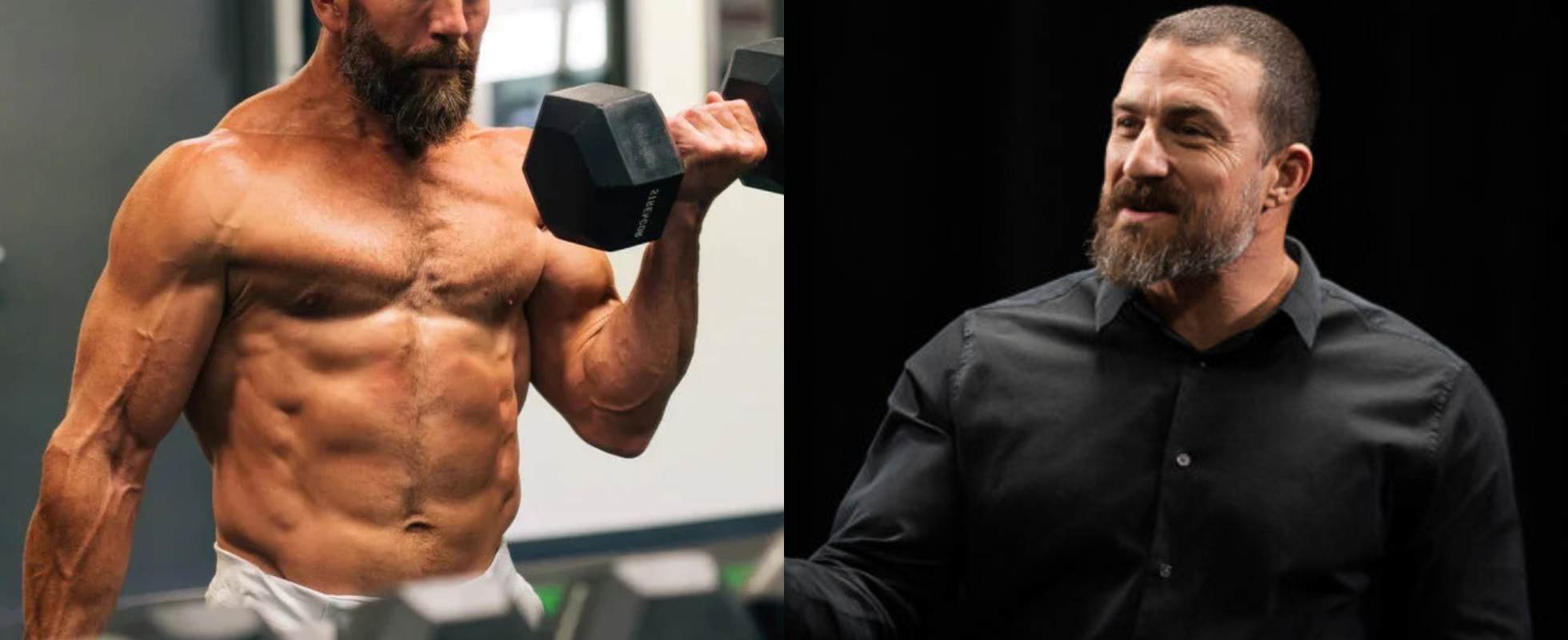
Stanford neuroscientist Andrew Huberman found himself on the defensive this week after a wave of audience skepticism followed his increasingly enthusiastic public commentary on peptides, forcing him to issue multiple denials of any financial ties to the pharma or peptide industries.
The clarifications came after a noticeable shift in Huberman’s tone on the subject prompted followers to question whether something more than scientific curiosity was driving his recent posts.
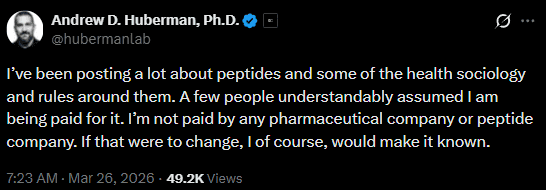
In a direct statement on X, Huberman addressed the speculation head-on: “I’ve been posting a lot about peptides and some of the health sociology and rules around them. A few people understandably assumed I am being paid for it. I’m not paid by any pharma company or peptide company. If that were to change, I of course, would make it known.”
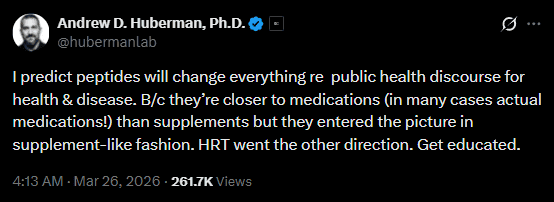
That post arrived shortly after he had published a sweeping prediction about where the science is heading: “I predict peptides will change everything re public health discourse for health and disease. Because they’re closer to medications, in many cases actual medications, than supplements but they entered the picture in supplement-like fashion.”
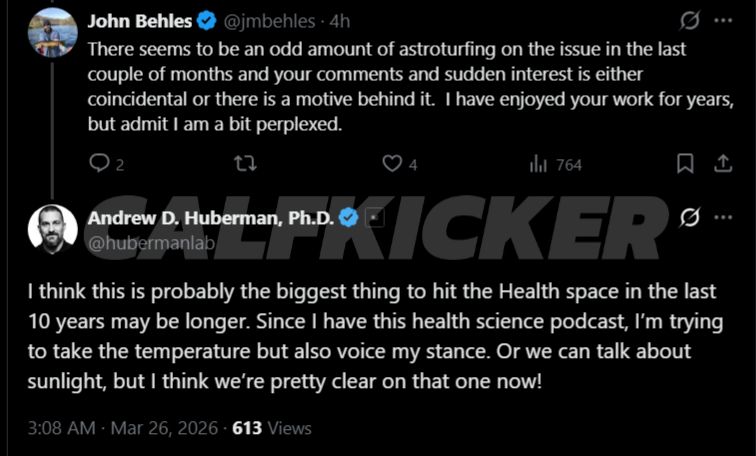
The denials did little to quiet the skepticism entirely. One follower, John Behles, replied directly to Huberman: “There seems to be an odd amount of astroturfing on the issue in the last couple of months and your comments and sudden interest is either coincidental or there is a motive behind it. I have enjoyed your work for years, but admit I am a bit perplexed.”
Huberman responded by framing his engagement as a natural extension of his platform: “I think this is probably the biggest thing to hit the health space in the last 10 years, maybe longer. Since I have this health science podcast, I’m trying to take the temperature but also voice my stance. Or we can talk about sunlight, but I think we’re pretty clear on that one now.”
What has drawn attention is not simply that Huberman is discussing peptides, but the trajectory of how he has been doing it. His commentary has evolved from relatively cautious mentions embedded in broader health topics to increasingly specific predictions and endorsements.
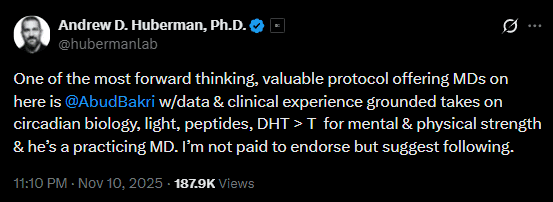
In one post, he publicly flagged Dr. Abud Bakri as “one of the most forward thinking, valuable protocol offering MDs on here” with expertise in peptides, while making a point of adding that he was “not paid to endorse.”
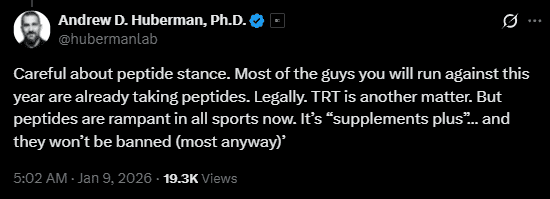
In another, responding to an athlete concerned about competition, he wrote: “Careful about peptide stance. Most of the guys you will run against this year are already taking peptides. Legally.” He went further in a separate post, stating plainly: “I get asked about peptides almost every week by pro and other athletes. It’s rampant right now.”
He has also ventured into regulatory territory, predicting in February that compounding pharmacies would still be permitted to produce and sell peptides, and speculating that the gray market was “about to get crushed.”
Then in April, in a post where he again disclaimed any financial stake, he offered specific picks for what he called “2026 takeover” compounds: GLP-1, Pinealon, and SS31.

His posts denying financial involvement have appeared in reply threads.
The scrutiny around Huberman’s peptide commentary arrives as the regulatory and commercial environment around these is becoming increasingly contentious. Healthcare entrepreneur Brigham Buhler, appearing on Joe Rogan’s podcast episode, laid out what he described as a fundamental hypocrisy at the heart of Big Pharma’s lobbying against compounded peptides.
According to Buhler, pharma giant Eli Lilly has been telling legislators that Chinese-sourced peptide ingredients are unsafe while simultaneously pursuing a major acquisition in that same market.
“In one breath, you’ve got big pharma companies saying, I’ll use Lilly again as an example because they’re the main culprit. Lilly is saying peptides are dangerous. They’re getting the API from China. We shouldn’t allow these compounders to make peptides,” Buhler said. “Meanwhile, Eli Lilly just signed a $7 billion deal to acquire a peptide company out of China.”
Buhler was clear that this wasn’t secondhand information. “What I have seen from being able to get behind the scenes and meet with lobbyists and legislators at the state and federal level is the lobbying power of big pharma is real. It’s real and it’s intense and it is not going away,” he said. “I know that’s what they’re telling these legislators because I’ve met with the legislators at the state and federal level.”
He also pushed back on the financial framing being used by pharma companies to characterize losses from compounders. “When Eli Lilly and Novo throw out a 7 billion number, where they’re cooking the books is they’re not telling legislators that a lot of that is gray and black market,” Buhler explained, adding context about the companies’ financial position: “Eli Lilly 7xed the value of their company, they’re worth $800 billion. They are literally worth more than most developed nations. This was the biggest blockbuster molecule in the history of the world. In the history of humanity, there has never been a drug that is this big of a blockbuster. The money was made 50,000 times over.”
As peptide access becomes a political battleground, health influencers with massive audiences occupy an unusual position: their commentary can shape public perception of such stuff that are simultaneously being regulated, lobbied against, and quietly acquired by the same companies making the safety arguments.
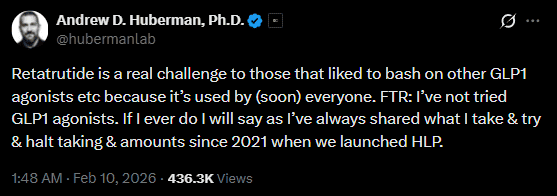
Huberman’s situation is further complicated by his earlier commentary on the related GLP-1 space. In February, he was asked to clarify whether he was personally using GLP-1 agonists after writing publicly about retatrutide and what he called the predictable path these compounds take from bodybuilding communities into Hollywood and then mainstream medicine.
He denied personal use at the time: “I’ve not tried GLP-1 agonists. If I ever do I will say as I’ve always shared what I take and try and halt taking and amounts since 2021 when we launched HLP.”
On TRT, he has been open for years, acknowledging in a recent post that “I talked about starting a microdose to move from mid-high to high ref range in 2021” and noting that his current interest has shifted toward peptides as potential alternatives: “Lately I’ve been talking about peptides that can replace TRT. But yeah, nothing new there.”
For a communicator who has built his brand around transparency and evidence, the need to keep repeating that disclaimer may itself be telling the story his audience is most interested in.