
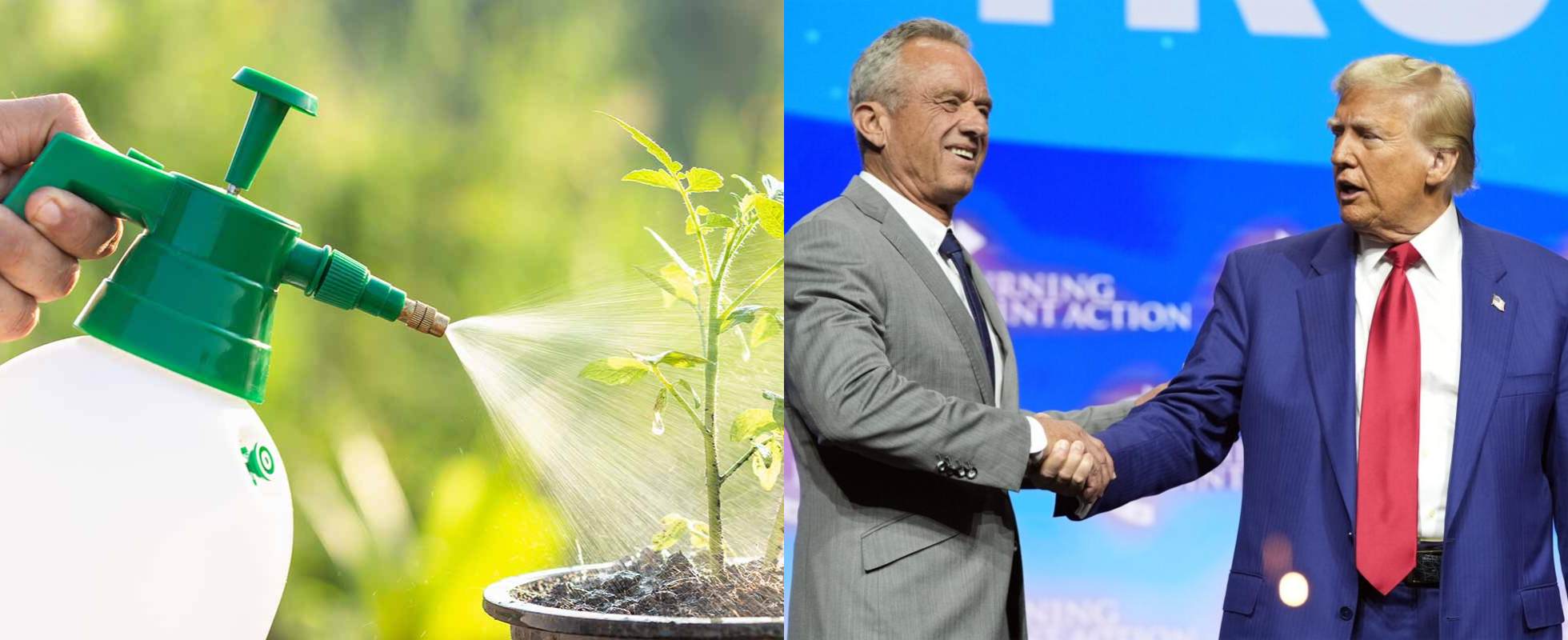
During his appearance on The Joe Rogan Experience, Robert F. Kennedy Jr. addressed the complex relationship between his decades-long initiatives against pesticides and his current role in the Trump administration, particularly regarding a recent executive order on glyphosate production.
Kennedy acknowledged the inherent tension in his position: “I’ve spent 40 years figh ting pesticides. I was part of the trial team on the Monsanto case, which was the team that, you know, we won three cases in a row and then got an 11 billion settlement with Monsanto.”
He made his personal feelings clear, stating, “Pesticides are poison. They’re designed to eliminate all life. It’s not a good thing to have in your food. So, it’s not something that I was particularly happy with. Let me put it that way mildly.”
However, Kennedy explained the national security rationale behind the executive order: “The president didn’t create this system. He’s dealing with a problem that was created long before over the past 60 years when through federal policies and subsidies and the management of farming in this country the agricultural management we have a**icted our farmers to these pesticides and particularly glyphosate.”
The scope of America’s glyphosate dependency is staggering. Kennedy revealed that “97% of corn in this country is produced with glyphosate and can’t be produced without it. 98% of soy is produced with glyphosate.”
He warned that banning it immediately “would destroy the American food system.”
The immediate concern driving the executive order, Kennedy explained, was Chinese control of the supply chain: “According to the industry reports, 99% of our glyphosate comes from China. So the Pentagon and others said this is a national security vulnerability that China controls the US food system.”
Kennedy emphasized that despite supporting the executive order for national security reasons, the administration recognizes the need for change: “We all know we’ve got to transition off of glyphosate. We all know that. And the farmers hate it.”
He detailed farmers’ concerns, including chemical-resistant weeds, expensive inputs, export restrictions from European countries, and soil degradation.
The health concerns Kennedy outlined were significant. “There’s a scientific association” between glyphosate and non-alcoholic fatty liver disease, though he noted it wasn’t strong enough for litigation. The successful lawsuits focused solely on non-Hodgkin’s lymphoma. Kennedy also explained that glyphosate “disrupts your gut biome” because “your stomach microbiome is plants.”
Particularly concerning is glyphosate’s use as a desiccant on wheat crops. Kennedy explained that “around 2003 they started using it to dry out the wheat just before harvest” and “for the first time, they were spraying it right on food.” He connected this timeline to the rise in celiac disease and gluten allergies, noting “around 2003 is when you started seeing these explosions in celiac disease and gluten allergies.”
Kennedy described the administration’s dual approach: addressing immediate security concerns while investing heavily in alternatives. “The president has made a big commit a billion dollar commitment not only the regenerate farming but also to developing new ways of dramatically reducing the amount of chemicals in our agriculture.”
He highlighted promising laser technology that can eliminate weeds without chemicals, resulting in “a 30% increase in productivity” with growing seasons shortened “by 3 weeks for onions.” One Texas onion producer reduced per-acre costs from $1,500 to $300 using this technology.
Kennedy concluded with cautious optimism about eliminating pesticides entirely: “I think technology is going to allow us that to happen.” However, he acknowledged fertilizer reduction would be “much slower” and admitted, “that’s going to be after my three years before that happens.”
Just days before the February 18 executive order, Robert F. Kennedy Jr. had publicly stated, “Well, I believe that glyphosate causes cancer,” reaffirming a position that has defined much of his four-decade environmental career.
Yet after Donald Trump invoked the Defense Production Act to boost domestic glyphosate and elemental phosphorus production, Kennedy defended the move in starkly different terms. In a statement to CNBC, he said, “Donald Trump’s Executive Order puts America first where it matters most: our defense readiness and our food supply… By expanding domestic production, we close that gap and protect American families.”
The decision also carries political consequences for Kennedy’s own Make America Healthy Again (MAHA) movement, which rallied voters around concerns about chronic disease, food safety, and chemical exposure. Glyphosate, the active ingredient in Roundup and the most widely used herbicide in U.S. agriculture, became a central symbol of those concerns.


