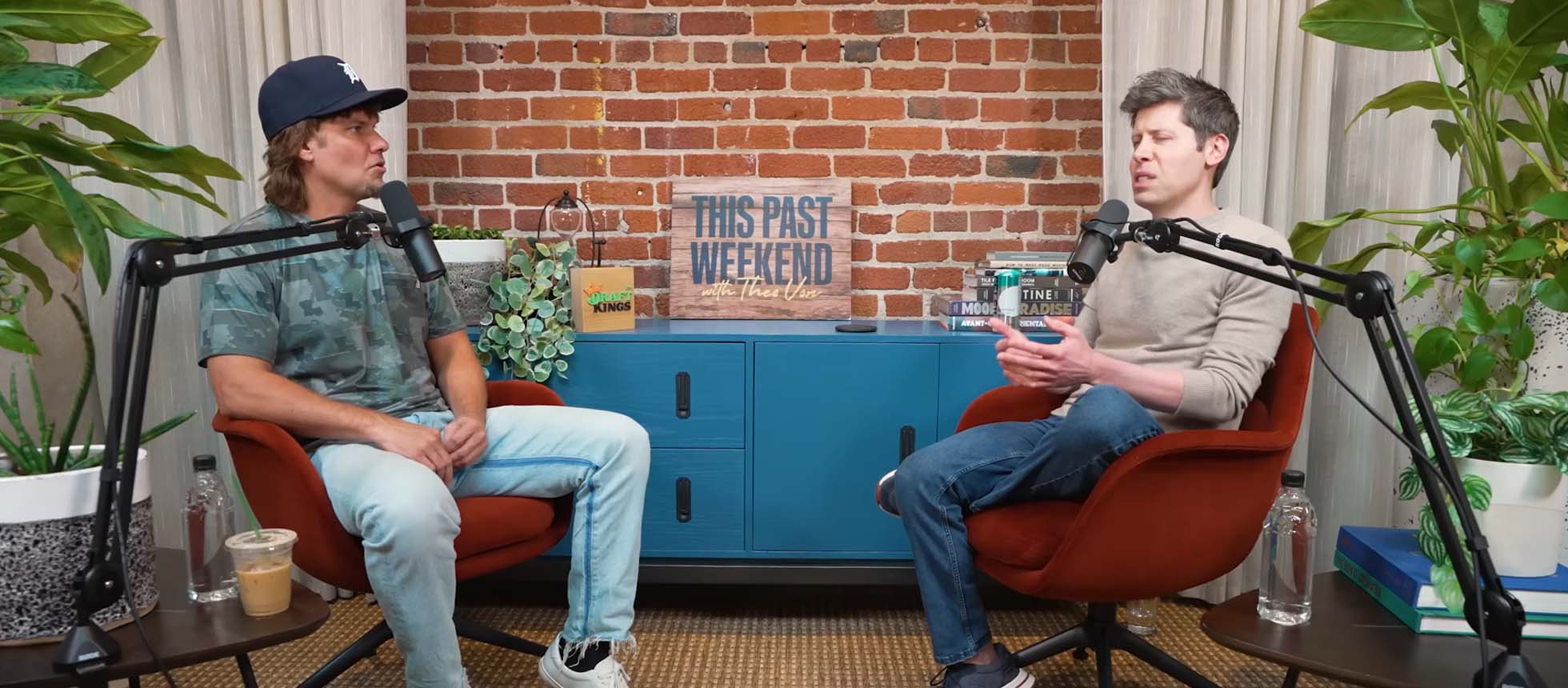
Sam Altman sat across from Theo Von in OpenAI’s surprisingly cozy San Francisco office, describing his four month old son’s rapid development with the same wonder he applies to artificial intelligence.
“Watching the speed with which he learns new things or gains new capabilities is just unbelievable,”
the OpenAI CEO said, admitting that the biological programming designed to make people love babies works perfectly on him too.
Beneath the new father’s joy lies a question that increasingly keeps people awake at night. In a world where AI can do everything humans currently do for work, how will people survive financially?
Altman does not shy away from the hard truth.
“There will be some jobs that totally go away,”
he acknowledged during the wide ranging conversation. Yet his perspective on human adaptability offers unexpected comfort.
He pointed to history’s pattern of technological disruption, reminding Von that people during the Industrial Revolution predicted mass unemployment when machines began doing physical labor.
“Everybody panicked and said there’s going to be no more jobs. And we figured out new stuff to want,”
Altman explained.
What looks like real work constantly evolves. Altman suggested that people from centuries past would look at today’s podcasters and tech CEOs and say,
“You guys are too rich. You’re wasting your time. You’re trying to entertain yourselves.”
Yet these roles feel intensely meaningful to those doing them.
When pressed on how people survive in an AI dominated economy, Altman outlined two scenarios. In the first, advanced AI systems become freely available to everyone, dramatically increasing individual productivity and earning power without requiring ownership of the underlying technology.
The second scenario is more complex. If most value creation happens through AI systems owned by a few companies, Altman believes society will demand new economic models. While he once championed universal basic income, his thinking has evolved.
“I don’t think it actually would be good for people”
to simply receive monthly checks, he said.
“What I would want is like an ownership share in whatever the AI creates so that I feel like I’m participating in this thing that’s going to compound and get more valuable over time.”
He outlined a radical idea, dividing global AI capacity into tokens with a portion distributed equally among all eight billion people on Earth.
“Everybody gets one trillion tokens and that’s your kind of universal basic wealth globally,”
he explained. People could trade these tokens freely, pool them for projects or sell them if unneeded. The concept moves beyond simple redistribution and gives people agency and stake in the AI powered future.
Von voiced what many feel.
“Purpose gives people work, work gives people so much of their purpose.”
Without traditional employment, what fills that void?
Altman centered his response on humanity’s deep wired need for connection and usefulness.
“People really do love to be useful to each other and people love to express their creativity as part of that,”
he said.
He noted how technological progress historically freed more people to pursue creative expression. Five or six centuries ago, few could afford to be artists. The Italian Renaissance happened because excess wealth allowed patronage. Today, many more people can be artists, content creators or entrepreneurs.
“I think it’s such a bad bet to assume that either human creativity or human fulfillment from being useful to other people ends,”
Altman said.
“We stay on this exponential and each year each decade our collective standard of living goes way up.”
Altman also believes humans will continue valuing authenticity over AI generated alternatives. He used food delivery as an example, discovering that different restaurant brands come from the same robotic kitchen feels disappointing.
“You would rather get that food from the dude who’s been making it and perfecting it in that little pizza shop on the corner for the last 20 years, right? Because that’s part of the experience. That authenticity is part of the experience,”
he explained.
This human obsession with other humans may be a saving grace.
“I don’t think that goes away,”
Altman said. Even if AI systems could create compelling content featuring only artificial entities,
“I really do feel deeply wired to care about the real person behind it.”
One of Altman’s most striking claims addresses the fear that only people who understand coding will thrive in the AI era. He sees the opposite happening.
“Very soon you can make any piece of software you want because you just ask an AI in English,”
he explained. Natural language interaction will democratize technology creation.
“If you have a great idea, AI will just make it happen for you.”
This accessibility could level playing fields rather than create new hierarchies.
“Right now, I think there’s a lot more good ideas than people who know how to make them,”
he noted.
Altman does not present a naive vision. He worries about psychological impacts, surveillance expansion and losing meaningful human experiences. He has expressed concern about short form video content and its effects on children’s development.
Yet he maintains that each generation adapts to its technological moment.
“You can’t imagine the world where it doesn’t exist,”
he said of people growing up with transformative technology. Children born today will never know a world where they are smarter than AI, just as previous generations never knew life without smartphones.
When Von confessed he sometimes gets stuck in doomsday thinking, Altman offered perspective grounded in uncertainty.
“No one knows what happens next. We’re going to figure this out.”
The question is not whether AI will transform work and wealth creation. It will. The question is whether systems will be designed to distribute benefits broadly while preserving what makes people human, creativity, purpose and the desire to be useful to each other. Altman’s answer suggests the future may look different than feared and possibly better than many dare to hope.