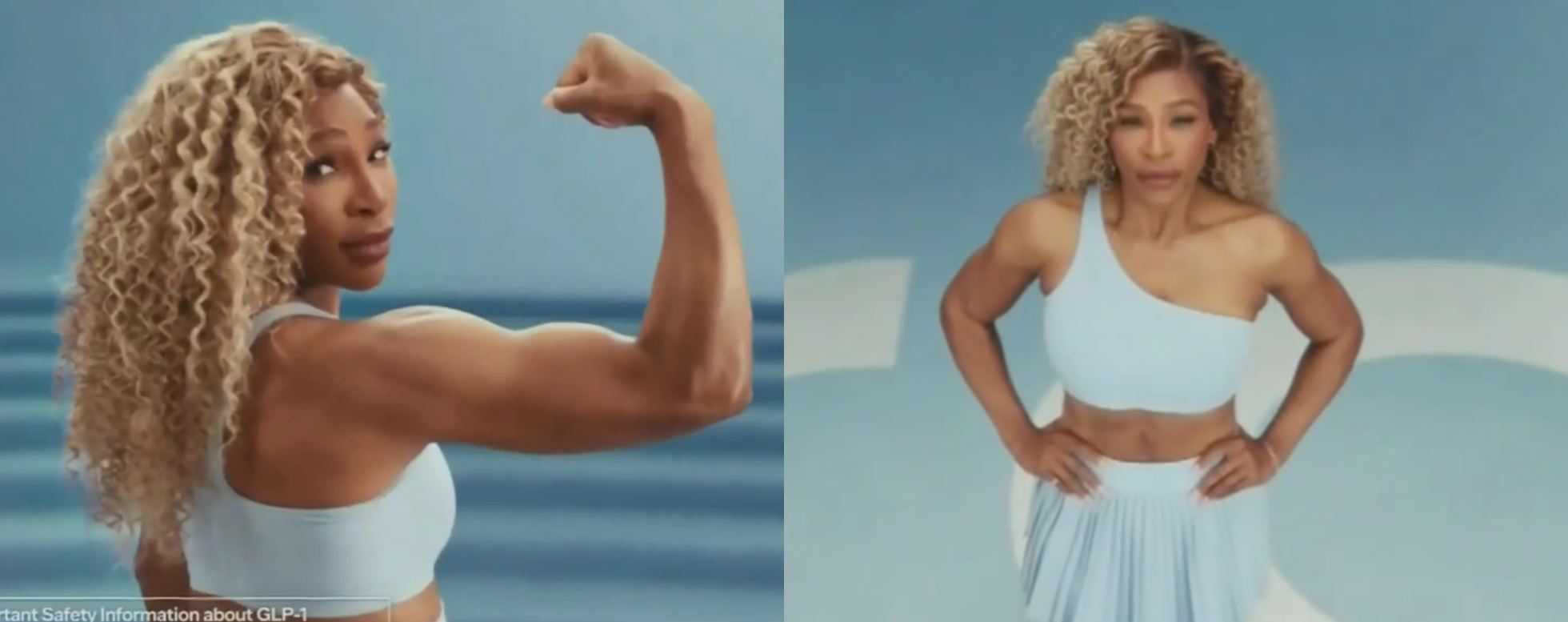
Tennis legend Serena Williams recently appeared in a Super Bowl commercial injecting herself with a GLP-1 while dancing and promoting the Ro telehealth app. The advertisement, which aired during one of television’s most-watched events, sparked immediate debate.
Critics took to social media to express concern about the timing and audience of the commercial. Many pointed out that millions of children were watching the game, raising questions about exposing young viewers to such advertising.

“Pushing Big Pharma weight loss injections while impressionable children watch feels wrong,” wrote one commentator who lamented the shift from traditional Super Bowl advertisements for beer and trucks.
The commercial itself showed Williams demonstrating how “convenient” it is to obtain GLP-1s through a mobile app, even mentioning that they are available in pill form.
Serena Williams injects herself with a GLP-1 weight loss drug as millions watch the Super Bowl.
She dances and shows off how “convenient” it is to get GLP-1s using the Ro app.
She even says you can get them in pill form.
I miss the days when the Super Bowl sold beer & trucks.… pic.twitter.com/snXlyGHZfS
— Vigilant Fox 🦊 (@VigilantFox) February 9, 2026
Several critics questioned why Williams, a multimillionaire married to a billionaire, would choose to promote such products. “Pathetic, she doesn’t need the money,” one observer wrote, suggesting the endorsement felt unnecessary given her financial status.
The most pointed criticism centered on Williams’ status as a role model for young women and girls.
“Every young girl who looks up to Serena as a symbol of strength and power just saw her say ‘just take a pill or an injection,'” one viewer noted, expressing concern about promoting pharmaceutical solutions amid an existing body dysmorphia epidemic.
Some described the commercial as representing a new level of cultural decline.
“We have arrived at the levels of dystopia we were warned about,” wrote one user, while another called it “peak Big Pharma” and labeled Williams a “pharma puppet.”
Williams’ decision to use and promote these stem from a genuine personal struggle. During an appearance on Oprah Winfrey’s podcast, she revealed that despite training eight hours a day as a professional athlete, she couldn’t lose weight after having children.
“My last match at the Open, I literally was working eight hours a day in the gym, training and I never could lose an ounce. In fact, I feel like I may have even gained weight,” Williams shared. “And it was incredible how my body looked even though I was putting in hours and I’m talking we’re in the summer in Florida putting in hours and hours and hours of training.”
Only after exhausting every other option did she reconsider. “Eventually I was like I’ve tried everything. I’ve tried every diet. I’ve tried every workout. I’ve tried walking for hours. I would go to Europe and Paris and I would just walk for hours and the 20,000 steps a day like every single thing, and nothing was working.”
Williams believes her biology changed after having children, and she was particularly struck by learning about the concept of a biological set point.
“I would lose the weight, but my body liked to be at a certain weight and that was so eye-opening for me. I was like, I feel like I didn’t know that. Whenever I lose weight, it’s like all of a sudden I’ll get even hungrier and my body wants to go back to the other weight.”
In August 2025, Williams announced she had lost 31 pounds (14 kg) and partnered with Ro to share her story. She emphasized that the results weren’t immediate. “I didn’t lose weight instantly. It took me a month or two for me,” she said, adding that she initially lost only about one pound while friends experienced similar slow progress.
Beyond weight reduction, Williams reported improvements in her joint health and overall quality of life.
“My life, I feel happier. I mean, I feel like I have more energy for my kids. I just feel like I can do more. I love to dance. I can drop it. I got knees like Megan now,” she said. “It affects my joints. My joints are so much lighter and so much better and I’m like, ‘Oh my goodness, I just wish I had done this while I was still playing.’ Like it would have made such a big difference for me in my career.”
Williams now frames the GLP-1s not as a shortcut but as treatment for a biological condition. “I’ve never taken a shortcut in my life. In fact, I would go the longer way to make sure I was the best, to make sure I did the extra work, to make sure I did the most. And that’s why it took me a little bit to want to start on the GLP-1 because I thought, well, is this a shortcut? And it really wasn’t. It’s just if anything, it’s just a shortcut to better health. And that’s just the way to look at it.”
Not all Super Bowl viewers opposed the commercial. Some argued that addressing America’s obesity crisis justified the advertisement. “I mean we do have an obesity issue in the USA, is this bad to promote?” one person asked.
Another wrote, “big pharma or not, obesity is a big issue and we gotta fix it lol.”