

Kevin O’Leary, the sharp-tongued investor from the long-running business competition series Shark Tank, is pointing young entrepreneurs toward two areas he believes will define the next decade of wealth creation: artificial intelligence services and data center development.
In a recent video, O’Leary stated: “If I was 25 years old today, what’s a good sector to get involved in? What business would I get involved in?”
“I think everything is looking at AI now in a different way,” he continued. “I think AI growth is going to be exponential, so anything to do with AI.”
Rather than pointing young people toward building the technology itself, O’Leary zeroed in on the gap between what exists and what most businesses can actually use. “It’s implementation and execution,” he explained. “Helping a business do that transfer into a world where they’re controlling their data and getting information from it.”
His reasoning is rooted in the scale of the small business economy. “The majority of businesses in America, for example, are between 5 and 500 employees. So, they’re small businesses. They create 62% of the jobs. They want to use AI. You should help them solve for that, and they’ll pay you.”
The second opportunity O’Leary flagged carries even more weight in his view. “The biggest pain point in AI is data centers,” he said bluntly. “That’s real estate development.”
He described the space as one of the most lucrative areas currently available to anyone with the appetite to enter it. “The demand’s insatiable. There’s only five gigs under construction right now, and demand for 30.”
He leaned on a familiar refrain to drive the point home: “You know that old adage, real estate, real estate, real estate? Well, add in data center, data center, data center.”
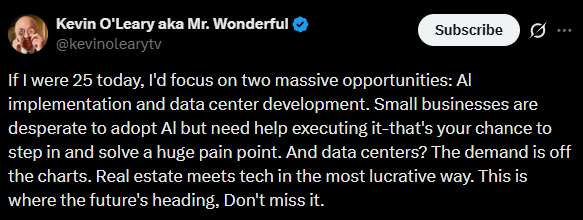
On social media, O’Leary wrote in the caption: “If I were 25 today, I’d focus on two massive opportunities: AI implementation and data center development. Small businesses are desperate to adopt AI but need help executing it, that’s your chance to step in and solve a huge pain point. And data centers? The demand is off the charts. Real estate meets tech in the most lucrative way. This is where the future’s heading. Don’t miss it.”
Data center infrastructure is genuinely stretched thin against surging demand, and the gap between businesses that want to adopt AI and those that know how to do it is a documented problem across industries.
That said, O’Leary’s credibility as a self-made success story has long been a subject of scrutiny. His public persona rests heavily on his role in building and selling a software company that eventually became The Learning Company, which was acquired by toy manufacturer Mattel in 1999 in a deal he frequently references as proof of his business genius. What often gets left out of that story is considerably less flattering.
Sources state that before the Mattel deal closed, The Learning Company had been flooding vendors with outdated products repackaged to appear fresh, a practice that left Mattel exposed to an enormous wave of returns it had not anticipated. The division that was expected to generate tens of millions per quarter instead produced a loss of over one hundred million dollars in its very first quarter under Mattel’s ownership.
The company’s stock collapsed, shareholder lawsuits followed, and Mattel eventually unloaded the assets at a loss of nearly 99.4 percent of what it had paid. Hundreds of workers lost their jobs in the fallout.
O’Leary was let go six months into a three-year contract. Despite the circumstances of his departure, he collected a severance package worth millions. His total take from the episode, when that payment is combined with proceeds from a stock sale made just before the disastrous earnings report became public, came to roughly eleven million dollars.


