Content creator and developer @measure_plan has spent the better part of a year building a series of games that demand real physical and creative effort from players, not just fast reflexes and good timing. The results range from a Tetris variant that straps the playing field to your body to a castle defense game where only live piano notes can hold back a wave of enemies.
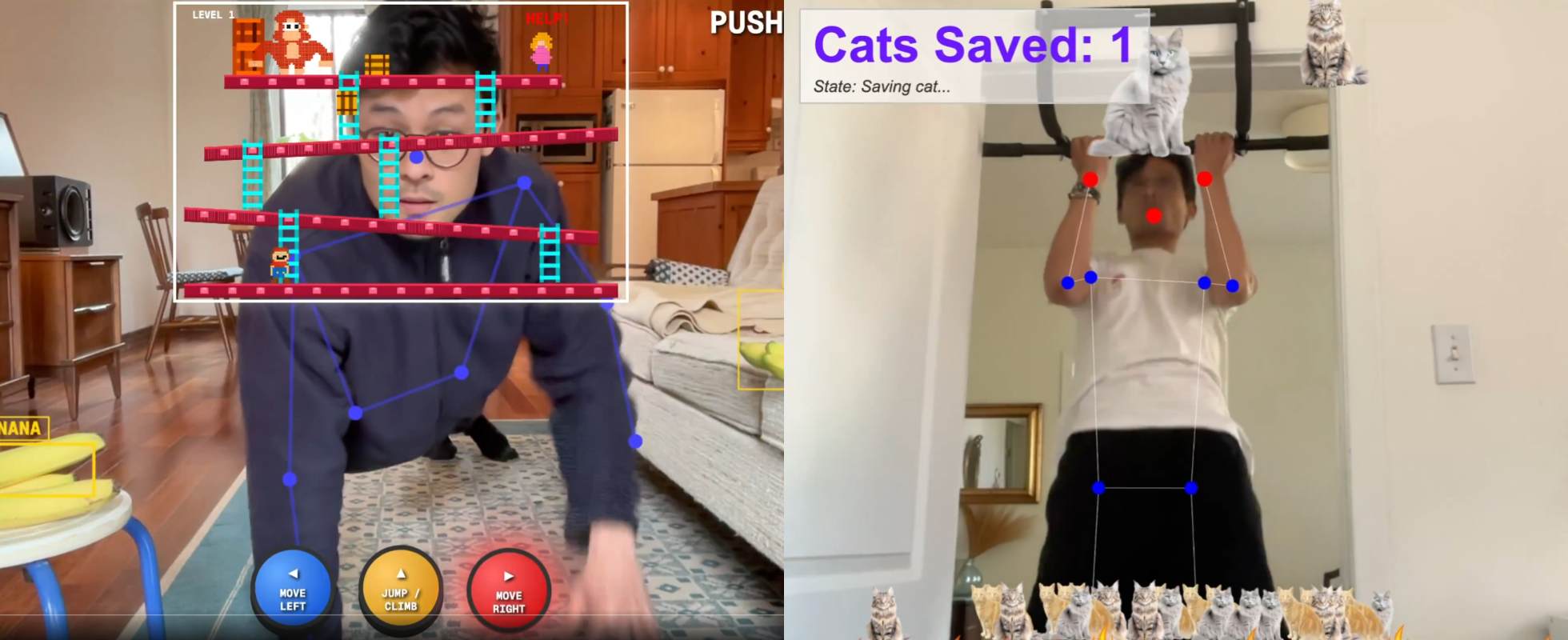
The fitness experiments started taking shape in the summer of 2025. In July of that year, @measure_plan shared a chin-up powered game, writing: “I made a game that forces me to work out. Do a chin-up, save a cat.”
i made a game that forces me to work out
🏋️♂️ do a chin-up, save a cat 🐈
built with @threejs and mediapipe computer vision
comment if you want to try. it’s buggy but I can get it off localhost pic.twitter.com/0RmpXIUlFF
— AA (@measure_plan) July 8, 2025
Built with Three.js and MediaPipe computer vision, the project tied in-game progress to the player’s ability to complete a rep. At the time, the developer noted it was “buggy but I can get it off localhost,” suggesting a build that worked but wasn’t yet ready for the public.
By early 2026, the concept had expanded. The developer reimagined Donkey Kong as a full-body workout, writing: “I made Donkey Kong but you play with pushups and planks and it’s quite inconvenient.”
i made donkey kong but you play with pushups and planks and it’s quite inconvenient
made with javascript, canvas, roboflow RF-DETR (for banana detection), and mediapipe body pose tracking
lmk if you want to play a few fitness games like this and i’ll try to get these online https://t.co/zB7yr1NToI pic.twitter.com/k3VZv3AgXO
— AA (@measure_plan) April 1, 2026
The project was built with JavaScript, canvas, Roboflow RF-DETR for banana detection, and MediaPipe body pose tracking, using computer vision to read the player’s movements in real time as direct game input.
Then came Tetris. On March 31, 2026, @measure_plan posted: “I made Tetris but the board and pieces are attached to your body and it’s quite tiring to play.” The announcement drew 2.8 million views, suggesting the concept had landed well beyond the developer’s usual audience.
i made tetris but the board and pieces are attached to your body and it’s quite tiring to play pic.twitter.com/yEoA49igpX
— AA (@measure_plan) March 31, 2026
Alongside the fitness games, @measure_plan has been building a parallel set of projects focused on musical skill. Midi Survivor, a rhythm-based web browser game, turns a real piano or MIDI keyboard into a weapon.
i made a game where you need to play the piano IRL to survive against waves of monsters
it’s live on the web for those who dare https://t.co/QL0aE3tt5j pic.twitter.com/BzgoKaUCSF
— AA (@measure_plan) January 29, 2026
Every note the player performs in the physical world registers as an attack against incoming enemies. Miss too frequently and the castle falls. Combos reward skilled players, and sustained notes deal with slower-moving targets that linger on screen. A standard keyboard can stand in for anyone without a MIDI device.
A separate music prototype, revealed on January 15, 2026, drew inspiration from DDR and Guitar Hero. It monitors what players actually play, walks them through chord patterns, checks accuracy in real time, and tracks scores as they improve.
Together, the projects point toward a goal. “I’m very bullish on creating personal software to level up at hobbies: learning an instrument, improving sports form, new languages, etc. Feels like there’s unlimited potential with the advancements in computer vision and large language model (LLM) tools,” @measure_plan said.
The developer has also signaled interest in releasing the fitness titles publicly, telling followers: “Lmk if you want to play a few fitness games like this and I’ll try to get these online.”