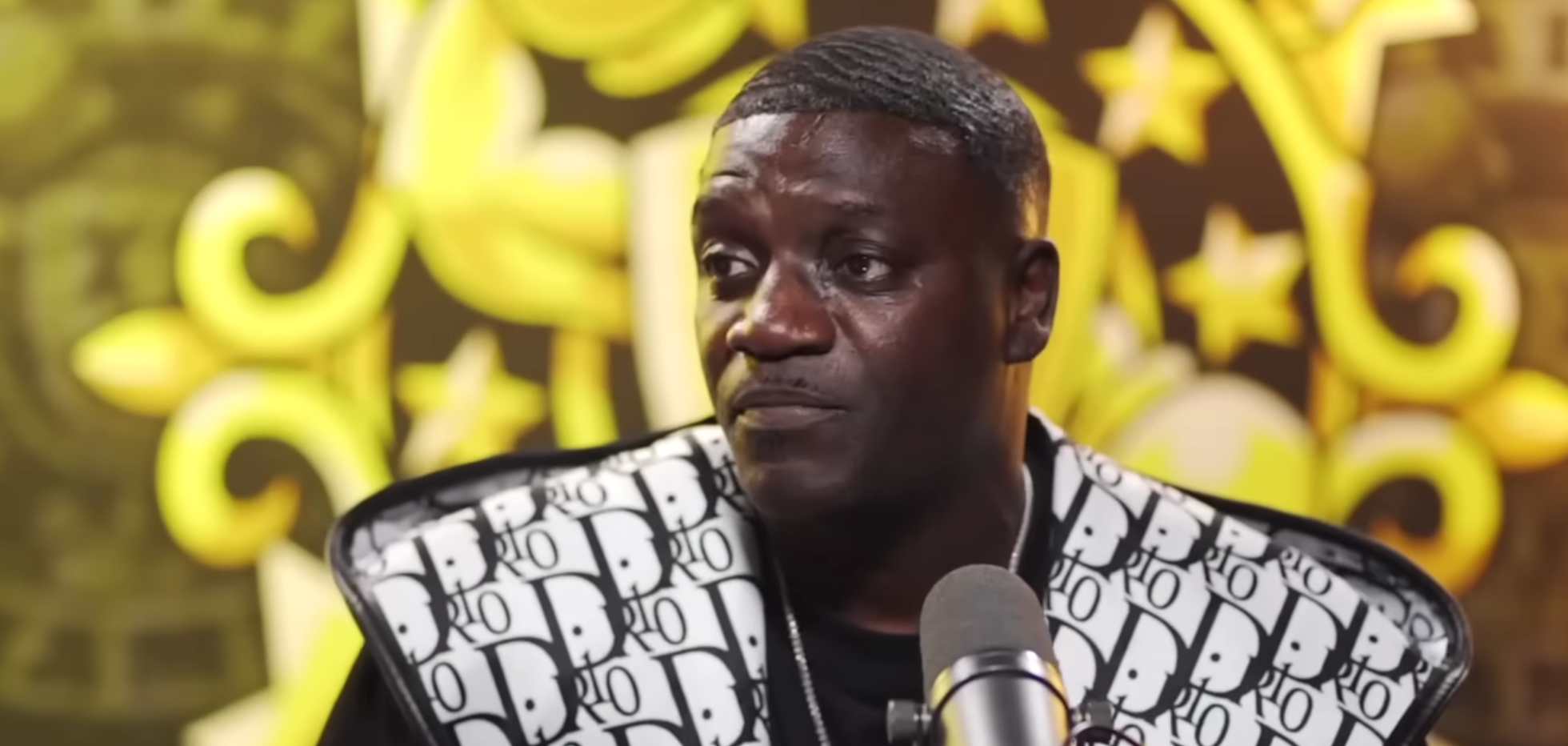
Rapper and producer Akon made millions by recognizing a business opportunity that other artists overlooked: ringtones. During his appearance on REVOLT’s Drink Champs, the “Locked Up” artist revealed how he turned brief audio clips into a lucrative revenue stream that eventually landed him in the Guinness Book of World Records.
The Senegalese-American artist explained that his ringtone success came from careful observation and business acumen. While touring and making music in the mid-2000s, Akon noticed something peculiar about the emerging mobile phone market that others in the industry were ignoring.
“I would hear songs on people’s phones and I said, ‘How much is that that you’re paying for?’ It’s $4.99, bro,” Akon recalled. “I said that’s for like a couple seconds. $4.99 and we’re selling singles for $1.99 for four minutes. I said, ‘Wait, hold up, this is different.'”
That realization prompted him to investigate the financial structure behind ringtone sales. When he contacted his attorney to find out how much he was earning from ringtones, the answer shocked him. The digital rights language wasn’t in his original contract, meaning potential revenue was accumulating without proper allocation.
Rather than rush to claim the money immediately, Akon employed a strategic approach. “This stuff stuck with me, so then I started making music specifically for the phone because it’s $4.99 for a few seconds. Any basic businessman can tell you that’s where the money is,” he explained.
The artist began tailoring his production specifically for ringtone consumption. “Every song that we was releasing was ringtone friendly,” he said, pointing to hits like “Mr. Lonely” as examples. “We always make ringtone versions, chop them up different parts of the song.”
When renegotiation time came, Akon was prepared. Record labels attempted to slip digital rights language into standard contracts, but he recognized this as a separate business opportunity. “That’s a separate deal altogether,” he insisted. “My advance for the digital side because at that time I was in the Guinness Book of World Records for the most ringtones sold ever, above Elvis Presley, Michael Jackson, any catalog, Beatles.”
His strategy paid off handsomely. Digital rights became “a whole other deal” that had nothing to do with traditional album sales. Akon credited his technology background for giving him foresight about where the industry was heading.
“I was always tech savvy, I was just always ahead of tech,” he said. “The word ‘digital’ made me know exactly what that meant, but I also knew where the world was going.”
Akon’s mindset places him in rare company, artists who didn’t just adapt to technological shifts, but anticipated them. One of the earliest examples of this foresight came years earlier from David Bowie.
In a now-famous 1999 BBC interview, Bowie described the internet as an “alien lifeform” with “unimaginable” potential. But his insight wasn’t limited to philosophy.
Bowie believed society had barely scratched the surface. “I don’t think we’ve even seen the tip of the iceberg,” he warned. “The potential of what the internet is going to do to society, both good and bad, is unimaginable.”
But Bowie’s vision wasn’t theoretical. Two years earlier, he became the first major artist to securitize future royalties, raising more than $30 million by selling what became known as Bowie Bonds. Two years earlier, Bowie became the first major artist to securitize his future royalties, selling more than $30 million worth of “Bowie Bonds.” He used the funds to launch BowieNet, an early social networking and internet service platform.
When asked during the interview if there was a point where having more money stopped mattering, Bowie delivered a line that perfectly captured his thinking: “Do you know how expensive it is to get involved in the internet?” He understood that digital infrastructure wasn’t just a creative playground, it was a capital-intensive business opportunity.
In this famous 1999 interview, David Bowie called the internet an “alien lifeform” with “unimaginable” potential.
Two years earlier, he was the first artist to securitize future song royalties and sold $30m+ of “Bowie Bonds.”
He launched a social network (BowieNet) with funds… pic.twitter.com/W4USL5DuJG
— Trung Phan (@TrungTPhan) January 4, 2026
Like Akon, Bowie recognized that music could be leveraged beyond albums and tours. By financially engineering his catalog to fund a tech startup, Bowie demonstrated the same core principle as Akon.