
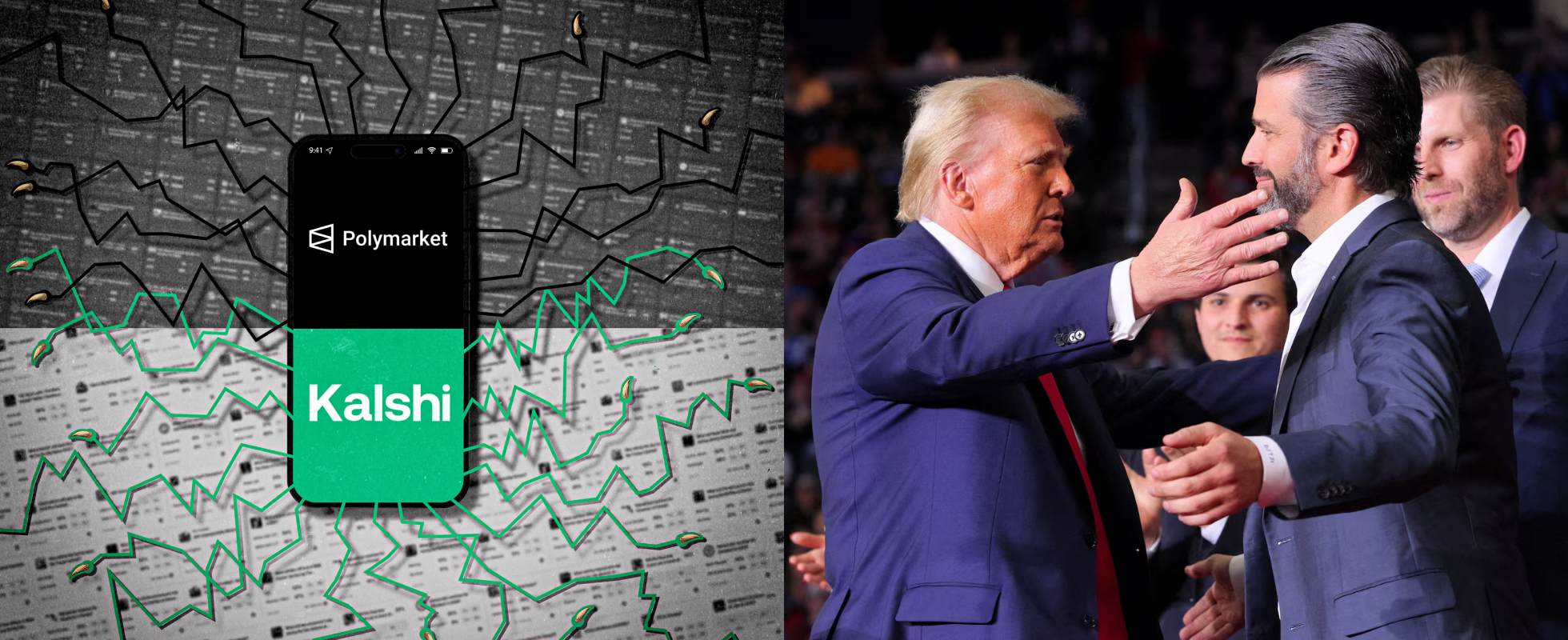
When Kalshi founders Tarek and Luana appeared on the Axios Show, the conversation quickly turned pointed as host Dan Primack pressed them on the Trump family’s financial ties to prediction markets and the question of insider trading enforcement.
Primack raised the issue directly, noting that Kalshi had hired Donald Trump Jr. as a paid advisor shortly after Inauguration Day. He also pointed out that Trump Jr. had become an investor in Polymarket and served as an advisor there as well.
“Is it fair to say that the Trump family has a financial interest in prediction markets being legal and successful?” he asked.
Tarek pushed back by arguing that the company’s advisory board was politically diverse. He highlighted that Kalshi had also brought on Democratic strategist Stephanie Cutter as an advisor, suggesting the firm was not aligned with a single political faction.
When Primack countered that Cutter did not have the same direct line to power as a member of the Trump family, Tarek dismissed the idea that the relationship had been used for influence.
“We have never asked for any favors of that kind, and he has never done anything or made any regulatory ask, nothing like that,” he said.
Luana then shifted the focus to what she described as the more consequential turning point for prediction markets: Kalshi’s legal victory against the previous administration. She argued that the lawsuit, not political connections, fundamentally changed the regulatory landscape for the industry.
“The biggest change that happened in prediction markets is the fact that we won our lawsuit against the last administration in October 2024, before the election,” she said. “That is the thing that we define as what is possible in prediction markets.”
The discussion then moved to insider trading enforcement. Primack noted that he had been unable to find a single case in which the Commodity Futures Trading Commission (CFTC) had taken direct action against an individual for insider trading on prediction markets.
Tarek acknowledged the observation but emphasized that enforcement cases often take years to resolve, pointing to the timeline of securities investigations as a comparison.
“Insider trading cases in the SEC, they don’t get resolved in six months,” he said.
When asked more directly whether the CFTC would likely bring cases within the next 12 months, Tarek said he expected that to happen, arguing that misconduct is inevitable in any large financial system and that enforcement is a natural part of market maturity.
“I think yes, because my expectation is that this is a large market,” he said. “There are cases that come in the stock market. There is no system where everything is perfect. Bad actors will try to attempt fraud and do things that are wrong. What our job as an exchange and the job of regulators is, over time, is to flag these bad actors, detect and deter them, and punish them when you find someone who did something bad. And inevitably, in our markets, this is going to happen. It should happen. It’s a good thing.”
Kalshi also confirmed that it had already taken enforcement action internally. Tarek pointed to a recent case involving a political candidate who attempted to trade on his own race.
“We put out an enforcement case actually a couple of weeks ago on a candidate for governor, I think of California, who was trading on his own candidacy,” he said. “We had an investigation, fines, banned him from the platform, and all of that.”
The company further described its proactive compliance system, which blocks certain individuals from trading on specific markets before any suspicious activity can occur. According to Tarek, the system uses lists of politicians, athletes, and related parties to prevent potential conflicts of interest at the point of account creation.
“If you even sign up to Kalshi and we think there could be an issue, you’re blocked from certain markets, which is going way further than the stock market,” he said.


