
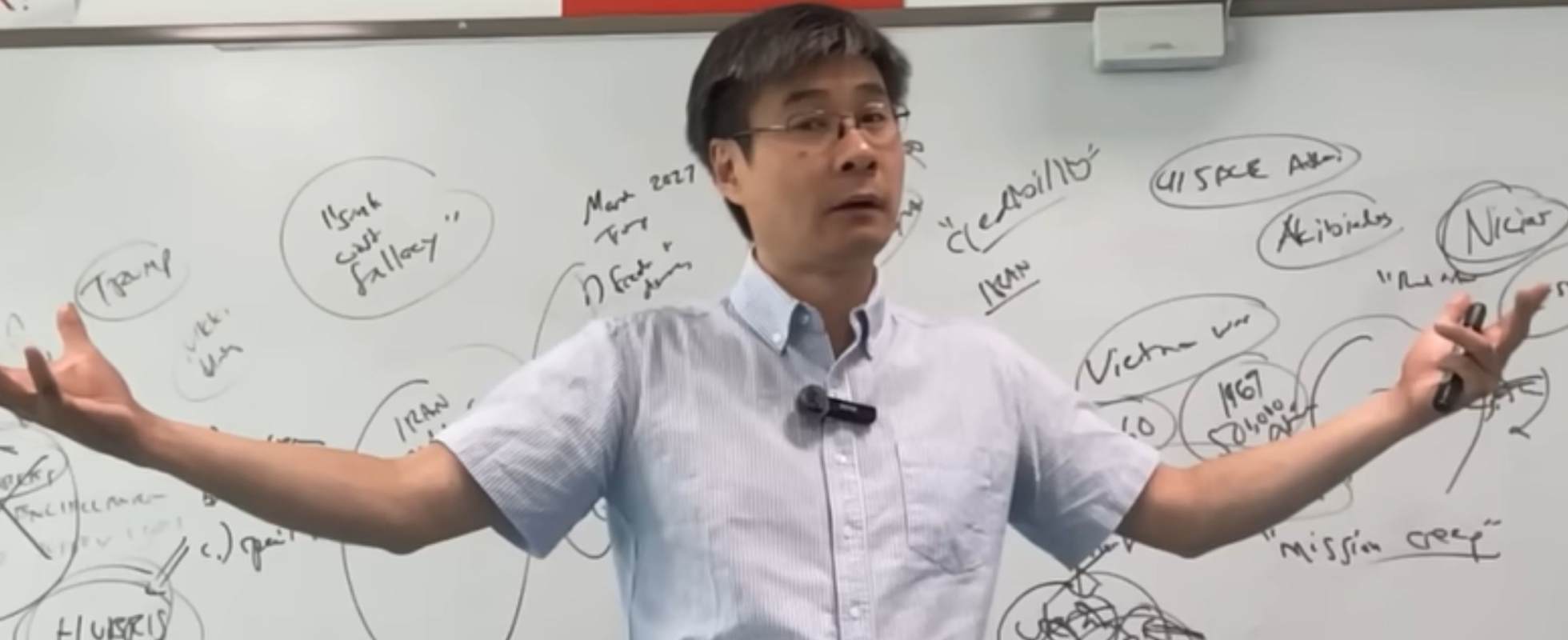
YouTube personality Professor Jiang recently appeared in an interview where he was challenged over his use of the title “Professor,” despite working as a teacher. The interviewer questioned why he continues to use the title on his Predictive History YouTube channel.
The interviewer addressed the issue directly. “You’re an English literature graduate and you’re not a professor,” he said. “I know it’s your YouTube moniker, but you’re a high school teacher. You’re not actually a professor, right?”
Jiang attempted to clarify his position. “Yeah, I’m not a professor,” he replied. “I’m not a professor, but I never said I was a professor. It’s the internet that calls me that.”
The interviewer then pointed out that Jiang holds no academic credentials associated with a professorship and proceeded to play clips from his own videos in which he repeatedly introduced himself using the title.
The footage rolled one after another: “Hi, YouTube. This is Professor Jiang,” he said in multiple uploads on his own channel.
The interviewer pressed the contradiction. “You do call yourself Professor Jiang, and you’re not a professor,” he said.
Jiang responded by drawing a comparison. “Look, look, there’s a guy on the internet who calls himself ‘the God,'” he said.
The interviewer countered with a pointed example. “I’m good friends with the radio host Charlamagne the God,” he said. “But no one actually thinks he’s a god. People actually think you’re a professor.”
The exchange has drawn attention to how Jiang presents himself online and what his actual background reveals. The Predictive History channel has grown rapidly, built largely around confident geopolitical forecasts that Jiang frames as the product of historical and game-theory analysis.
He claimed to have predicted Donald Trump’s 2024 presidential victory and a subsequent confrontation between the United States and Iran, two predictions that earned him considerable credibility among his audience.
His actual credentials, however, point in a different direction. Jiang holds a bachelor’s degree in English literature and teaches at Moonshot Academy, a middle school in Beijing. He has never held a university-level position and has no advanced academic degrees.
Archaeologist Flint Dibble, host of the YouTube channel Archaeology with Flint Dibble, recently examined the historical claims underpinning Jiang’s reputation. His conclusion was direct: Jiang is not a historian, not a professor, and not a reliable source on the subjects he discusses.
Dibble focused on specific examples. In one lecture, Jiang argued that the Battle of Cannae in 216 BC, a decisive Carthaginian victory over Rome, never occurred. He then extended the argument to claim that Hannibal himself never existed, and ultimately that all of Roman history is a fabrication. Dibble presented a substantial body of evidence against these claims.
The Greek historian Polybius lived during the Second Punic War and wrote an account of it. The Roman analyst Lucius Cincius Alimentus was personally captured by Hannibal, placing him among the most direct sources available. Physical evidence reinforces the written record: the town of Cannae shows signs of abandonment consistent with the historical timeline, coins minted by Capua as an independent power correspond to the period of Hannibal’s presence in Italy, and dung residue found in the Alps documents the passage of his army.
The rest of Jiang’s theories follow a similar pattern. He has argued that the Egyptian pyramids served as energy storage devices rather than burial monuments, that evolution is not credible, and that ancient priests used ritualistic trauma and dissociation to control pharaohs. He has also promoted antisemitic theories about covert organizations and global power, and has publicly questioned the Holocaust, stating “we don’t actually have any concrete evidence for the Holocaust.”
Dibble noted the extensive physical, photographic, documentary, and survivor evidence that directly contradicts this claim.
Jiang has been candid about his own methods. His approach, which he calls “predictive history,” borrows the concept of psychohistory from Isaac Asimov’s science fiction Foundation series.
In one interview he acknowledged: “I don’t actually use documentary evidence in my classes. I use a lot of first-principal thinking.” In another, he described his process in personal terms: “I’m always accessing a higher force and I’m receiving this information that I can then articulate to you in class.”
None of this has slowed the channel’s growth. Jiang continues to produce geopolitical commentary to large audiences.