
When tech entrepreneur Pieter Levels spotted yet another pothole on his local street, he did what any programmer would do and automated the complaint process.
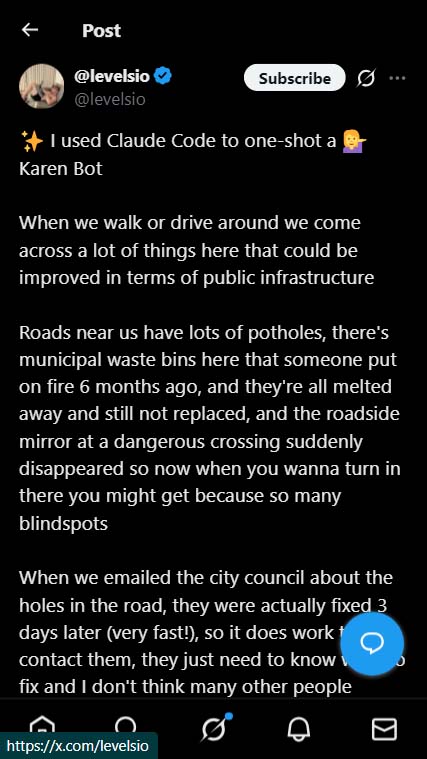
The digital nomad entrepreneur, known online as Levelsio, recently built what he calls a Karen Bot using Claude Code. The tool targets a familiar frustration for anyone who has tried to report municipal issues, the slow and bureaucratic process of contacting city officials.
“When we walk or drive around, we come across a lot of things here that could be improved in terms of public infrastructure,”
Levels explained on social media. His neighborhood faces common urban problems, including damaged roads, municipal waste bins that caught fire months ago and were never replaced and a roadside mirror at a dangerous crossing that disappeared, creating blind spots for drivers.
What surprised him most was that local government actually responded. After Levels emailed the city council about the road damage, crews repaired the potholes within three days. The results were effective, but the process itself remained tedious.
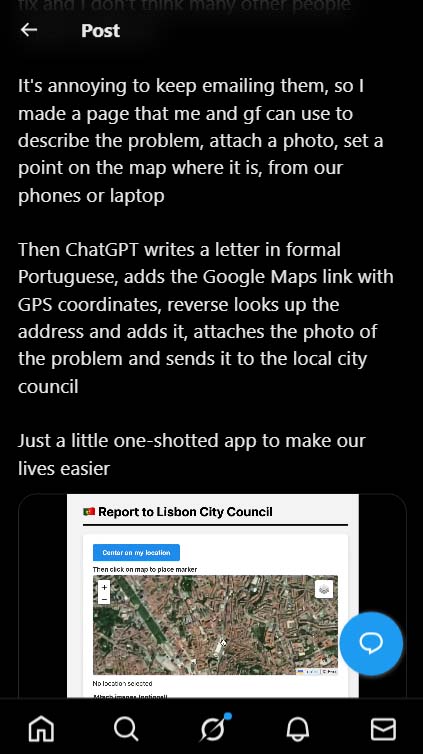
Instead of continuing to send emails manually, Levels built a system. The application allows him and his girlfriend to describe infrastructure problems, attach photos and pin locations on a map from their phones or laptops. Everything else is handled automatically.
ChatGPT generates formal letters in Portuguese, adds Google Maps links with GPS coordinates, performs reverse address lookups, attaches photos and sends complete reports directly to the city council.
“Just a little one-shotted app to make our lives easier,”
Levels wrote.
The project reflects Levels’ long standing approach to building software, identify friction, create minimal tools and move quickly. He previously launched 12 startups in 12 months and has built more than 40 projects over the course of his career.
His philosophy prioritizes speed and validation.
“I need to go fast. I need to make things fast to see if an idea works,”
Levels said during a podcast appearance. He often aims to launch new products within two weeks.
The civic reporting tool joins a mix of profitable and non commercial projects. His remote job board, RemoteOK, generates roughly $40,000 per month. Interior AI brings in an estimated $40,000 to $50,000 monthly by helping users visualize interior design concepts. Photo AI, which creates personalized AI generated images, became profitable shortly after launch.
Not every project makes money. Hoodmaps, his crowdsourced neighborhood mapping site, has never generated revenue despite going viral. At one point, Levels received a $20,000 bill for map hosting after traffic surged. He continues to subsidize it, acknowledging that some projects exist simply because they are interesting.
The Karen Bot appears to fall into that same category. Levels has not indicated any plans to monetize it. For now, it functions as a personal utility that reduces administrative friction while improving local infrastructure reporting.
The project comes as Levels has also been exploring more physical pursuits. In May, he announced that he had started Brazilian Jiu-Jitsu training, posting a photo with the caption:
“the regular slightly psychotic face you get after BJJ.”
When followers suggested other combat sports, he replied:
“BJJ is kinda wrestling, I think, and most important martial art of our time.”
Physical training serves as a counterbalance to long hours in front of a screen.
“I do bench press, squat, deadlifts. Because it acts like therapy for me,”
Levels has said. He credits physical exertion with helping maintain mental clarity.
That mindset traces back to advice from his father.
“When I’m depressed or something, he says, ‘Get a big mountain of sand or something from construction, and just get a shovel and bring it to the other side, and just do physical labor, do hard work, and do something. Set a goal, do something,’”
Levels told Lex Fridman.
“And I kind of did that with startups too.”
The Karen Bot shows how technical skills can be applied to everyday problems with broader public benefit. If more residents used similar tools to report issues, municipalities would have clearer data on where repairs are needed.
Whether Levels expands the project or moves on to his next idea is unclear. His history suggests he will continue building, experimenting and solving problems others are content to complain about.
For now, at least one neighborhood in Portugal has fewer potholes and one resident who replaced frustration with automation, without ever having to learn formal Portuguese himself.