
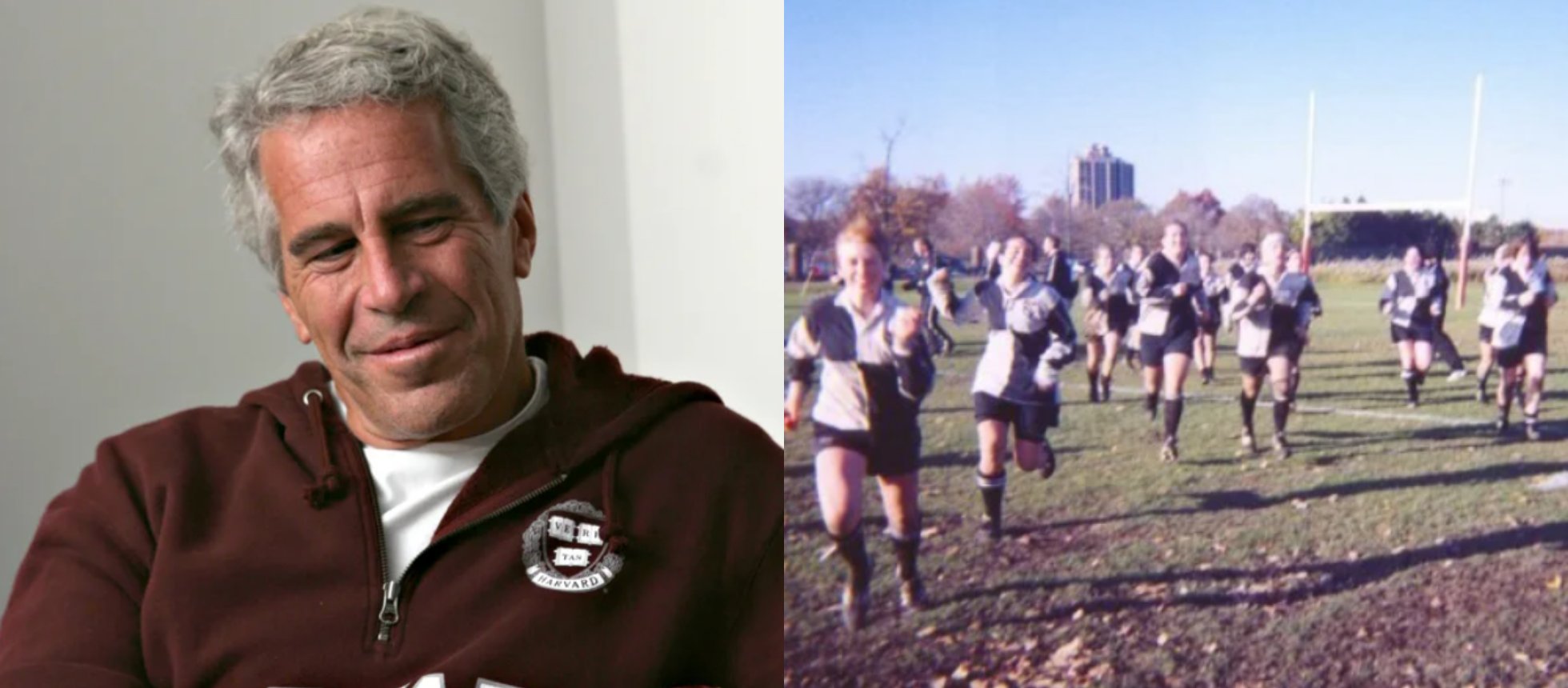
A confidential Harvard University document, never before referenced in public, reveals that Jeffrey Epstein established a named fund specifically tied to a college sports program, despite privately expressing a deep contempt for athletics.
The document, obtained by Pablo Torre and the Harvard Crimson, bears Harvard’s logo at the top and reads: “Jeffrey E. Epstein Fund for Women’s Athletics.” According to the same document, the fund began in 2004. 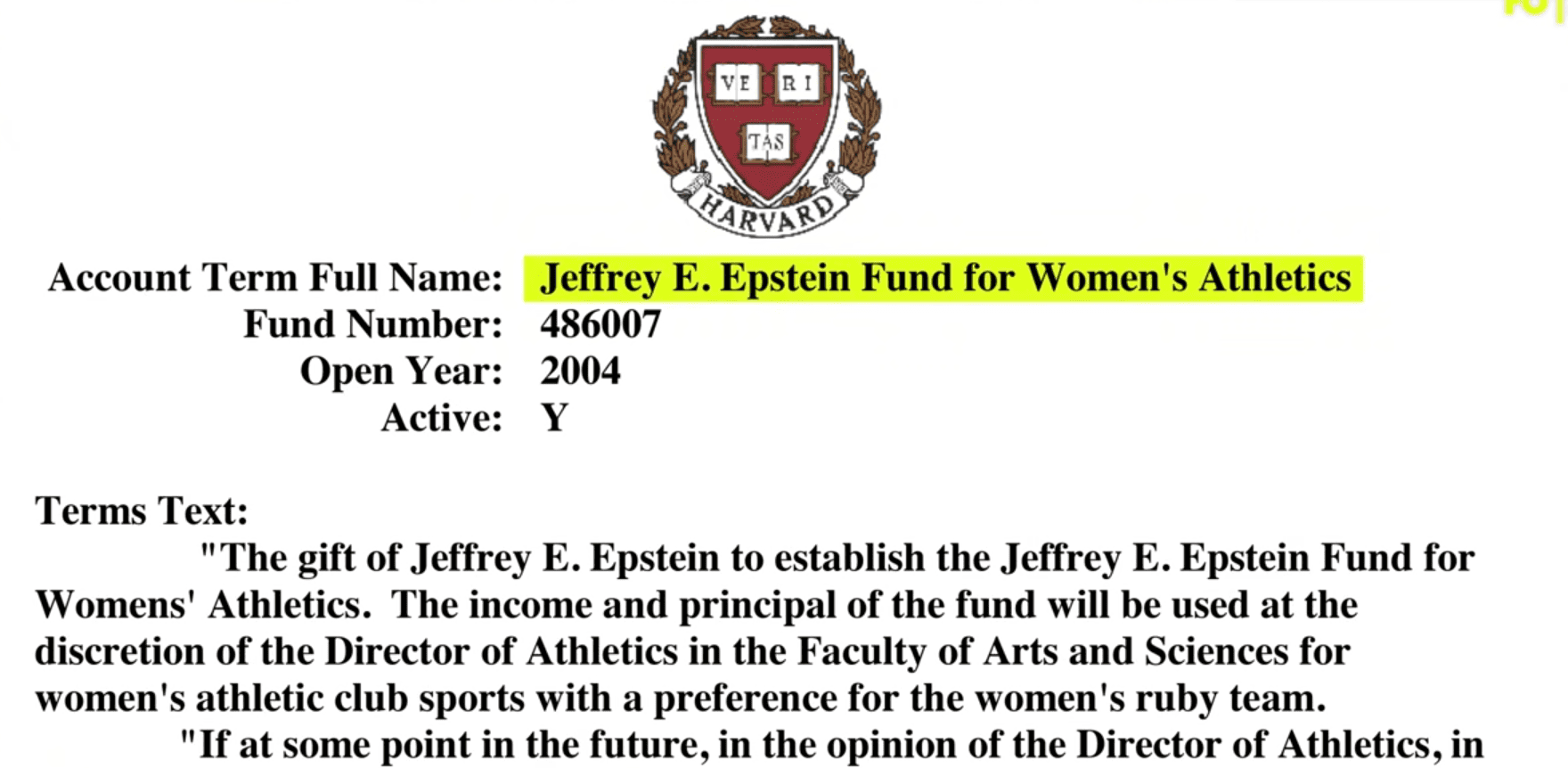
The full text of the gift, accessed from inside Harvard’s fundraising system by a current university employee, reads: “The gift of Jeffrey E. Epstein to establish the Jeffrey E. Epstein fund for women’s athletics. The income and principle of the fund will be used at the discretion of the director of athletics in the faculty of arts and sciences for women’s athletics club sports with a preference for the women’s rugby team.”
The fund amounted to $25,000, directed toward Harvard’s Radcliffe Rugby club, a scrappy, financially under-resourced team that was not a varsity sport at the time. Players described cleaning dormitory toilets, signing up for psychology studies, and renting cars from Enterprise to travel to away games.
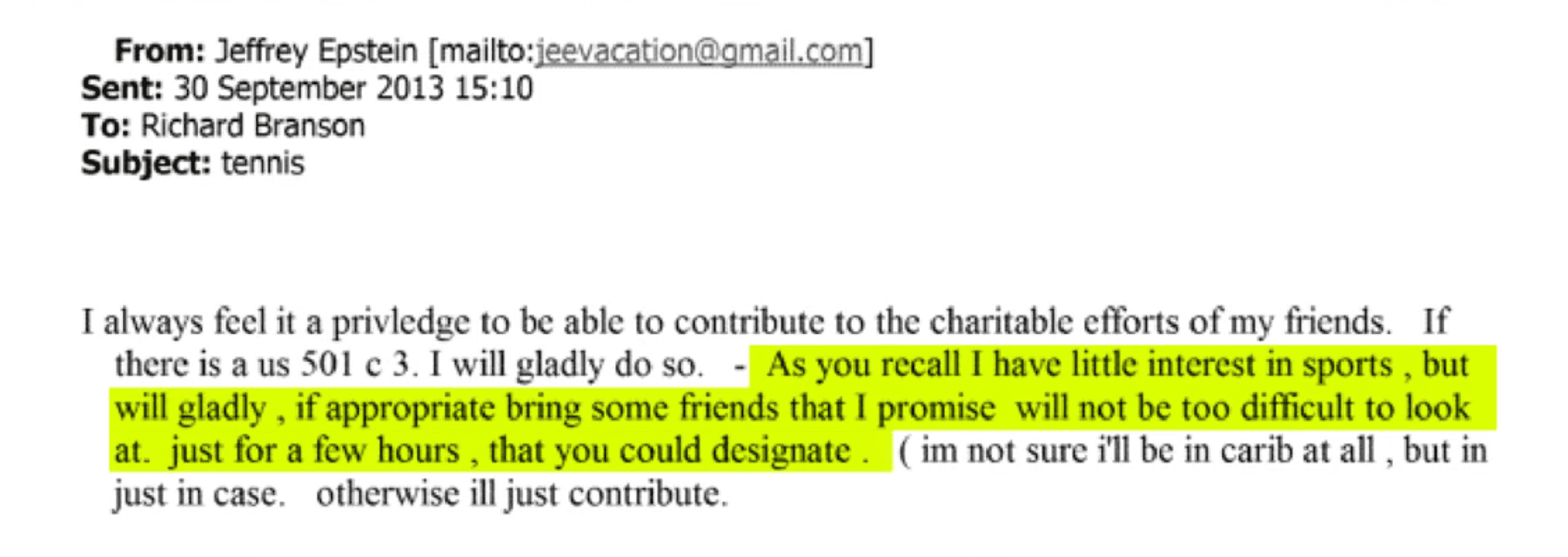
The irony of Epstein attaching his name to a sports fund is made plain by his own words. When offered the opportunity to play tennis with Rafael Nadal on Sir Richard Branson’s private island, Epstein emailed Branson to say: “As you recall I have little interest in sports, but will gladly, if appropriate, bring some friends that I promise will not be too difficult to look at just for a few hours that you could designate.”
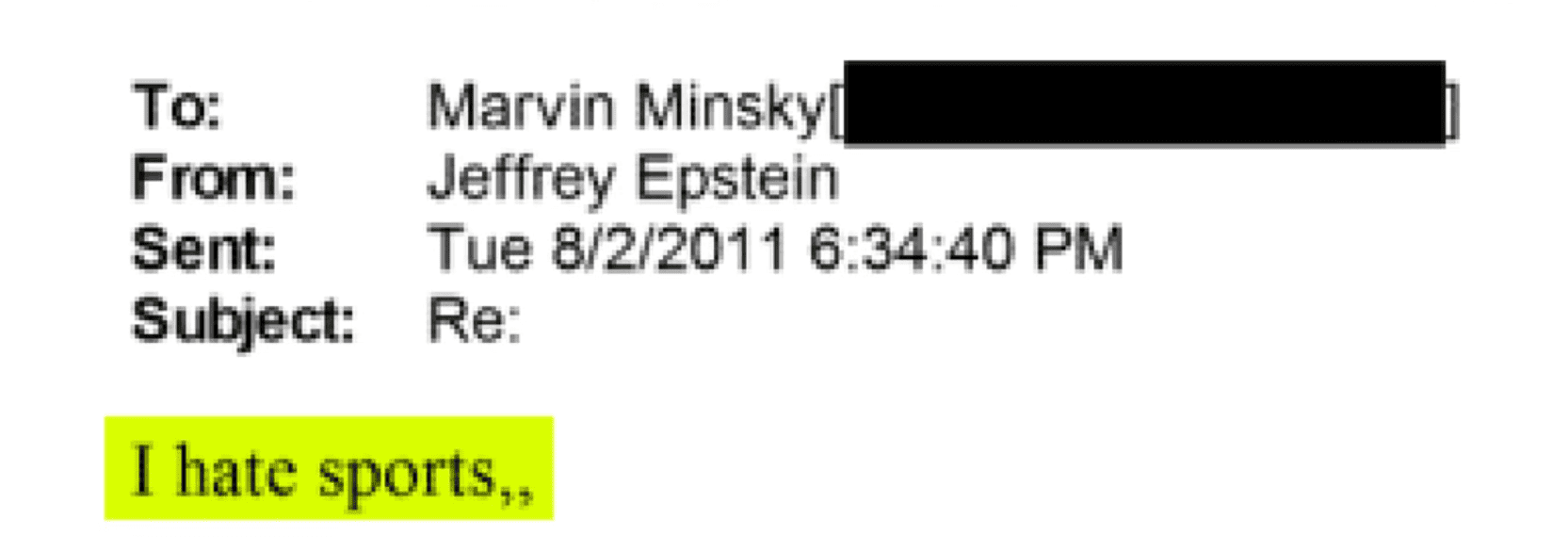
He also communicated his position even more bluntly to Harvard’s own Marvin Minsky, a pioneering computer scientist, writing simply: “I ha te sports.”
The rugby players who benefited from the fund had no idea Epstein’s name was attached to it. As one anonymous teammate recalled: “She sent an email around to a lot of us. Does anybody remember this? And as we sort of collectively pieced this memory together, I just remember feeling so sick because we never asked to be affiliated with this monster and it was surprising. It was surprising.”
Professor Emily Riehl, who served as club president during the relevant years and later received a cold email from a Harvard lawyer during the 2019 self-investigation, described the team’s reaction to learning the source of the money: “Surprise and confusion were some initial responses.”
The players had been told to keep the donation quiet. They were led to believe the money came from then-President Larry Summers. “We only ever heard about it as money from Summers. Epstein’s name was not mentioned. The name of the fund is not in our records anywhere. We were told to keep it quiet, which is interesting.”
A second anonymous teammate added: “We were asked to keep news of the gift confidential, which also we, I guess, understood because there’s only so many funds to go around.”
The fund was not a lump sum but a draw-down arrangement. As the Crimson’s Dhruv Patel explained, the team would pull roughly $1,000 per year when they needed to travel to games or purchase uniforms. Harvard’s 2020 self-report, the result of an investigation that reviewed more than 250,000 pages of documents, made no mention of the Jeffrey E. Epstein Fund for Women’s Athletics.
The unspent balance on the 2004 gift, including interest, was ultimately part of the $2,937 Harvard donated in 2020 to two organizations supporting those harmed by human trafficking and SA.