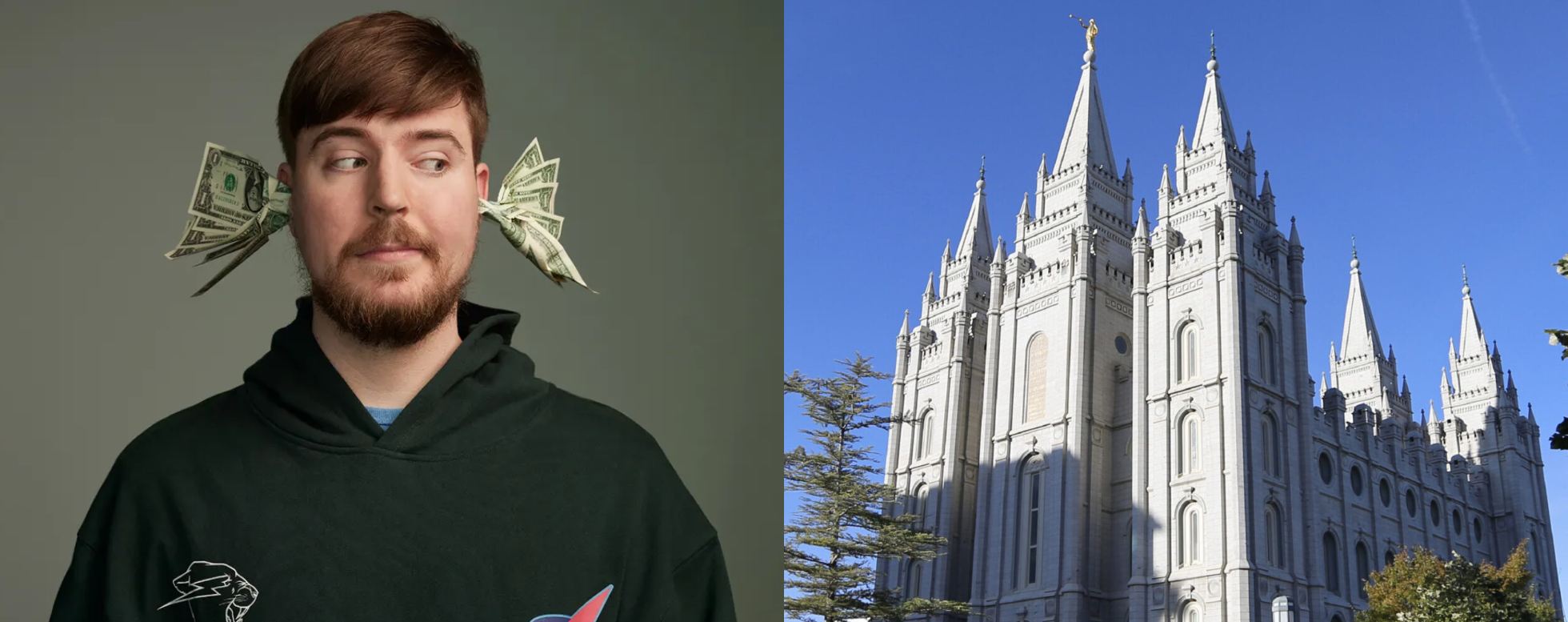
YouTube sensation MrBeast has formed an increasingly close relationship with The Church of Jesus Christ of Latter-day Saints. The connection became official when MrBeast (real name is Jimmy Donaldson) listed the Mormon Church as a diamond sponsor on his website.
MrBeast’s ties to the Mormon community extend back years through key mentors and collaborators. Derral Eves, one of MrBeast’s long-term mentors and executive producer of “The Chosen,” is a devout Mormon who recently received a high-level leadership appointment within the church. Mark Rober, another frequent collaborator who attended Brigham Young University, is also a practicing member.

Google Trends data reveals a striking pattern: Utah, the center of Mormon culture and church headquarters, consistently shows the highest search interest for MrBeast. This hasn’t just been recent. Going back to 2004, before MrBeast even started his YouTube channel, Utah has maintained the top position for search volume related to him.
Given MrBeast’s well-documented obsession with analytics, this demographic information has likely influenced his strategic decisions for years. The data suggests that Mormons represent a significant and loyal portion of his audience.
In 2004, MrBeast promoted JustServe, a service-oriented platform owned and operated by the Mormon Church.
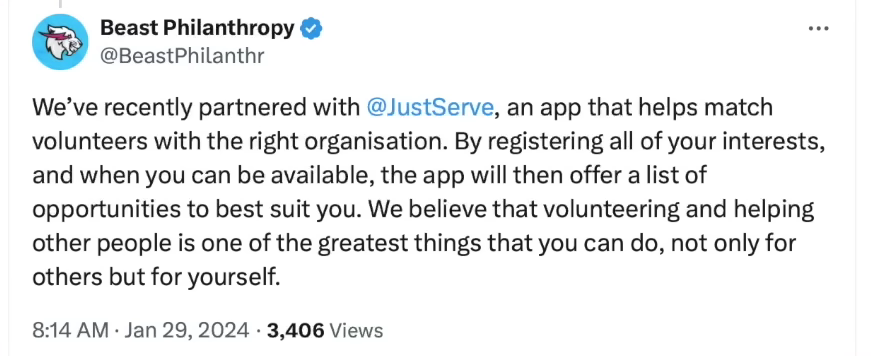
The Deseret News, a church-owned publication, covered the collaboration enthusiastically. This relationship deepened recently when the church became a diamond sponsor, with visitors to MrBeast’s website able to click directly through to the Mormon Church’s homepage.
The sponsorship level raises questions about financial arrangements. Reports indicate that a weekend with MrBeast costs $100,000, suggesting the diamond sponsor designation likely required substantial payment. For a church that donated approximately 1.3 billion dollars to charity in one year, this seems notable until that figure is measured against their estimated total worth of 256 billion dollars.
MrBeast built his empire on what researchers call “stunt philanthropy.” His videos follow a predictable structure: surprise someone in need, give them money or assistance, capture their emotional reaction, and turn it into viral content. Titles like “Giving a Homeless Man $10,000” and “I Saved 1,000 Animals” represent this approach.
In one video where he gives his mother $100,000, she initially refuses. MrBeast responds by saying that if she doesn’t take the money, he won’t have a viral video. Her reply captures the essence of the criticism: “So you’re using me for cli cks?”
Academic research has questioned whether the intent behind such content is “good intent or just good content.” MrBeast didn’t start his channel with charitable goals. His early content featured video game reactions and commentary on other YouTubers. He appears to have discovered that charity content went viral and expanded that formula with bigger numbers, more people, and larger sums of money.
MrBeast’s net worth is estimated at 2.6 billion dollars, with annual earnings reported at 85 million dollars. When asked about his most luxurious purchase, he casually mentioned chartering a private jet to visit his girlfriend, using the abbreviation “PJ” multiple times as if it were an everyday occurrence.
This creates a fundamental tension: someone whose brand identity centers on charitable giving has become extraordinarily wealthy. The financial benefits he derives from charity content appear to far exceed the amounts given away. An early video titled “Giving a Homeless Man $10,000” has 11 million views, likely generating revenue well beyond the $10,000 donated.
The Mormon Church shares this pattern of accumulating wealth while promoting a charitable image. Despite being the wealthiest church in America, the church donates less than one percent of its worth annually to charity. Using 2024 figures from the Salt Lake Tribune, the percentage was actually less than half of one percent that year.
As a church, the organization pays no taxes in the United States. If taxed like other corporations, they would pay approximately 20 percent of their wealth. Instead, they donate less than one percent while receiving full tax exemption benefits.
The church’s estimated 256 billion dollars in assets makes it wealthier than McDonald’s, T-Mobile, Pepsi, Verizon, AT&T, and Disney. This estimate likely understates their true wealth, as independent researchers at the Widows Mite Report must reverse-engineer these figures from property tax records and known investments. The church is not required to fully disclose its finances to the government.
In 2023, the Securities and Exchange Commission fined the Mormon Church for obscuring investments and not fully disclosing how much money they had. Following this scandal, the church increased its charitable donations, likely responding to members questioning why they should donate 10 percent of their income to an organization wealthier than Disney.
Mormon doctrine makes tithing central to salvation. The Doctrine and Covenants, part of Mormon scripture, calls tithing “fire insurance” because those who pay will not be burned in the last days. Members cannot receive a temple recommend or achieve exaltation without paying tithing. It functions as an entry fee to heaven.
Children learn to calculate 10 percent as some of their first math lessons. Annual tithing settlement meetings require members to meet with their bishop and certify they have paid a full tithe. Even young children face these questions.
The church’s failure to donate even 10 percent of its own income to charity stands in contrast to the requirement that members donate 10 percent of theirs. They aren’t following their own rule.
Both MrBeast and the Mormon Church engage in highly visible, media-optimized charity designed to enhance their public image. The church’s giving machines, which appear in prominent locations during Christmas, create photo opportunities for social media. Travis Kelce has promoted them, generating additional publicity.
The Deseret News regularly publishes articles about church charitable giving. JustServe, while helping coordinate community service, primarily provides visibility for the church without requiring substantial financial investment. The platform allows members to volunteer their labor while the church receives credit for orchestrating the effort.
This approach contradicts Jesus’s teaching in Matthew chapter 6: “Take heed that you do not your alms before men to be seen of them. When thou doest alms, do not sound a trumpet before thee, as the hypocrites do in the synagogues and in the streets. But when thou doest alms, let not thy left hand know what thy right hand doeth.”
Publishing news articles about charitable donations and wearing branded vests during service projects resembles sounding a trumpet.
Critics describe feel-good news stories about children selling bracelets to pay lunch debt or workers handling 12-hour shifts alone as examples of the “orphan crushing machine.” These stories celebrate individual acts of resilience while ignoring systemic failures that created the need in the first place.
Stunt philanthropy operates similarly. It doesn’t address why people are homeless, why students have lunch debt, or why systemic poverty exists. Instead, it throws money at individual cases, captures the emotional moment, and moves on without questioning the structures that create ongoing need.
A revealing test involved calling churches to request baby formula while playing audio of a crying baby. The Mormon Church, despite its billions in assets, refused to help. On missions, members are instructed not to offer church assistance to people they encounter, with the reasoning that people might join for the wrong reasons.
Even active members find church assistance operates on a pay-to-play basis. Recipients typically must attend services, fulfill their callings (unpaid church jobs), and demonstrate full participation before receiving help.
Mormons’ attraction to MrBeast likely stems from his wholesome, family-friendly image. His content offers a sanitized version of reality where problems have simple solutions and good deeds always lead to happy endings. This two-dimensional worldview, with saturation turned up and edges smoothed over, resembles the Disney aesthetic that also resonates strongly with Mormon audiences.