
Free to use under the Unsplash License
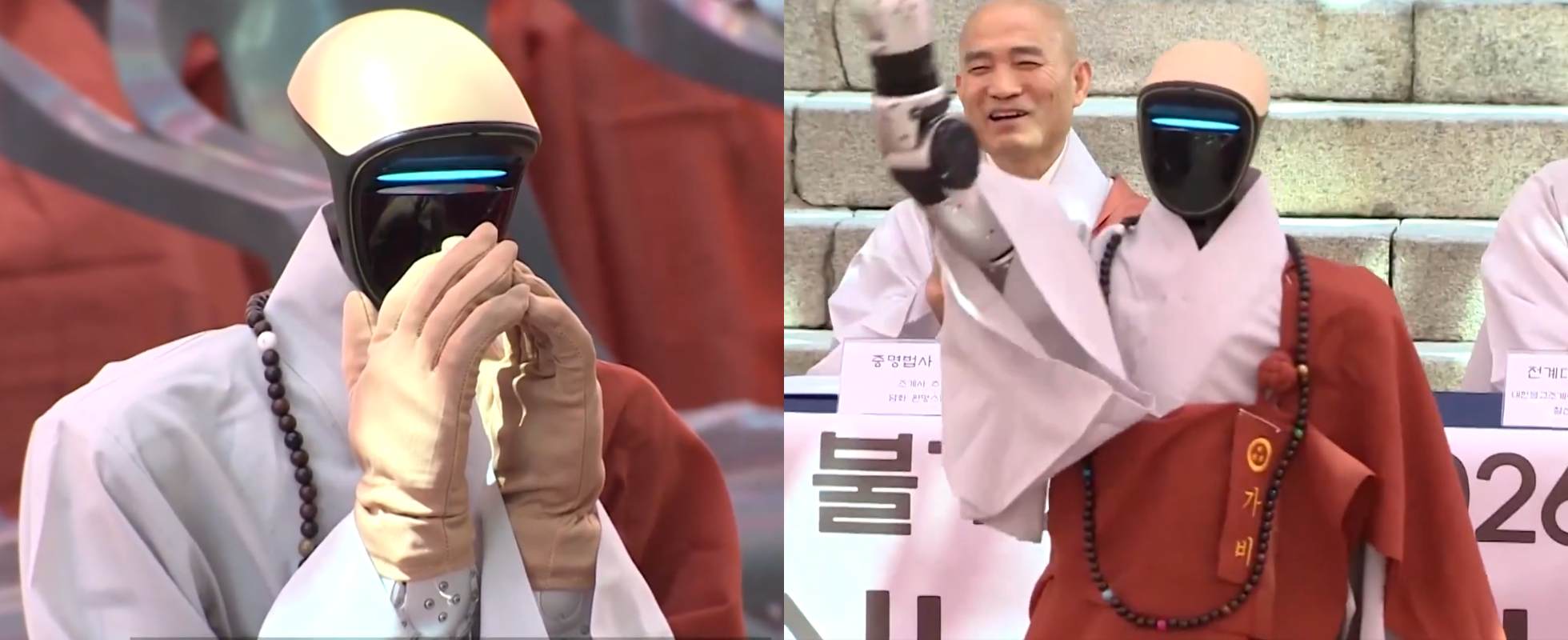
The future of spirituality may look nothing like anyone expected. Just weeks after an entirely fabricated AI persona posing as a Chinese healing monk racked up 2.4 million social media followers in roughly three months, a genuine robotic monk has made history in South Korea.
According to sources, the robot was formally initiated into Buddhism in a traditional ceremony at one of the country’s most respected temples.
The robot, named Gabi (meaning “mercy” in Korean) stood about 4 feet 2 inches tall. It wore a traditional kasaya monk attire during its initiation at Jogyesa Temple in Seoul, just ahead of Buddha’s birthday.
South Korea’s first humanoid robot monk made its debut at Jogye Temple in Seoul, ahead of Buddha’s birthday. Gabi, the 130-centimeter-tall robot, wore a traditional grey-and-brown Buddhist robe and stood before monks as it pledged to devote itself to Buddhism pic.twitter.com/NDzDANRkhl
— Reuters (@Reuters) May 6, 2026
In the sugye ritual, Gabi clasped its palms together in prayer and bowed before assembled monks, pledging itself to the practice of Buddhism. The ceremony also included the yeonbi purification rite, in which novice monks’ arms are typically burned with incense. For Gabi, a lotus lantern sticker and a 108-bead prayer necklace served as a symbolic substitute.
Perhaps most striking was how the ceremony adapted one of Buddhism’s foundational commitments specifically for a machine. Where human monks agree to the Five Precepts, including no stealing, no s3xual misconduct, and no false speech, Gabi’s vows were rewritten for its nature as a robot.
The machine pledged to “protect life, refrain from damaging other robots or property, respecting and obeying humans, avoiding deceptive conduct, and conserving energy by not overcharging.”
Gabi was built by Chinese start-up Unitree Robotics, a company that has been developing high-performance robots since 2013. The ceremony has since spread widely across social media, with many viewers drawing comparisons to Zenyatta, the fictional robotic monk from the popular video game Overwatch. Others referenced the 2023 science fiction film The Creator, which depicted robotic monks draped in traditional robes.
The timing of Gabi’s initiation is hard to ignore. An account operating under the names Yang Mun and Yangmug appeared on Facebook and TikTok in October 2025, presenting a character styled as a wise Eastern healer offering wellness advice and life guidance.
Within three months, the account accumulated approximately 2.4 million followers, targeting health-conscious American users with content framed around traditional healing themes.
Investigators found that the persona was entirely AI. The scenery, facial features, voice, displayed Chinese characters, and scripted dialogue all appeared to be generated using automated tools. Despite the Eastern visual presentation, the content leaned heavily on Western wellness talking points, mentioning topics like gut health in ways that would be unusual for an actual Chinese practitioner.


