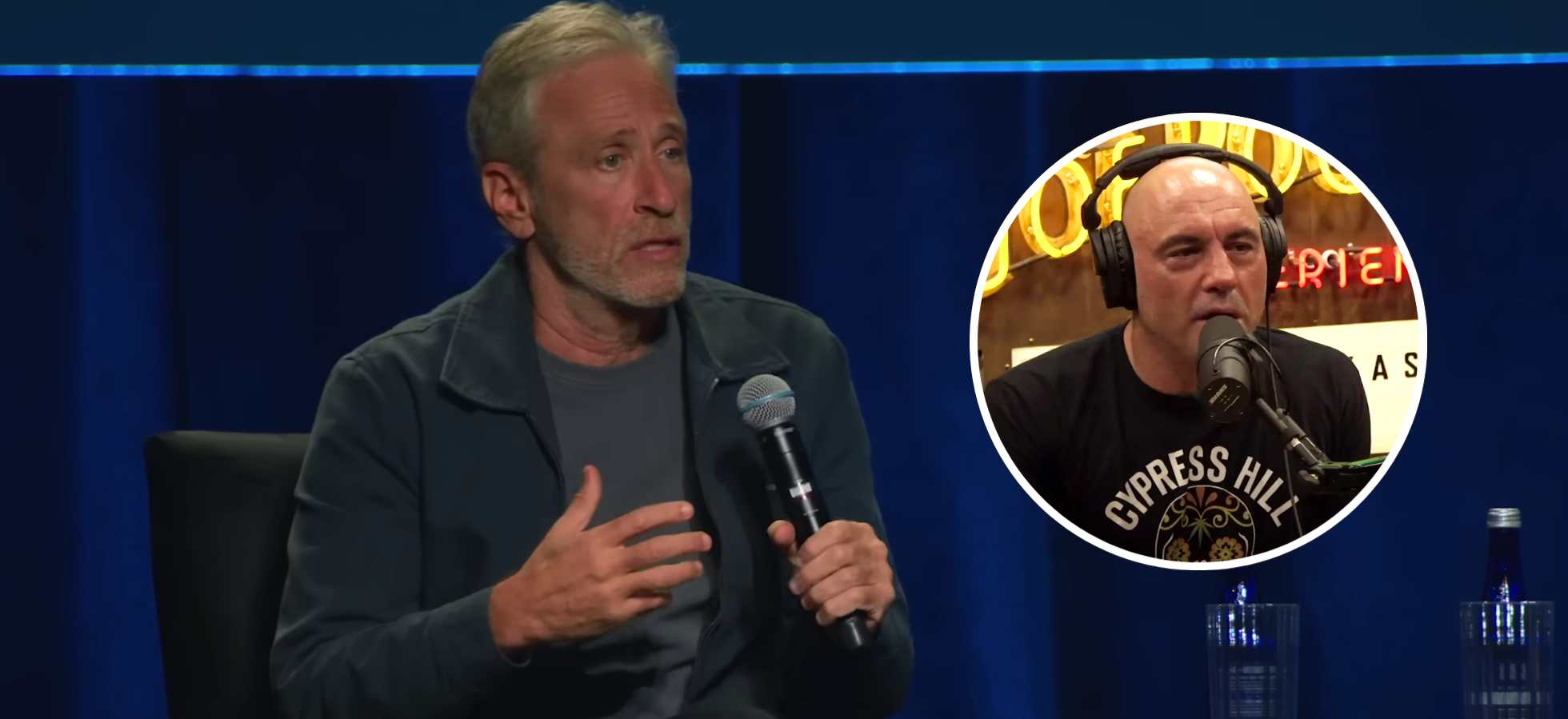
In a recent New Yorker interview, Jon Stewart offered a nuanced defense of podcaster Joe Rogan, pushing back against critics who lump him in with strategically orchestrated right-wing media operations. Stewart’s comments reveal his broader concerns about how the left approaches media criticism and political messaging in an increasingly fragmented information landscape.
When asked about his experiences appearing on Rogan’s podcast, Stewart was unequivocal: “There are right-wing weaponized commentators whose sole purpose is to manipulate things to the benefit of the Bannon Project or the Project 2025. Rogan’s not that guy.”
Instead, Stewart characterized Rogan as “a curious comic who fell into this thing that got enormous” with “opinions all over the political spectrum.”
The distinction Stewart draws is significant. While acknowledging that Rogan “has tendencies that people on the left does not fit the aesthetic” and noting he’s “a hunter,” Stewart refuses to categorize him alongside deliberately ideological operatives building parallel conservative institutions. He even admitted, “I enjoyed being on Rogan. I think he’s an interesting interviewer.”
When pressed about Rogan platforming guests who are “N**i curious,” Stewart deflected with characteristic self-awareness: “So have I. I mean I’ve interviewed Kissinger, and he was carpet bomb curious.” His point wasn’t to excuse problematic content, but to reject the notion that interviewers must be deputized as prosecutorial gatekeepers.
Stewart’s approach reflects a broader frustration with left-wing purity tests and cancel culture. “It’s not acceptable to just say well I don’t like what he does then do it better beat them at their own game,” he argued. “It’s not enough to just complain that that guy got a platform and don’t platform that guy.” He specifically criticized scientists who complain about RFK Jr.’s misinformation but refuse to engage publicly: “Get out there. Fight.”
This perspective connects to Stewart’s larger critique of Democratic strategy. He believes the party has failed to offer compelling affirmative visions, instead relying on being “not Trump.” The left’s tendency toward rigid litmus testing, Stewart suggests, prevents the kind of robust debate and engagement needed to win hearts and minds in spaces like Rogan’s podcast, which reaches millions.
Stewart’s defense of Rogan isn’t an endorsement of everything the podcaster does or says. Rather, it’s a call for the left to distinguish between strategic right-wing propaganda operations and independent voices who don’t fit neatly into partisan categories. In Stewart’s view, treating everyone who deviates from progressive orthodoxy as an enemy only cedes ground to actual bad actors while alienating potential allies and audiences.