

There is a peptide that physicians are quietly prescribing to patients, athletes are covertly using to recover from injuries, and researchers have studied for decades in preclinical models, yet it will almost certainly never receive formal FDA approval. The reason has nothing to do with safety. It has everything to do with money.
According to sources, BPC-157, is a synthetic peptide derived from a protein found naturally in human gastric juice. It has been linked in animal studies to accelerated healing of tendons, ligaments, bones, muscles, and nerves, and even to recovery from cardiovascular injury and chronic wounds.
And yet despite a growing body of preclinical research and a passionate community of physicians and patients who swear by its effects, it sits in a peculiar regulatory limbo, neither fully approved nor fully condemned.
Dr. Jesse Morse, a physician who has prescribed BPC-157 to patients for over five years and used it personally for roughly the same period, laid out the economic reality plainly in a recent social media post.
“The reason why BPC-157 will never be approved by the FDA is because it takes roughly 5 to 10 years to go through research and d**g trials, at the cost of approximately $500 million,” he wrote. “The company is not going to spend that much money for a d**g whose patent expires in 7 years and will become generic.”
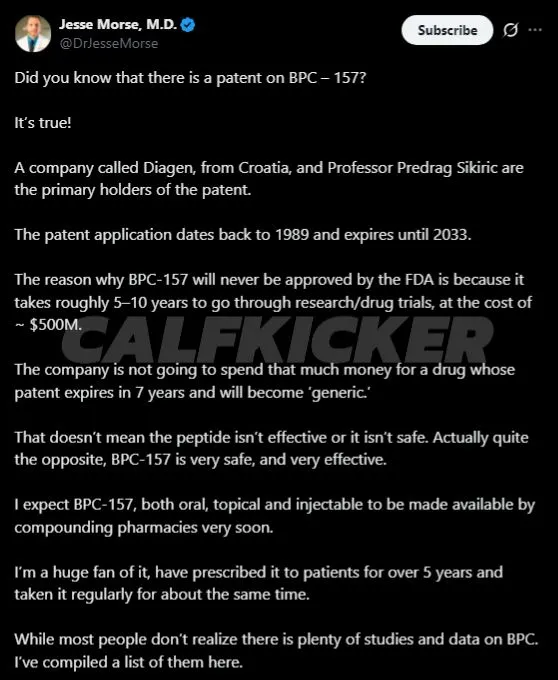
That company is Diagen, a Croatian firm, and the primary patent holder alongside Professor Predrag Sikiric. The patent application dates back to 1989 and runs until 2033. For any pharma company considering the enormous investment required to push BPC-157 through the full FDA approval process, the timeline simply does not pencil out.
By the time a d**g clears clinical trials, earns approval, and reaches the market at scale, the patent protection shielding it from generic competition could already be gone, eliminating any realistic return on that investment.
“That doesn’t mean the peptide isn’t effective or it isn’t safe,” Morse emphasized. “Actually quite the opposite. BPC-157 is very safe, and very effective.”
His confidence is grounded in years of clinical use and a review of the available research, though that research comes with important caveats. The overwhelming majority of studies demonstrating BPC-157’s regenerative effects have been conducted on animal models, particularly rodents. Human clinical evidence remains limited.
A Phase I trial launched in 2015 with 42 healthy volunteers, but its results were never published after submission was cancelled in 2016. One small retrospective study involving 12 patients with knee pain found that 11 of them reported significant relief following intra-articular injection, a promising result from a frustratingly small sample.
Systematic reviews of the existing literature have been candid about these gaps. “Most of the studies presenting its consistently positive effects were performed on animal models, particularly rodents, while human studies are scarce,” one review noted.
Another concluded that “more extensive human-oriented studies indicating therapeutic and toxic profiles of BPC 157 are required.” The science is intriguing, but it is far from complete, and researchers have been clear that the current body of evidence, while encouraging, remains incomplete and requires larger human trials to validate.
Still, what the preclinical research does suggest is compelling. Studies indicate BPC-157 may stimulate osteoblast activity critical to bone formation, promote angiogenesis to improve blood flow to damaged tissue, enhance collagen synthesis for connective tissue repair, and modulate the inflammatory responses that slow recovery.
That argument has found high-profile allies. Joe Rogan, in a recent episode of his podcast alongside bow hunters Cameron Hanes and Adam Greentree, pushed back against physicians who have been skeptical of the compound.
“I’ve talked to doctors that s**t on it,” Rogan said. “And I had this one conversation with a doctor, I like him, he’s a nice guy, and he’s like, I think it’s a lot of placebo. And I go, there’s peer-reviewed studies on BPC-157, like you’re saying this and you haven’t done the research. Like this is not debatable. BPC-157, there’s a very clear pathway they show why it works. It naturally exists in the human body and you can enhance your body’s ability to recover from soft tissue injuries.”
Hanes, who at 58 credits a combination of modern wellness interventions with helping him reach what he calls the best physical condition of his life, echoed the sentiment from personal experience.
He stated: “I see a lot of doctors who kind of s**t on BPC or s**t on stem cells and I’m like, whatever you’re saying, cool. But I’ve never felt better.”
Stanford neuroscientist Dr. Andrew Huberman brought a different dimension to the conversation when he shared his own experience with BPC-157 on the Flagrant podcast. Dealing with an L5 spinal compression that had left him in persistent discomfort despite rounds of massage, heat therapy, and electrical stimulation, he turned to BPC-157.
“Two injections of BPC-157,” he said. “Look, if it was placebo, okay, I’ll take it. Gone, gone.” He also referenced a widely discussed but unverified recovery story involving an Olympic athlete who tore his Achilles before a Games and returned in what many attributed, at least in part, to the compound.
Huberman’s comments on social media went further, touching on the peptides’ spread through competitive sports. “Most of the guys you will run against this year are already taking peptides. Legally. TRT is another matter. But peptides are rampant in all sports now. It’s supplements plus, and they won’t be banned, most anyway.”
When another user noted that BPC-157 is in fact prohibited under both WADA and USADA regulations, Huberman offered a striking observation about why detection has remained elusive.
“New variant with two amino acids altered not detected. No one really is using real BPC anymore,” he wrote, suggesting athletes have moved to chemically modified analogs that evade current testing protocols while reportedly retaining similar effects.
Huberman was careful to note that sourcing matters enormously for anyone considering the compound. Obtaining BPC-157 through licensed physicians and reputable compounding pharmacies is essential, he stressed, given that the unregulated market cannot guarantee purity or authenticity. He also noted that peptides broadly promote growth across all tissue types and should be cycled rather than used continuously, functioning best as a complement to foundational health practices rather than a replacement for them.
That compounding pharmacy pathway may be exactly where BPC-157’s future lies. Dr. Morse, for his part, remains optimistic.
“I expect BPC-157, both oral, topical and injectable to be made available by compounding pharmacies very soon,” he wrote.
Without FDA approval, compounding pharmacies represent one of the few legal avenues through which physicians can prescribe the compound directly to patients.


