When news spread of the passing of Chuck Norris at the age of 86, tributes poured in from martial arts gyms, television audiences, and families around the world who had grown up watching him.
Actress and singer Jessica Simpson recalled a story about the actor in her memoir. According to sources, she remembers being pulled aside by industry representatives who delivered blunt advice about her early performances.
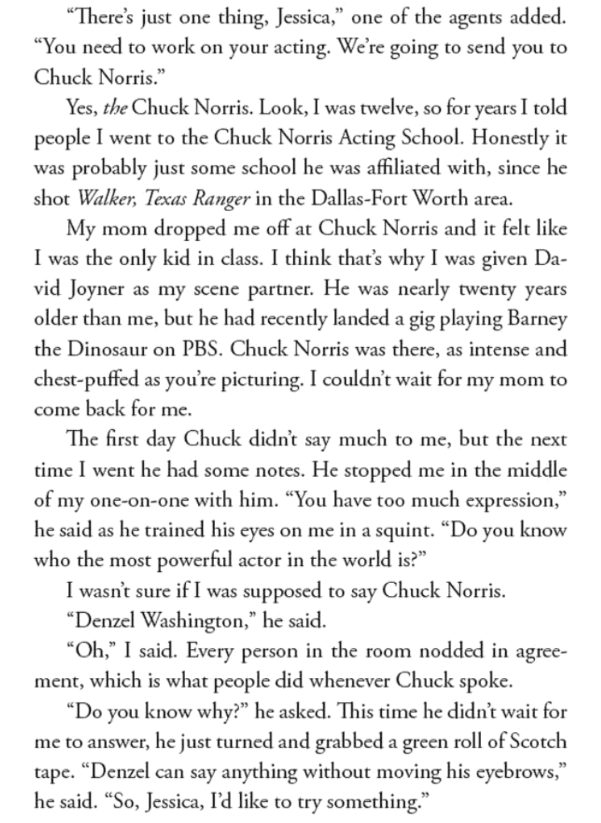
“There’s just one thing, Jessica. You need to work on your acting. We’re going to send you to Chuck Norris,” he said.
Simpson was just twelve years old at the time. Her mother drove her to the sessions, where she remembered feeling as if she were the only student in the room.
Her assigned scene partner was David Joyner, nearly two decades older and fresh off landing the role of Barney the Dinosaur on PBS. Norris himself was present throughout the sessions.
The first visit passed without much direct feedback from Norris. But during the second session, he interrupted her mid-scene, delivering what would become the defining lesson of the experience.
“You have too much expression,” he said, fixing his gaze on her. “Do you know who the most powerful actor in the world is?”
Simpson briefly wondered if she was supposed to guess Norris himself. She didn’t have to.
“Denzel Washington,” he said.
The room responded in unison, offering the kind of automatic agreement people often give when a figure like Norris makes a declaration.
“Do you know why?” he asked. Without waiting for an answer, he reached for a roll of green Scotch tape. “Denzel can say anything without moving his eyebrows. So, Jessica, I’d like to try something.”
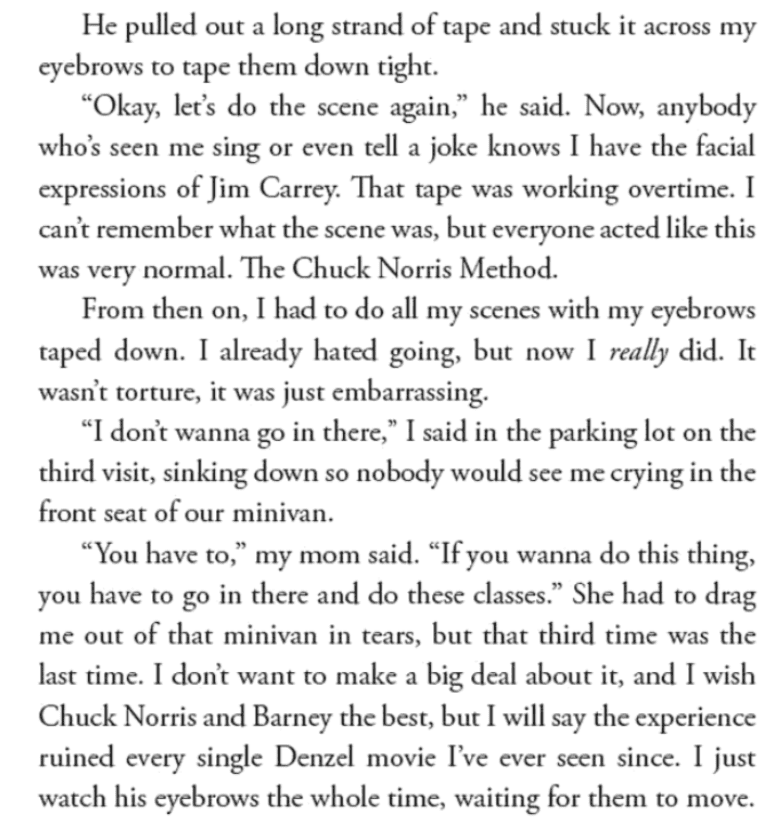
He pulled a long strip of tape and pressed it firmly across her brows, then gestured for her to begin again.
“Okay, let’s do the scene again,” he stated.
For anyone familiar with Simpson’s expressive personality, whether in music performances, interviews, or television appearances, he image of her acting with her eyebrows taped down feels almost surreal. Yet everyone in the room, she later recalled, treated the exercise as completely normal. It was simply the Chuck Norris method.
She wasn’t eager to return. By the third visit, Simpson found herself slumped low in the passenger seat of the family minivan, parked outside the building, hoping no one would notice the tears in her eyes.
“I don’t wanna go in there,” she told her mother, trying to hide from view.
The response she received was firm.
“You have to,” her mom said. “If you wanna do this thing, you have to go in there and do these classes.”
She was eventually coaxed out of the van and went inside, but it would be her final session. Years later, Simpson joked that she wished Norris and Barney well, though she admitted she has never watched a Denzel Washington film the same way again, spending entire movies waiting to see if his eyebrows move.
Following his passing, the Norris family confirmed the news in a statement shared on Instagram, asking for privacy during a time of profound loss.
“It is with heavy hearts that our family shares the sudden passing of our beloved Chuck Norris yesterday morning. While we would like to keep the circumstances private, please know that he was surrounded by his family and was at peace,” the statement read.
“To the world, he was a martial artist, actor, and a symbol of strength. To us, he was a devoted husband, a loving father and grandfather, an incredible brother, and the heart of our family. He lived his life with faith, purpose, and an unwavering commitment to the people he loved. Through his work, discipline, and kindness, he inspired millions around the world and left a lasting impact on so many lives.”
Long before he became a household name through ‘Walker, Texas Ranger’, Norris had built his reputation on real training mats. He held black belts in judo, karate, and Taekwondo, and began studying Brazilian jiu-jitsu under the legendary Gene LeBell as early as the 1960s.
When asked about the rise of mixed martial arts, Norris was candid about how his diverse background would have translated into modern competition.
“I feel I would have done very well in the MMA arena because of my judo training. I was a black belt in judo, and I had multiple black belts in karate, Taekwondo, you know, Tang Soo Do and so forth, and I’ve studied jiu-jitsu with Gene LeBell back in the early ’60s and ’70s, and so I felt I was pretty well-rounded,” Norris once said.
He extended that same confidence to his longtime training partner, the legendary Bruce Lee. He said, “I think Bruce would have, too. He was the fanatical trainer.”
In the 1980s, Norris began training with the Machado brothers and earned his Brazilian jiu-jitsu black belt at a time when the art was still largely unknown in the United States. His support would prove pivotal not just for their careers, but for the spread of the discipline itself.
When the brothers first arrived in the U.S., they opened their initial academy under the name Carlos Gracie, honoring their family lineage. However, a naming dispute within the extended family soon created serious legal risk and forced them to reconsider their direction.
“When we came to United States, the first school we opened was called Carlos Gracie,” recalled Rigan Machado. “But we had problems to control the name Gracie. I had a cousin who didn’t want to give us the rights at the time.”
The situation escalated quickly.
“We went to a point where they said, ‘You use the name Gracie, you’re going to be sued. I have the rights.’ I didn’t want to go to a lawsuit with my own family because of a name,” he mentioned.
Norris offered straightforward advice that would ultimately shape their future. He stated, “Chuck Norris came to me and said, ‘Put Machado. It’s not worth it for you guys to fight for the name.’ That’s when the Machado name started.”
His involvement didn’t stop there.
When Machado considered returning to Brazil due to financial pressure, Norris invited him to take one more look at an opportunity. He walked him into a shopping mall he personally owned and pointed to a large empty space.
“I want you to open a school over here,” Norris told him. When Machado expressed concern about the cost, Norris cut through the hesitation immediately. “You don’t understand. I own the mall. It’s my mall. You guys don’t have to pay anything. It’s for free, and you can stay here for four years. You don’t need to give me one dime.”
He then leveraged his celebrity status to ensure the academy succeeded. A public demonstration at the mall drew thousands of spectators and widespread media coverage.
“He went to the mall, had 5,000 people, all the media, and he put us everywhere. He did the demonstration in the middle of the mall with us. He came and did all the arm bars,” Machado said. “In one week, we had 200 students.”
Norris also mobilized his legal resources to help secure the brothers’ immigration status.
“He got his lawyers to get all my paperwork. His lawyers right away got letters from everybody. We had 100 letters from celebrities, friends of Chuck, signing for us, and we got citizenship in one year,” Machado noted.
For Machado, the gratitude has never faded. He said, “The Machado or Chuck Norris is everything. Without Chuck Norris, I believe no Machados. We owe everything to him.”