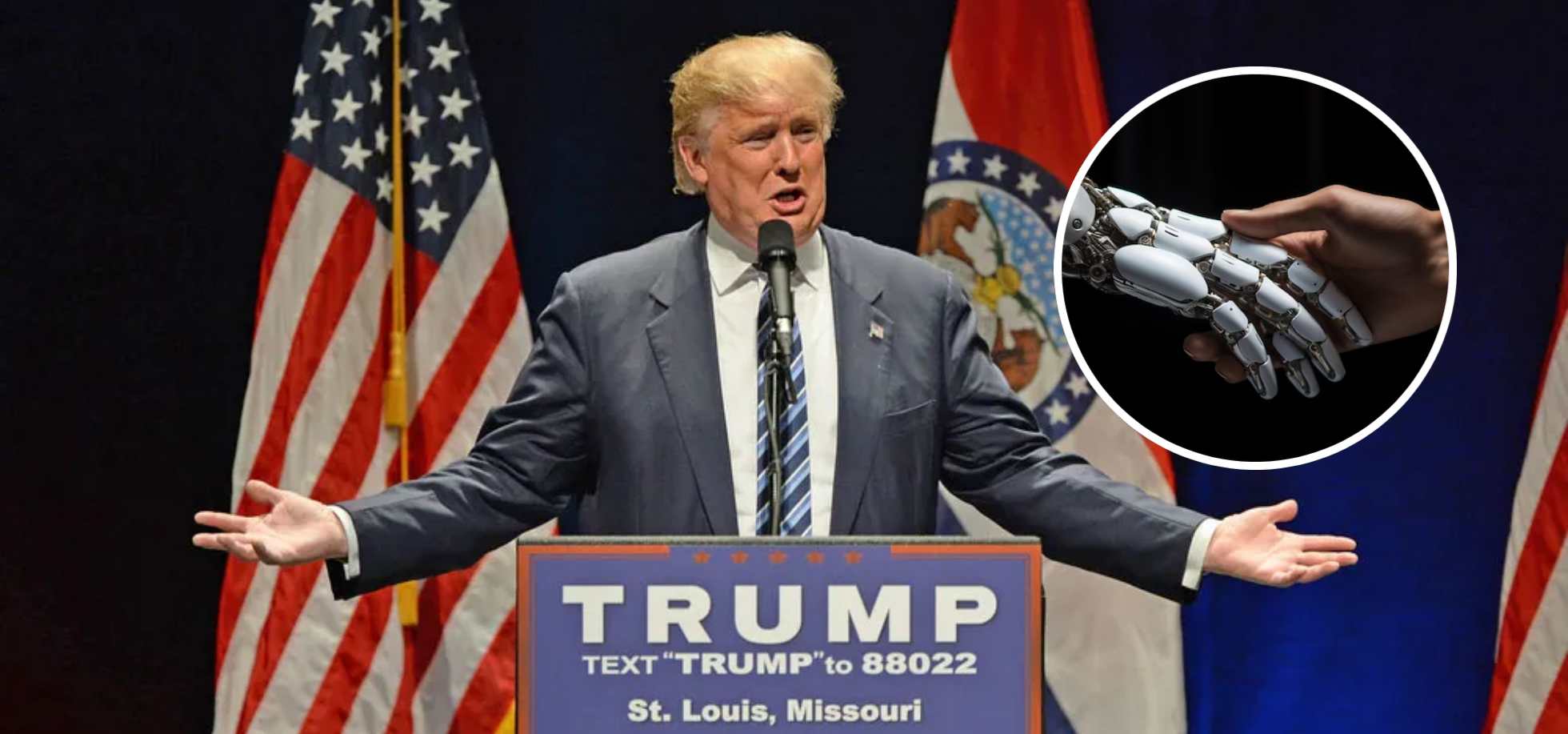
President Donald Trump recently outlined his vision for America’s future workforce, emphasizing a significant role for robotics and artificial intelligence alongside human workers.
During a press conference, Trump stated: “We’re going to have tremendous workforce availability. We’re also going to have robots helping us. We’re going to have a lot of robots helping us because we need it.”

He connected this technological expansion to his administration’s infrastructure plans, explaining, “And because we’re going to town, we’re building a lot between the AI and the auto plants. So, we’re going to need robots.”
According to sources, Commerce Secretary Howard Lutnik has been making efforts to advance America’s robotics industry as a companion to the nation’s artificial intelligence initiatives. The administration is reportedly considering a robotics executive order for implementation next year.
Executives from major robotics companies including Aptronic, Boston Dynamics, and Tesla have been advocating for a comprehensive national robotics strategy. Their argument rests on the connection between hardware and software: robots represent ‘the physical embodiment of AI’ and constitute ‘the hardware side’ of the technology revolution.
During the conference, President Trump stressed that automation would complement rather than replace human workers. “We’re going to have robots, but that’s going to help us. We’re going to have tremendous workforce,” he said.
He elaborated on the relationship between human labor and automation: “And in order to operate the, you’re always going to need people. You know, you could have robots, but you’re going to have to get somebody to start those robots and you’re going to have to improve the robots.”
Trump’s vision includes a hybrid approach to manufacturing and industry. “But we’re going to have robotic factories plus manpower. So, we’re going to have enough,” he explained.
Trump then introduced a broader concept of automated labor, stating: “We’re going to need the help of robots and other forms of, I guess you could say employment. We’re going to be employing a lot of artificial things.”
Despite the emphasis on automation, Trump insisted this technological shift would create more opportunities. “But the beauty is we’re going to have more jobs than we’ve ever had,” he asserted.
Trump supported this claim with current employment data: “Just so you know, a number came out the other day. We have more jobs right now in the United States. More people are working right now in the United States than at any time in the history of our country. Think of that. Pretty amazing.”
That optimism is shared by leaders within the robotics industry. Jeff Cardenas, CEO of Austin-based startup Aptronic, achieved a $5 billion valuation with backing from Google. He recently provided insight into the economic implications.
“I’m very hopeful that we’ll see more and more interest coming from Washington. I do believe that robotics is the key to the future. If you think about what is an economy, economy is productivity per person. If you change the number of productive units, you can fundamentally change an economy,” Cardenas explained.
He continued, “So this is literally economic and society transforming technology and it’s really important that we get it right and that we do have a national strategy that gets in front of this and helps us shape it so that it is for the benefit of society as a whole.”
Aptronic’s humanoid robot, Apollo, weighs 160 lbs (73 kg) and can lift approximately 55 lbs (25 kg). The robot currently operates in Mercedes-Benz auto factories, though Cardenas envisions broader applications, including elder care services.
Trump concluded by reiterating his approach: “So, we’ll have the help of, you know, mechanical help, if you want to call it that, but we’ll have tremendous employment. They’ll be paid a lot of money. They’ll make, they’ll do better than they ever did.”
Industry data appears to support that claim. Representatives cited figures from A), which show a historical trend in which rising robot sales have coincided with falling unemployment rates. This challenges the widespread fear that automation inevitably displaces human workers.