

Free to use under the Unsplash License
Prediction markets were always a clever idea in theory. Give people financial stakes in their forecasts, and they’ll forecast more carefully. The concept worked in academic settings, among panels of analysts trying to anticipate commodity shortages or election outcomes.
Then someone looked at that framework and asked: what if anyone could bet on anything, and we took a cut of every transaction? According to sources, Platforms like Polymarket and Kalshi now sit at the middle of Wall Street logic and cable news catastrophism. They advertise during the Super Bowl. They’ve partnered with the Associated Press. One has embedded itself into Substack, positioning its odds feeds not as g*mbling lines but as journalism.
The CEO of Polymarket has said, without irony, that prediction markets are the future of news delivery. In a sense, he’s right. When the future is a product, its coverage becomes a sales pitch.
The evolution here is worth tracing, because it didn’t happen overnight and it didn’t happen by accident. Daily fantasy sports platforms first discovered that the metabolism of g*mbling could be accelerated. They understood that instead of waiting a season for a fantasy football outcome, you could compress wins and losses into a single game, a single drive, a single play.
Users could place hundreds of micro-bets in an afternoon. The platforms discovered that faster cycles meant faster losses, and faster losses meant faster reinvestment, and the whole machine hummed along for everyone except the people feeding it.
From there, it was a short walk to Bitcoin speculation, then to meme coins designed from the start as obvious wealth transfers, then to GameStop and more. Each step normalized the next.
Geopolitical conflict was always the logical terminus. Not because anyone planned it that way, but because the underlying philosophy, that anything can be financialized, that value can be extracted from any event by simply taking a position on its outcome, has no natural stopping point.
War is, after all, an event. It has measurable components: timing, geography, casualty counts, regime continuity. All of that is, technically, bettable.
And so it is. You can currently wager on whether Iran will launch retaliatory strikes. Whether certain world leaders will retain power. Whether nuclear weapons will be used in a given timeframe.
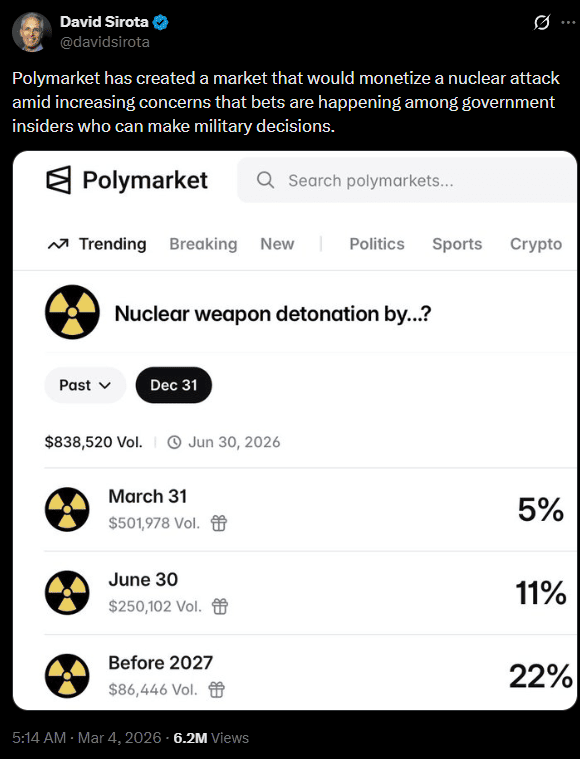
The platforms have been careful, in places, to dress these markets in the language of forecasting rather than gambling. One platform recently refused to pay out on a bet involving a k*lled head of state, arguing that the specific conditions of the wager, complete regime dissolution, hadn’t been met.
Fifty-four million dollars was returned to bettors. The CEO explained that the platform doesn’t allow direct profiting from death.
However, every market adjacent to that one, like Iranian gas prices, regional flight cancellations, missile launch probabilities, is also a bet on d*ath. It is a bet on the infrastructure of vi*lence, the byproducts of mass casualty events, the political consequences of airstrikes on civilian populations.
These concerns are already being raised in public, and the platforms remain largely unregulated, operating in legal gray zones that the current political environment shows no appetite for closing.
Polymarket recently removed the market speculating on the use of nuclear weapons after they were widely criticized it on X.

There are websites now that broadcast traffic cameras from around the world, letting users bet on vehicle counts at intersections in fifteen-minute windows. This is not a dystopian thought experiment. It exists. Someone built it and people use it and somewhere, a team is looking at that model and asking how to scale it.
The promise of prediction markets, as their advocates tell it, is that they surface truth. The house, as always, will win. The question is what we’re all losing.


