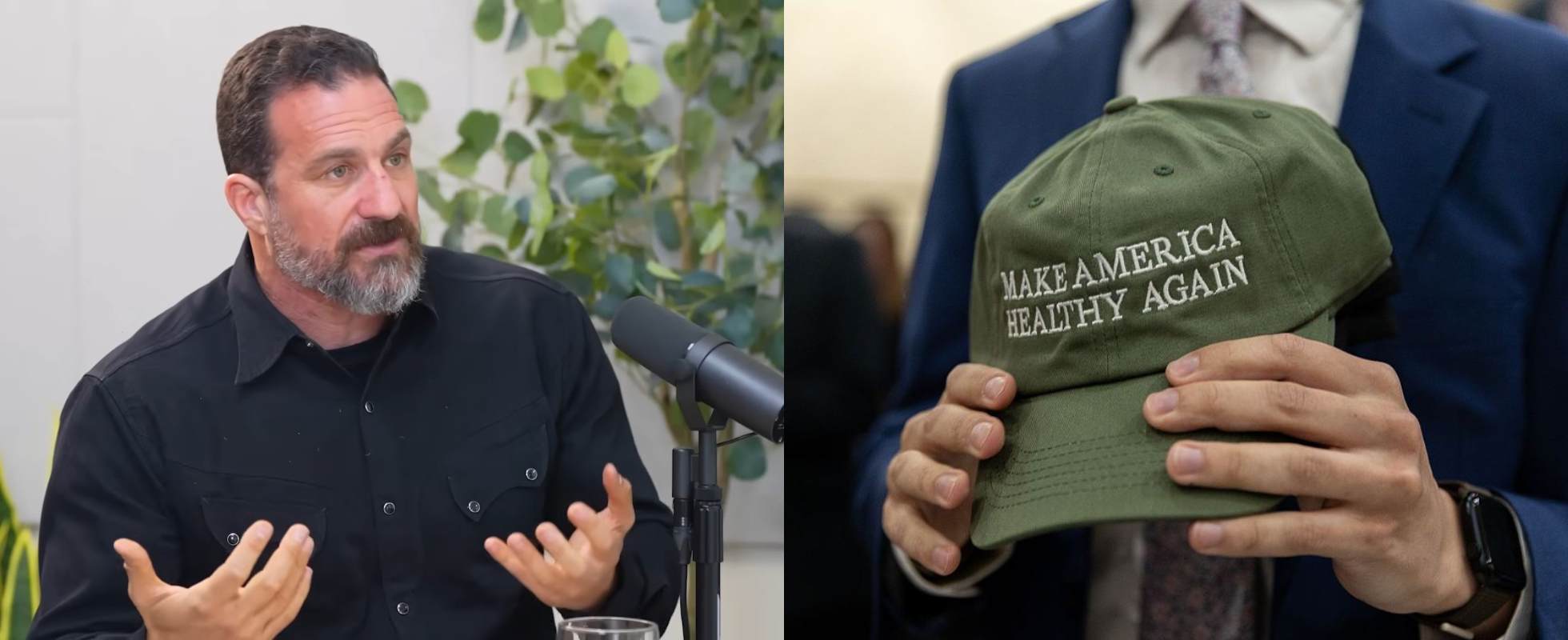
Neuroscientist Andrew Huberman recently appeared on the a16z podcast to discuss health, technology, and the future of medicine. When the conversation turned to politics, Huberman made it clear that maintaining independence has been a deliberate decision on his part.
Speaking about the MAHA movement, Huberman said he has intentionally avoided formally associating himself with it. “I very deliberately did not join a MAHA panel to maintain the flexibility that I want to say what I believe,” he said, explaining that staying unaffiliated allows him to comment freely on issues without being tied to a specific political group.
That does not mean he disagrees with everything connected to the movement. Huberman acknowledged that some of its goals align with the kind of work he promotes through the Huberman Lab platform.
“I think that some of the things they’re doing are directionally right, trying to improve the food supply, get people embracing healthy behaviors,” he said, adding that those priorities are “very much Huberman Lab things.”
At the same time, he pointed out areas where he strongly disagrees, particularly when it comes to funding for medical research. Huberman emphasized the importance of continued investment in emerging cancer treatments, saying that “the mRNA vaccines for cancer are a transformative, incredible, life-saving technology,” and arguing that “a lot of funding has been cut.”
He said he spoke publicly about the issue after appearing on Bill Maher’s show, where he criticized what he believed were cuts to cancer research funding. After that appearance, Huberman said he received a call from Washington clarifying the situation.
“I said it’s foolish to cut this funding for the cancer research,” he recalled, but officials responded by saying, “We didn’t cut the money for that, we cut the money for the other thing.” Huberman said he accepted the clarification but noted that “the messaging has been deliberately broad on both sides.”
Another topic that came up during the podcast was the label some commentators have attached to him online. Huberman said he has been surprised to see himself described as a “MAHA podcaster,” something he says he never intended to be.
“I’ve been called a MAHA podcaster. I don’t know how they got to that because I don’t ever recall,” he said. When the interviewer joked that Huberman’s work actually predates the movement, he laughed and replied, “Yeah, they took it from me. No, I’m kidding.”
According to Huberman, the label may have stemmed from a relatively mild comment he once made about dietary guidelines. He said he had simply noted that he believed the recommendations were “directionally right,” but that he would have liked to see “more vegetables and fiber, some low sugar fermented foods.”
The backlash to that comment, he said, was unexpectedly intense. Reflecting on the criticism, Huberman said that when he sees something so minor become a target, it makes him think critics “must be so poorly paid or just so desperate to write something for whatever 500 bucks or a thousand bucks to make rent.”
Additionally, Huberman argued that the current media environment plays a big role in how these narratives spread. “I do think that there’s been a real drop in standards of what we consider news,” he said, adding that it “cheapens the entire health space.” In his view, traditional media outlets bear much of the responsibility for that shift.
He also argued that the polarization of modern media encourages people to interpret everything through a political lens. “We’ve got right-wing media and we’ve got left-wing media,” Huberman said, noting that there are only a few figures in the middle who attempt to call things as they see them. The prevailing attitude, he suggested, is essentially: “Don’t say anything positive about the other side, even if there’s something that they’re doing that’s favorable, and really paint with a broad brush.”
For his part, Huberman said he intends to continue evaluating issues individually rather than aligning himself with a particular side. “I’ll be supportive of the things I think are good, and I’m going to criticize the things that I think are not good,” he said, acknowledging that this approach sometimes comes with consequences. “It means I have fewer friends and more enemies. I’m kind of used to that by now.”
Still, he views that independence as a strength. “I love that I don’t belong to any camp,” Huberman said. “I feel very free.”
Behind the scenes, he added, he has also been working to protect funding for scientific research. “I’ve worked very hard behind the scenes to try and ensure that funding for basic research is not cut,” he said, noting that current discussions suggest there may even be a modest increase. “It looks like there might be a 2% increase. There’s bipartisan support to maintain funding for NIH research, basic research.”


