
Free to use under the Unsplash License
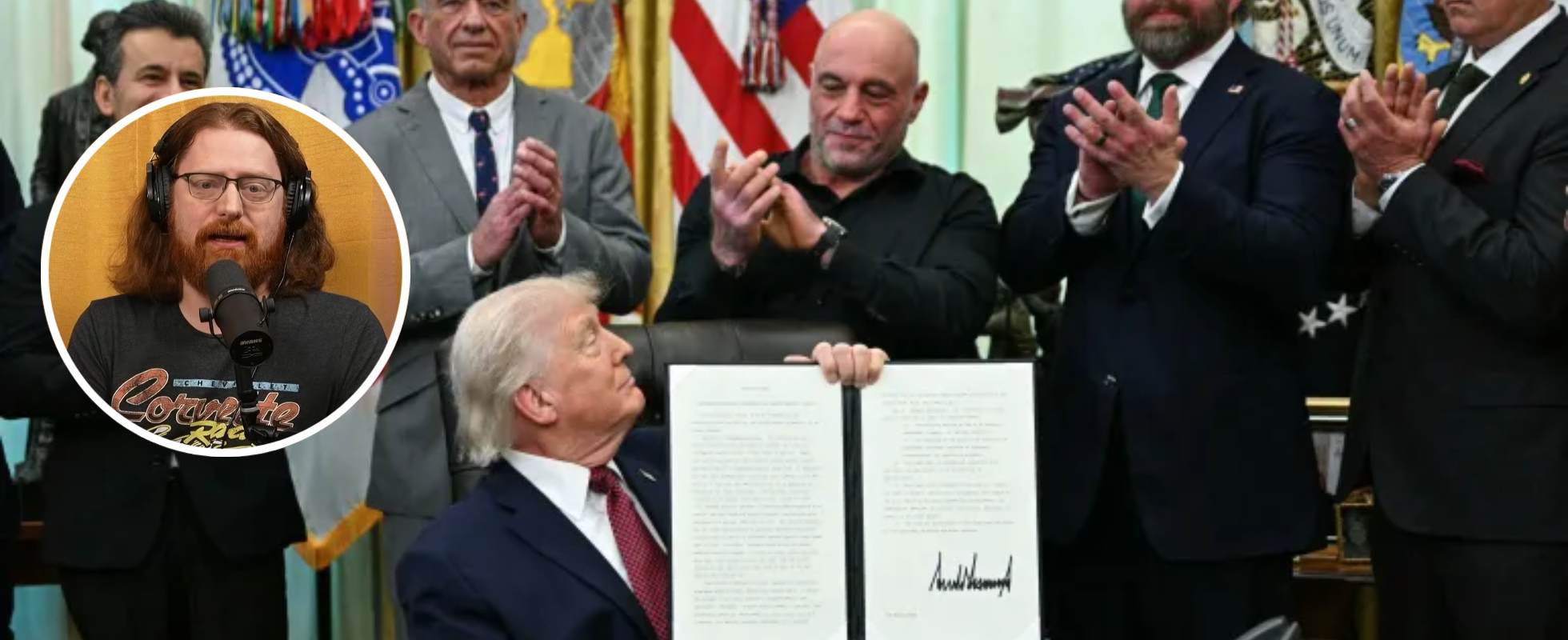
On a recent episode of Crashing Out, co-hosts Philip DeFranco and Alex Pearlman delivered an unfiltered takedown of podcaster Joe Rogan following his appearance in the Oval Office alongside Donald Trump, Robert F. Kennedy Jr., and Mehmet Oz to discuss the president’s executive order fast-tracking FDA review of psychedelic d**gs.
Pearlman opened the segment by launching directly into a blistering critique of Rogan’s presence at the White House. “Joe Rogan’s a b**ch, alright. He’s b**ch-made. He’s always been a b**ch. He’s continuing to be a b**ch,” he said.
Mocking Rogan’s frequent claim of being politically independent, Pearlman added, “Oh, I’m politically homeless. You weren’t homeless in the f**king Oval Office hiding behind that f**king chair like a wee little man pretending that he’s there doing a good thing.”
DeFranco followed with a visual jab at Rogan’s appearance during the event, suggesting the staging itself made him look diminished. He joked that budget cuts had apparently eliminated apple crates from the Oval Office setup, meaning “Rogan looked like the little b**ch that he was,” he said.
He also criticized the group of figures Rogan appeared alongside, framing them as an unlikely coalition of controversial personalities. “You have the man with the brainworm, the TV doctor who sold miracle pills, and the podcaster who’s like, ‘The moon landing makes me a little suspicious,'” DeFranco said. “And then we’re just supposed to be like, ‘Everything they say is probably great.'”
Pearlman then turned to Rogan’s business relationships and political access, arguing that financial incentives had shaped his behavior. He claimed Rogan had “sold out to Spotify executives long enough so they could invest in drone warfare,” he said, before privately texting Trump about psychedelic d**g policy.
The criticism sharpened around what Pearlman saw as Rogan’s selective advocacy: choosing to speak up on certain issues while remaining silent on others.
“I find it interesting that Joe Rogan texted him about magic mushrooms, but he didn’t text him about ICE agents m*rdering people in the streets,” Pearlman said. “He didn’t text him about the tariffs. He didn’t text him about the Strait of Hormuz. He didn’t text about Iran. He didn’t text him about Gaza. He didn’t text him about all these other things that have happened for the last 18 months. But when he got to his little pet project, suddenly he can stand behind the f**king chair.”
Addressing Rogan’s comments about the historical criminalization of psychedelics, Pearlman argued that the framing echoed familiar political rhetoric. “Joe, you’re just using an older term for panickans and DEI,” he said. “And civil rights activists, we don’t talk about those, Joe. That’s woke.”
He continued by criticizing Rogan’s willingness to appear publicly alongside Trump despite past controversies surrounding the former president.
“Maybe you need to back up a little bit in your talking points as you stand behind the man who is, you know, occasionally describing himself as Jesus Christ and is best friends with Jeffrey Epstein, a thing you stopped caring about all of the sudden,” Pearlman said.
Pearlman closed the segment with a pointed summary of his view of Rogan’s motivations, arguing that the podcaster was consciously playing a role to maintain influence. “I can look at Joe Rogan and say, ‘F**k you,’ because I have empathy,” he said. “Because I can put myself in his shoes and go, you are pretending to be dumb. You’ve been pretending to be dumb.”
He concluded by describing Rogan, along with others in Trump’s orbit, as believing he could “wield power in the background and get his thing done without it ever hurting him,” ultimately characterizing Rogan as simply “very flexible” when it comes to “pushes from his audience and access to power.”


