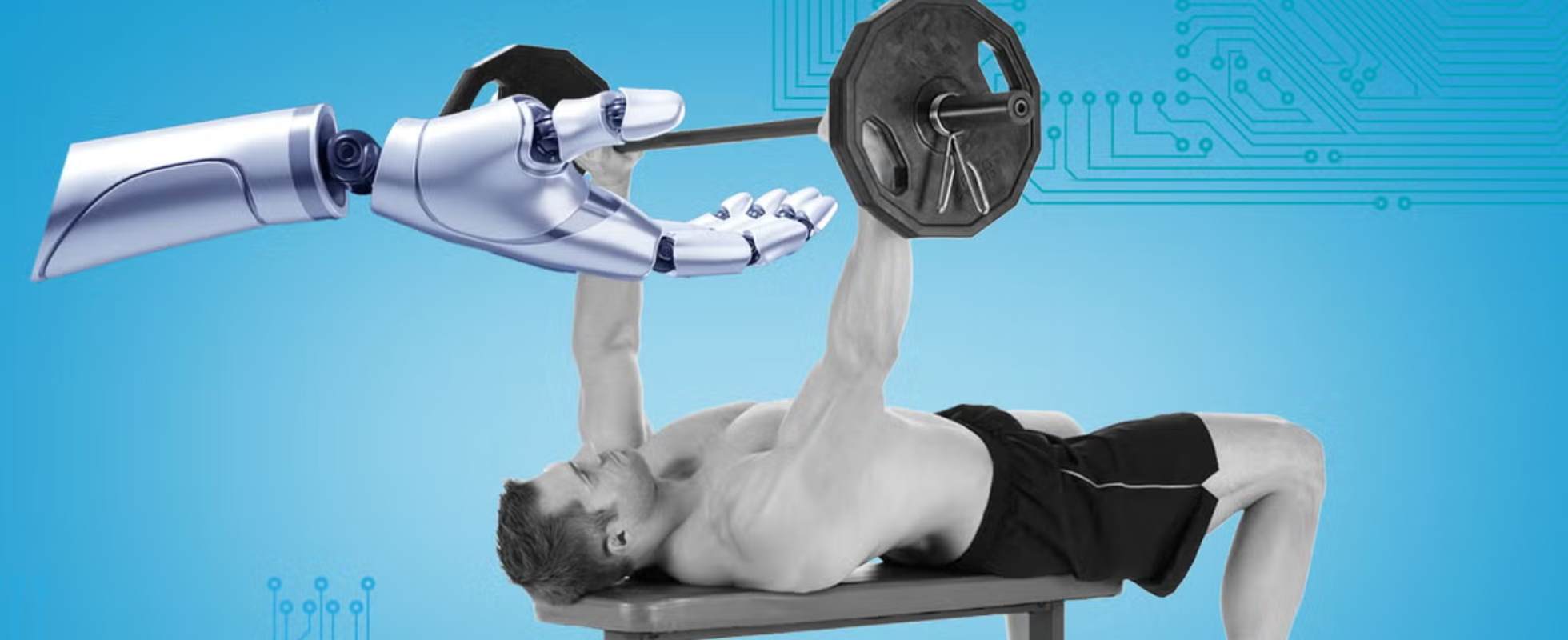
On a recent episode of the Palumbo Podcast on RxMuscle, host Dave Palumbo and veteran bodybuilding journalist John Romano tackled what Romano identified as the number one trending topic in bodybuilding right now: AI and data-driven training.
“It’s touted as the end of bro science,” Romano said, introducing the subject.
Palumbo’s reaction was immediate: “Oh, AI is training people now.” He acknowledged the appeal of moving past bro science but admitted, “I will tell you this, I’m not ready for AI science though.”
The premise behind AI-driven training is that wearable gadgets gather information on the athlete, predict performance levels, coach in real time, and even track active muscle fiber recruitment during a set. In theory, every variable of a training session becomes a data point fed into an algorithm designed to optimize results.
But both Palumbo and Romano were skeptical that any of this changes the fundamental truth of building muscle. As Romano put it, the entire process still comes down to one thing: “Get the body to believe it’s not adequate. Kickstart the survival mechanism. And you adapt. You adapt by getting stronger. Get stronger by building more muscle. That’s the only way to do it.”
Palumbo pointed to Dorian Yates as the clearest example of that principle in practice.
“Dorian Yates said it best. Go to the gym and in as few sets as possible, lift the heaviest weights as possible with the fullest range of motion and control the negative and you will get huge. And it works every time. Guess what? It never doesn’t work,” he said.
Palumbo added that the formula extends beyond the gym. He said, “If you do that and you eat enough protein in your diet and you get enough rest at night and you don’t train seven days a week, you have to build muscle. It’s impossible not to.”
Romano agreed and said that it’s “because your body’s adapting to stress.”
The conversation turned personal when Palumbo described his own experience with AI, recounting a lengthy back-and-forth with ChatGPT over a malfunctioning couch refrigerator that cost him $100 in wrong parts before the system finally admitted it was off base.
“I feel like I’m arguing with someone,” he said. “They have personality, these things. It’s crazy.”
Romano noted the disclaimer that appears at the bottom of ChatGPT: “It says right at the bottom, ChatGPT can make mistakes.”
AI, for all its data and predictive capability, is not yet flawless, and bodybuilding has never needed it to be. The fundamentals have always been simple.
“People think there are shortcuts,” Palumbo said.
Romano agreed, saying, “They want to push the easy button.”
The real answer, according to both men, has nothing to do with algorithms. It never did.