
Free to use under the Unsplash License
The Aegyo-sal aesthetic, a soft puffiness beneath the eyes that appears naturally when some people smile, has been trending across Asia for years. But what started as a subtle, sought-after feature has spiraled into a public health crisis, driven by social media tutorials, counterfeit products, and people injecting themselves at home.
The procedure is called a “lying silkworm” injection. The goal is to create a small raised ridge under the lower eyelid, making the eyes appear larger, softer, and more youthful. When done correctly with proper medical-grade hyaluronic acid, it is considered minimally invasive with a relatively quick recovery. The filler can also be dissolved if something goes wrong. That last part matters, because things are going wrong constantly.
Platforms like Douyin and Xiaohongshu have flooded their feeds with under-eye filler content, including influencers filming their own at-home injection tutorials in under 60 seconds. Comment sections are not filled with people asking whether they should try it. They are asking where to buy the products and how much it costs.
The demand created a marketplace for cheap, counterfeit filler products sold online, with suspicious packaging and no proper registration. Real medical-grade fillers are expensive, and unlicensed beauty clinics and individuals alike started cutting corners by sourcing these knockoffs to inject near one of the most delicate and vascular areas of the face.
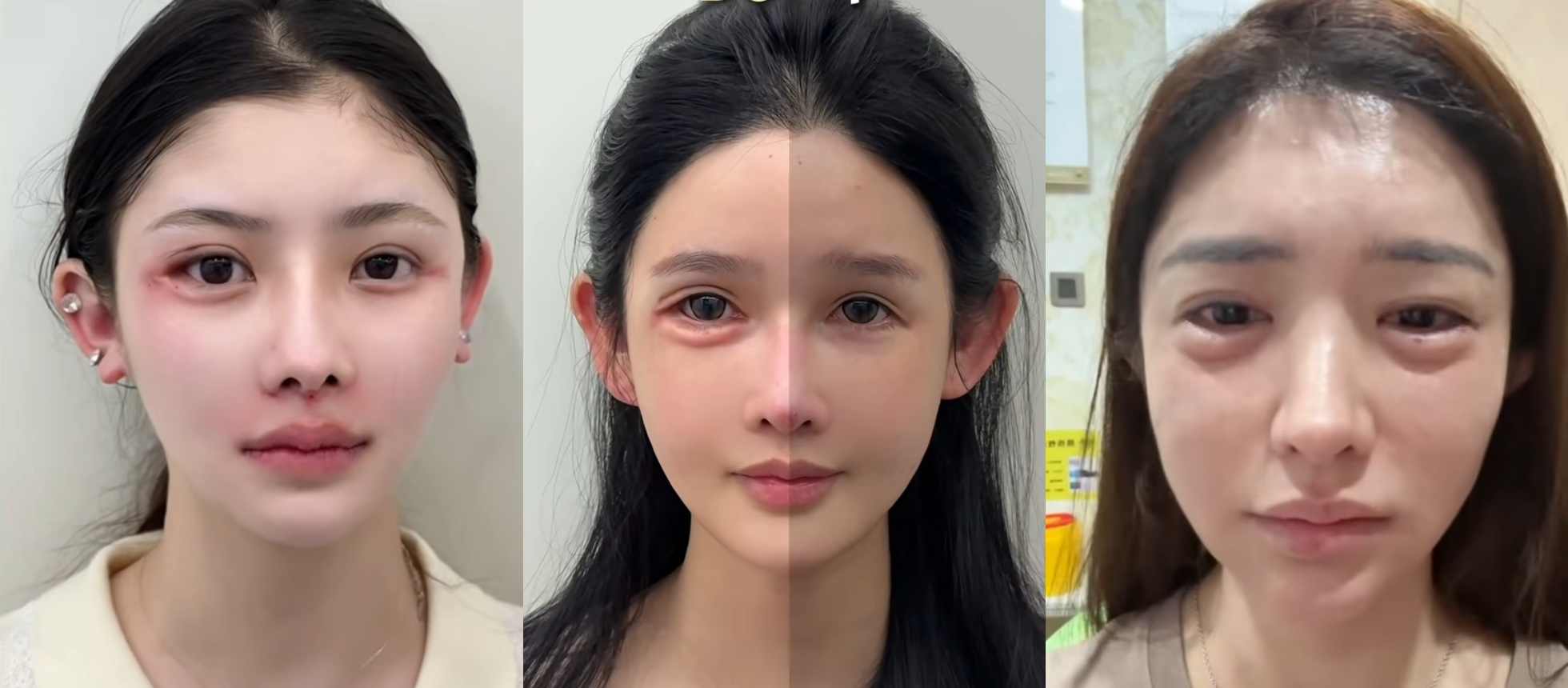
The result has been a wave of “bubble eye” cases, where the filler does not settle properly and instead bloats, spreads across the face, and in some cases forms a transparent, pus-filled sac beneath the eye that looks on the verge of bursting.
One widely reported case involves a woman named Ms. Lu, who underwent the procedure at a beauty clinic. That same night, she developed severe inflammation and an allergic reaction. During attempts to dissolve the filler, clinic staff reportedly squeezed the area so aggressively that the eye bag ruptured. Multiple correction procedures followed, ulcers developed around her eyes, and doctors in Shanghai eventually diagnosed her with severe inflammation caused by an unknown product.
The corners of her eyes became permanently stuck together, her vision was limited, and her face remained swollen. The clinic offered roughly 150,000 yuan, approximately $25,000, in compensation. She declined. The product manufacturer stated there was no known solution for that specific allergic reaction.
Then there are the DIY cases. A 40-year-old woman purchased a water light injection kit online, watched Douyin tutorials, injected it herself at home, and went to sleep. She woke up with pain and swelling in her cheek. A broken needle had been moving through her face overnight, traveling from her eye area down to her cheekbone. Doctors removed it through her mouth and warned that if it had reached her nerves or blood vessels, the outcome could have been far worse.
For those who felt standard fillers were not dramatic enough, some have gone further. A woman named Xiao Hou, dissatisfied with her lack of natural under-eye bags, underwent a procedure where tissue was transplanted from her body into her eye bags. She took out an online loan to cover the cost. She ended up with swollen, asymmetrical, bulging results, her boyfriend left her, and the hospital blocked her contact attempts until journalists got involved.
Doctors have been consistent in their warnings. The skin beneath the eyes is extremely thin and packed with blood vessels. Injecting anything near that area without proper training and verified materials carries serious risk, including permanent tissue damage, ulceration, spread of filler across the face, and blindness.


