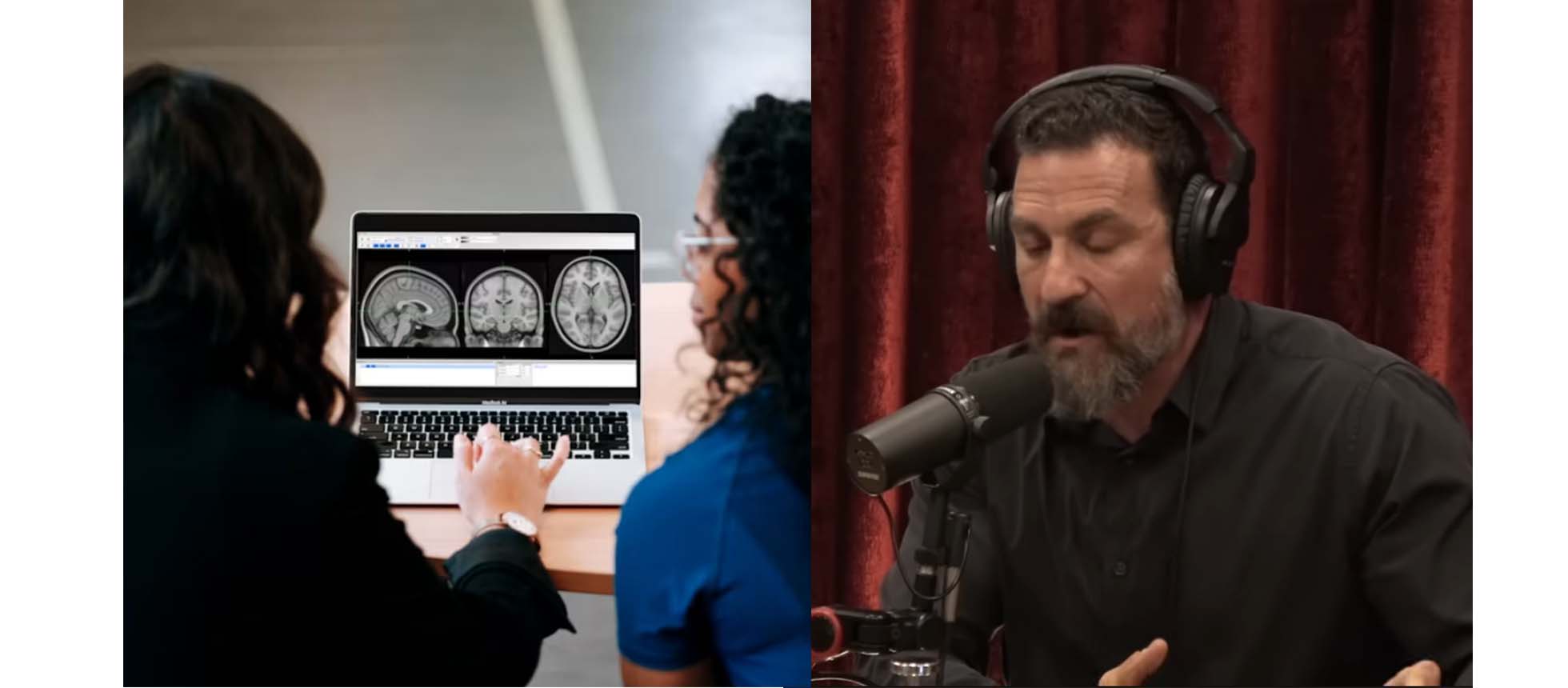
Screenshot from YouTube video by JRE, and a free-to-use image under the Unsplash License.
Neuroscientist Andrew Huberman found himself at the center of a social media firestorm this week after promoting full-body MRI scans on Twitter without disclosing his financial ties to a company that sells them.
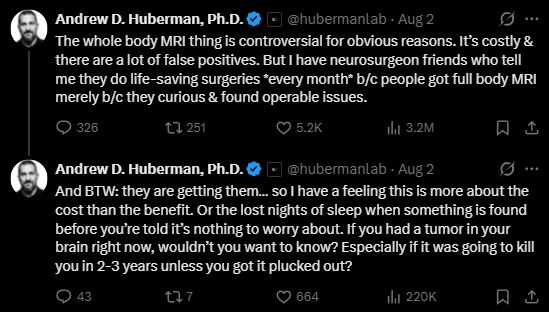
Huberman posted a thread defending whole-body MRIs, claiming that neurosurgeon friends told him they perform life-saving surgeries “every month” because people got full-body MRIs out of curiosity and discovered operable issues.
“If you had a tumor in your brain right now, wouldn’t you want to know? Especially if it was going to kill you in 2-3 years unless you got it plucked out?” he wrote to his millions of followers.
Image credit: Andrew Huberman via x.
The response from the medical community was unforgiving.
“Neurosurgeon here. This is hogwash,” wrote a professional in reply to Huberman’s claim. Another neurosurgeon was equally direct: “I have never once operated on any incidental ‘life saving’ lesion found on a whole body mri.”
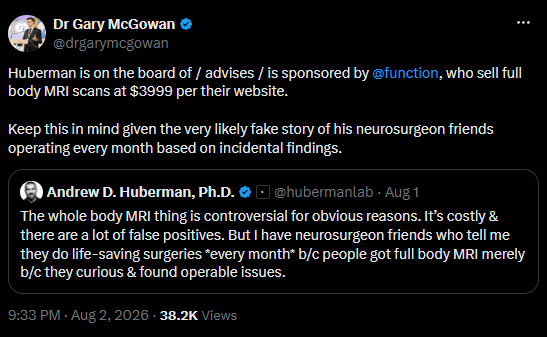
The criticism intensified when Dr. Gary McGowan revealed on Twitter what Huberman had failed to mention: his connection to Function, a company that sells full-body MRI scans for $3,999 on its website.
Screenshot of function.com as recorded on August 3rd, 2026
“Huberman is on the board of / advises / is sponsored by @function,” McGowan wrote. “Keep this in mind given the very likely fake story of his neurosurgeon friends operating every month based on incidental findings.”
Dr Gary McGowan via X
Dr. Shariq Shamim questioned the ethics of Huberman’s promotion. “Imagine sitting on a board for a company that promotes whole body MRI then making tall claims like this without disclosing that COI or how he gets paid for promotional posts,” he wrote. “Why do most of these ‘Longevity Gurus’ turn into Grifters?”
Even surgeons who would theoretically benefit financially from increased MRI scanning pushed back. A user stated: “Surgeon who takes out cancer for a living, whose PhD is actually in health outcomes & policy here. Just stopping by to say this is objectively + categorically wrong. Stats>anecdotes that likely didn’t happen.”
Huberman’s initial post acknowledged that whole-body MRIs are “controversial for obvious reasons” due to cost and false positives, but he suggested the resistance was more about expense than genuine medical concerns. When one user questioned the value of such screening, Huberman responded: “I’m just not seeing the rationale for limiting availability.”
While some screening tests have clear benefits supported by large-scale studies, whole-body MRI scans for asymptomatic individuals remain contentious. Medical organizations generally do not recommend them due to concerns about false positives leading to unnecessary procedures, anxiety, and healthcare costs.
As of publication, Huberman had not publicly addressed the criticism or disclosed his relationship with Function in the original thread.