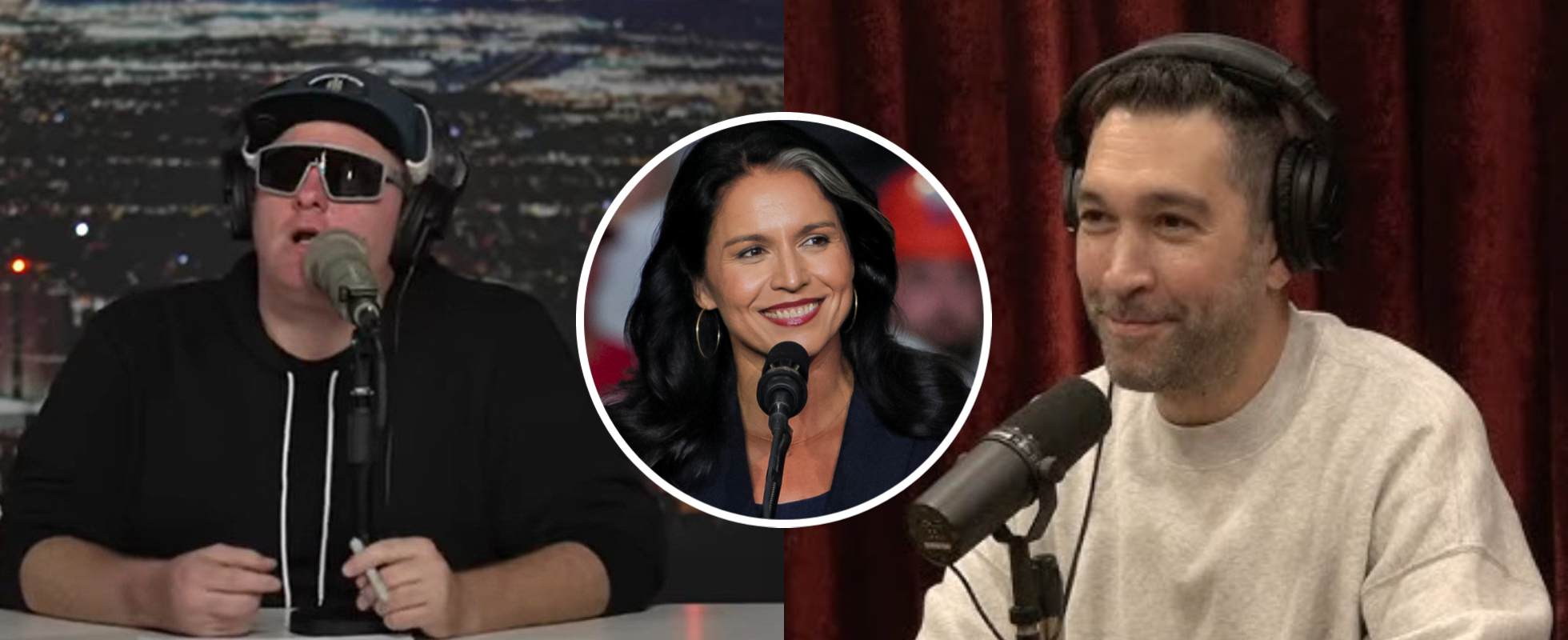
Podcaster and comedian Joe Rogan has long been one of Tulsi Gabbard‘s most vocal supporters, praising her as one of the few authentic people in politics.
“The system turns you into a sociopath,” Rogan has said. “And I think there’s very few people, Tulsi Gabbard, my friend being one of them. I love her. She’s amazing. She’s a real person. Like that lady is the same person on air, off air, meeting people, hanging out with her husband. I’ve hung out with her hours and hours and hours. That’s who she is.”
But not everyone in Rogan’s circle shares that enthusiasm anymore. As Director of National Intelligence, Gabbard has faced growing criticism from commentators who once respected her, largely over her shifting position on Iran.
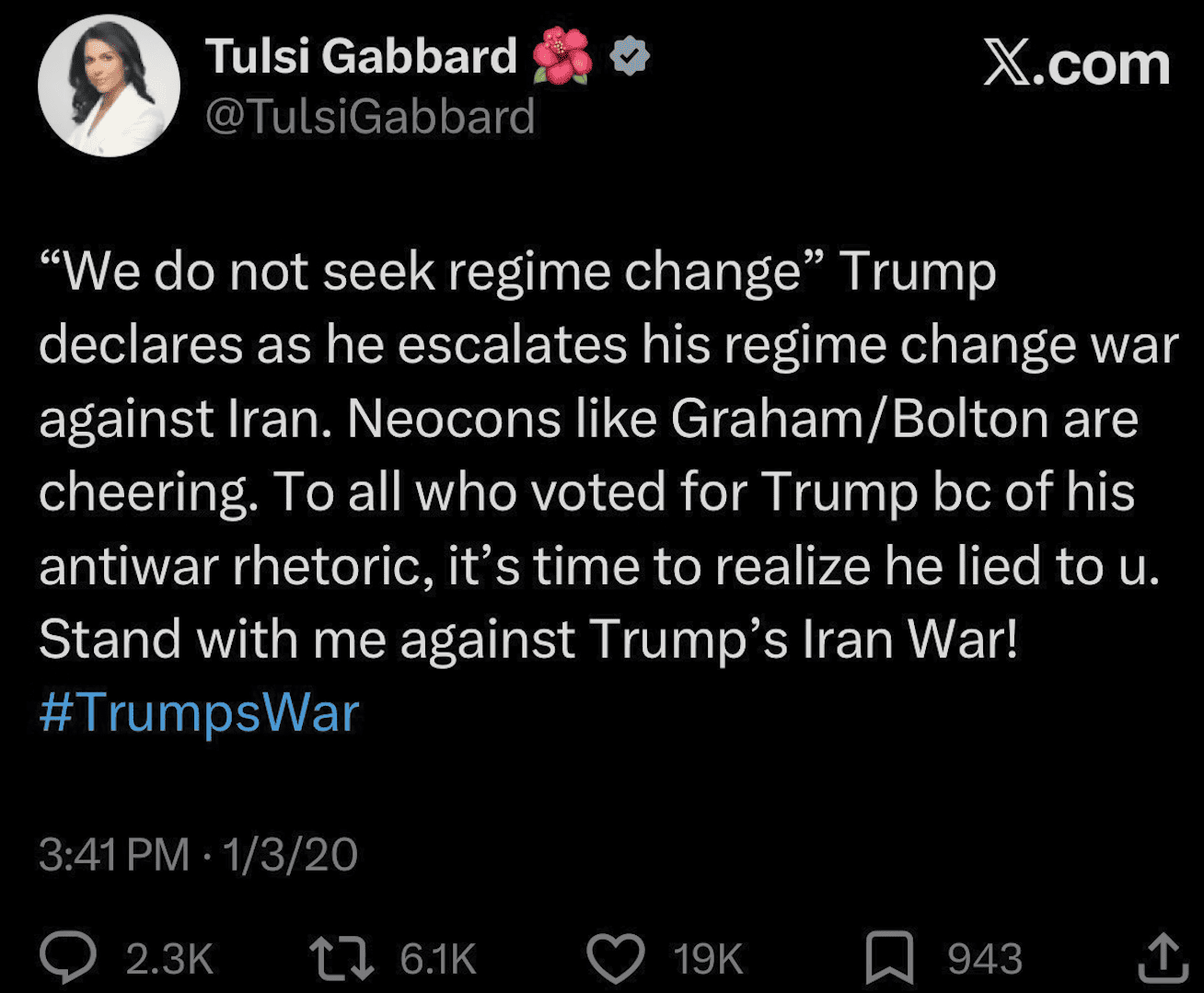
She famously sold t-shirts reading “No War with Iran” and in 2020 tweeted directly at Trump voters: “It’s time to realize he lied to you. Stand with me against Trump’s Iran war.”
Now, as part of the Trump administration, she has been a visible figure in the lead-up to military action against the very country she once urged restraint toward.
Comedian and political commentator Dave Smith has been the most direct in his criticism.
“What a f**king evil person Tulsi Gabbard turned out to be,” Smith said. “She’s lying us into war. She’s lying us into the war that she warned about.”
Smith has argued that Gabbard has sold out and can never be taken seriously again, pointing to contradictions between her earlier threat assessments on Iran’s nuclear program and her later backing of Trump’s claims that Iran posed an imminent threat.
Tim Dillon has also taken aim at Gabbard, though with noticeably more hesitation. Aware that Rogan listens to his podcast and is close with Gabbard personally, Dillon has repeatedly caught himself mid-rant to clarify his personal feelings.
“I like Tulsi Gabbard,” he has insisted, even while questioning her role and performance in office. At one point, he challenged the basic function of her position: “She’s the director of national intelligence. It’s like a fake job. She goes and reads, ‘Well, it is the president’s job to decide who to attack and when.’ Is that a real job?”
The tension became especially visible when Smith appeared on Rogan’s podcast and accused Gabbard of lying the country into war.
Rogan pushed back, and Smith partially walked it back, saying, “Okay, fair enough. That was not a lie. Maybe I’m being a little harsh by saying lying in that example.”
The frustration among these commentators is that Gabbard was seen as genuinely different, someone who would hold the line against the kind of foreign policy decisions she had publicly opposed for years. Whether she resigned from those principles by choice or circumstance, the comedians who once defended her are finding it increasingly difficult to stay quiet.